By Roy Ramos
ZAMBOANGA City, Philippines
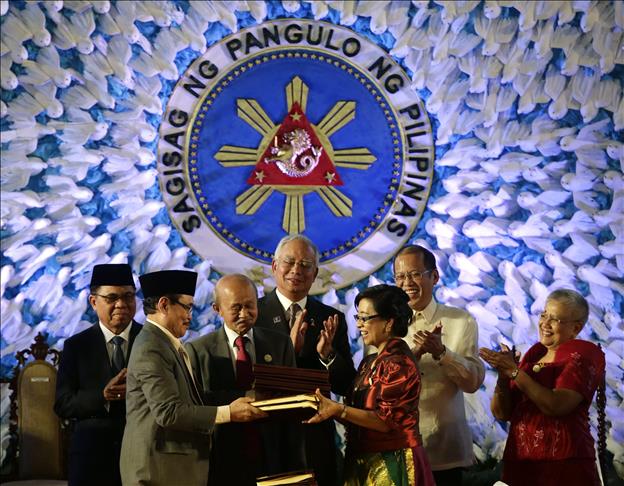
The pending introduction of a new autonomous region in the southern Philippines is leading to a clamor for a federal system on the archipelago, local media reported Wednesday.
The Bangsamoro Basic Law is to establish a new political entity in the Muslim-majority southwest of Mindanao island next year to replace the Autonomous Region of Muslim Mindanao.
But the change, expected to be ratified early next year, is fueling calls for greater autonomy on other parts of the island and around the country, the MindaNews website said.
Rodrigo Duterte, the popular mayor of the island’s largest urban center, Davao City, is one of the most vocal leaders of the federalist movement.
Speaking at the Mindanao Leaders Summit this week, Duterte said the “privileges” given to the Bangsamoro region raised questions about what is due to other regions.
In particular, the proposed division of wealth between the Bangsamoro authority and the national government is causing envious glances from other regional leaders.
Reuben Canoy, a long-time advocate of federalism, told the summit the pending law would give the Bangsamoro government 75 percent of all its revenues.
“If approved, the revenue-sharing arrangement would be clearly unjust to other regions and makes it all the more imperative to federalize the government so that all regions… will be on [an] equal footing,” Canoy said.
Criticizing the current relationship between the central government and the provinces, Emmanuel Pinol, the former governor of North Cotabato, an area bordering the Bangsamoro region, cited the case of the island province of Palawan in western Philippines.
Referring to the gas fields in the Philippine Sea, he said the Palawan authority “has to go to court for its share of the Malampaya natural gas but with the mere stroke of a pen, hundreds of millions go to big name politicians close to the powers that be.”
Duterte said a federal system would help address unrest in Mindanao, which he blamed on the uneven distribution of wealth and resources.
The island, the second largest in the Philippines, has been torn by decades of conflict as insurgent groups seek greater autonomy from Manila.
The 21 million population is made up of various ethnic groups and although Christians are in the majority across Mindanao and surrounding islands, a Muslim enclave exists in the southwest.
Duterte said the proposed Bangsamoro region had already served as a catalyst for federalism in the country.
"[If] they have given it to the Bangsamoro, the Cordillera Autonomous Region, Ilocanos, Bicolanos and others will also ask for it," he said, referring to regions on Luzon island.
The 69-year-old mayor added that he was not campaigning for Mindanao’s independence.
“I’m trying to save Mindanao from being fractured,” he said, alluding to fears of what might happened should the Bangsamoro experiment fail.
Fernando Capalla, the retired Archbishop of Davao, called for a switch to federal government to replace the “incompetent” and “morally bankrupt” government in Manila.
He added: “If the peaceful departure of high officials of the present government is not carried out in the soonest possible time, does this non-action by the people not appear [to be] approving of scandalous wrongdoing?”
www.aa.com.tr/en