SRINAGAR
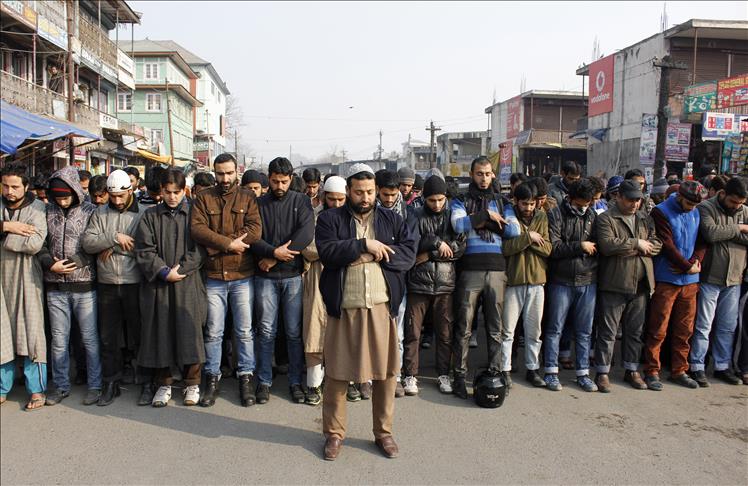
Protests erupted after the Friday prayers in several parts of Indian-held Kashmir (IHK) against the Bangladeshi government's execution of Jamaat-e-Islami leader Abdul Quader Molla on Thursday.
In-absentia funeral prayers were held in several mosques across IHK for the executed leader and several Kashmiri separatist leaders condemned the execution.
Mosques resonated with anti-American, anti-Indian and anti-Bangladeshi slogans protesting against last night’s execution. For many Kashmiris, the hanging of the 65-year-old leader brought back memories of Afzal Guru, a Kashmiri who was hanged by the Indian government in February 2013 for his role in the 2001 Parliamentary attack.
Most speakers at mosques heavily criticized Pakistan for its silence, casting it as the country’s complicity.
Abdul Quader Molla, a senior Islamist and pro-Pakistan leader, was hanged for his role in war crimes during the country's bloody 1971 war of independence from Pakistan.
“It is nothing but political vengeance and it is a day of mourning,” spokesperson of the Tehreek-e-Hurriyat separatist party Ayaz Akbar told AA.
“He was a man who loved Pakistan and did not want its partition, and today Pakistan’s silence on his execution is an act of ingratitude,” Akbar said.
Akbar said that Syed Ali Shah Geelani, the party's head and a senior Jamaat leader, did not know Molla personally but held the same ideology.
The Tehreek-e-Hurriyat also said the Indian Government had a role in Molla’s execution. Akbar added, “Also, we have no doubt that the Indian embassy in Bangladesh had a big role to play in his hanging.”
Kashmir, a Muslim-majority Himalayan region, is held by India and Pakistan in parts and claimed by both in full. The two countries have fought three full-fledged wars – in 1948, 1965 and 1971 – since they were partitioned in 1947, two of which were fought over Kashmir.
Since 1989, Kashmiri resistance groups in IHK have been fighting for independence from Indian rule or for unification with neighboring Pakistan.
More than 70,000 people have reportedly been killed in the conflict so far.
IHK has had its own history with hangings at the hands of the Indian government, which first hanged Kashmiri nationalist leader Mohammad Maqbool Bhat in 1984 and then Afzal Guru earlier this year. Their bodies weren’t returned to Kashmir and were instead buried within the prison premises in New Delhi.
By Zahid Rafiq
englishnews@aa.com.tr