CAIRO (AA) – US support for the army-backed interim administration in Egypt following the ouster of elected president Mohamed Morsi is seen as a typical response in light of Washington's longstanding policy of swiftly recognizing new regimes perceived to be able to stand their ground and placating them with aid packages, experts believe.
"In the event of turbulence threatening a ruling regime in Egypt, the US tends to swiftly recognize the new regime as long as it is perceived to be able to remain firmly in power," Essam al-Dosoki, professor of modern history at Helwan University, told Anadolu Agency.
Back in 2011, the US swiftly recognized Egypt's January revolution, urging former president Hosni Mubarak to step down once it became clear that demonstrators were standing their ground and that the regime was crumbling.
Washington was also quick to recognize the 2012 election of Morsi, a senior Muslim Brotherhood leader, despite US' uneasiness with Islamist groups.
Many believe the US is now doing the same.
During a three-day visit to Egypt this week, US Deputy Secretary of State William Burns said his administration was committed to helping Egypt succeed in its "second chance" at democracy.
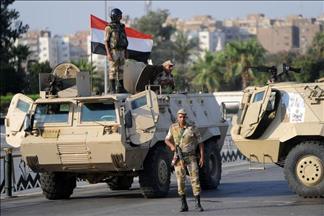
The powerful army, which has longstanding strategic relations with the US, overthrew Morsi – Egypt's first democratically elected president – on July 3 following mass protests against his regime.
It subsequently suspended the constitution and named Adly Mansour, the head of Egypt's constitutional court, as interim president.
Up until the June 30 protests, Washington’s position was largely seen as being pro-Morsi and pro-Muslim Brotherhood.
-Aid Packages-
Analysts say the second objective of US policy on Egypt is to win over the new regime via financial assistance.
While countries like Turkey and Tunisia describe the army's ouster of Morsi as a military coup, the US has avoided using the term to avoid the automatic halt of aid to Egypt as is stipulated by US law.
Egypt receives $1.55 billion in annual aid from the US, including $1.3 billion in military aid.
Burns also made it clear that his administration supported reforms that would lead to agreement between Egypt and the International Monetary Fund over the terms of a proposed $4.8-billion loan to Egypt.
Journalist Mohamed Ali Kher believes the two main pillars of US Middle East policy are to maintain Israel's security and the flow of oil in the region, followed by Gulf security and the Suez Canal.
Kher highlighted the "strategic relationship" between Egypt's military establishment and the US.
"Most of the top army brass was trained in US, while the military assistance means that Egypt gets weapons almost entirely from the US," he told AA.
Kher believes the close relationship between the Egyptian army and the Pentagon had an influence on the US position regarding the June 30 protests that led to Morsi's ouster.
"While the White House failed to decide on whether Morsi's removal was a 'coup' or not, the Pentagon favored the view that it was a 'popular revolution' backed by the army," he concluded.
By Hajar al-Desoqi – Anadolu Agency- Cairo