Thai premier denies meddling in impeachment process
Junta leader refutes claims of interference as former Prime Minister Yingluck Sinawatra faces impeachment vote.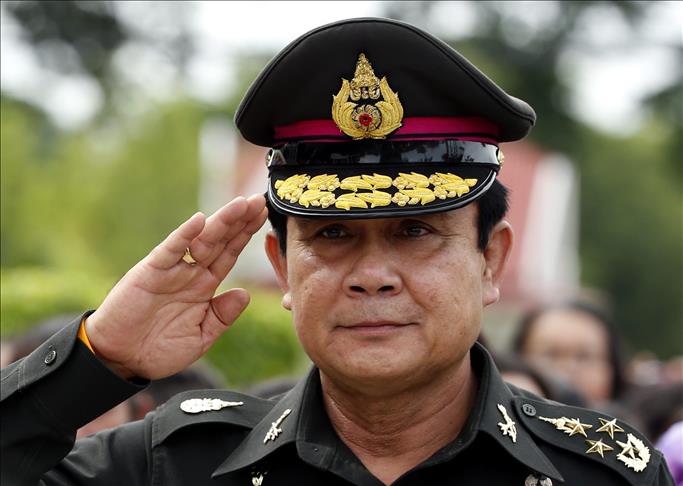
Thai Prime Minister Prayuth Chan-ocha has denied trying to pressure the National Legislative Assembly into impeaching his predecessor Yingluck Shinawatra, local media reported Monday.
“I have never sent any signal. Never. There has never been an order,” Chan-ocha was reported as saying by the Khaosod news website.
Yingluck, whose government was deposed in a military coup led by Chan-ocha last May, is facing an inquiry over a rice subsidy scheme that is said to have resulted in huge losses of public money and led to large-scale corruption.
Over the weekend several members of Yingluck’s Puea Thai party claimed the junta had ordered the assembly’s 220 members to pass a motion to impeach her on Jan. 23.
The assembly has been handpicked by the junta and around half its members are current or retired military officers.
Worachai Hema, a high-ranking Puea Thai member, claimed the impeachment process was “part of a campaign to uproot obstacles in the way of the coup-makers and those who want to prolong Prime Minister Chan-ocha’s stay in power,” the Bangkok Post reported.
After the coup, Chan-ocha promised an election at the end of 2015 but has recently said that no poll will take place before 2016.
Yingluck, whose brother Thaksin was prime minister before her and who receives most of her support from the rural north, will be banned from politics for five years if she is impeached.
The 47-year-old is accused of failing to stop the subsidy scheme, which bought rice from farmers at 40 percent above the market price.
Critics say the scheme resulted in huge financial losses for the state and was run without transparency. In November, the Thai finance ministry said losses had run to the equivalent of $15.8 billion since July 2011, when Yingluck was elected prime minister in a landslide vote.
At the opening of the impeachment debate on Jan. 9, she denied all charges from the National Anti-Corruption Commission and defended the policy.
“My party understands farmers… how they are perennially plagued with debts, meager incomes and low rice prices,” she said. “Besides, subsidizing rice-farmers is nothing new, it has been done for 33 years.”
Last week, Yingluck failed to appear before the assembly, sending four of her previous ministers in her stead.
She will make a closing statement on Thursday, her lawyer Norrawit Lalaeng said on Twitter.
Yingluck was removed as prime minister two weeks before the coup by the Constitutional Court over irregularities in the transfer of the head of national security. The decision followed six months of demonstrations calling for her to go.