Turkey dedicated to boosting its global aid drive: Deputy PM
Turkey's policy of extending foreign aid is aimed at enhancing human life and economic development in different countries
ANKARA
Turkish Deputy PM Hakan Cavusoglu said Thursday that Turkey's policy of extending foreign aid is aimed at enhancing human life and economic development in different countries worldwide and that the country's activities in places such as Africa, Jerusalem and Rakhine highlight this specific role Turkey has taken.
Relations with Sudan
Speaking in a televised interview on Turkey's TRT Arabic, Cavusoglu underlined deep-rooted relations with Sudan, which he said was reflected by several cooperation projects between the two countries.
Cavusoglu referred to a recent development project on Sudan's Suakin Island which is supervised by the Turkish Cooperation and Coordination Agency (TIKA).
He said the project is aimed at developing and restoring the island and it has no military purposes whatsoever.
He also pointed out that TIKA supported agriculture in Sudan with several other projects as well.
"Turkey goes to these countries in order to develop them and for the welfare of its people, economically, by developing the capabilities of their country," Cavusoglu said.
Turkish support for Somalia
Answering a question on the Turkish role in Somalia, the Turkish deputy PM described Somalia as a “bleeding wound for us and for the Muslim world.”
He said Somalia had "wasted" its capabilities in wars that continued for years, adding that tensions in Somalia “are still ongoing till today".
He referred to Turkish President Recep Tayyip Erdogan’s visit to Somalia in 2011 when Somalia suffered greatly at the hands of drought and famine.
He said Erdogan's "historical visit opened a new phase" in the country as it directed the world's attention back to Somalia.
Cavusoglu said Turkish projects in Somalia helped Somalis rebuild their country's infrastructure as well as security through the Turkish-backed military training centers.
Cavusoglu also said Turkey was constructing a new parliament building in Somalia and a new school of agriculture.
"Turkey-backed projects in Somalia which are supervised by TIKA alone are worth $1 billion dollars," he said.
Jerusalem a red line
On the recognition of Jerusalem as Israel’s undivided capital by the U.S. administration, Cavusoglu said, "The city of Jerusalem is a red line for all the Muslims of the world."
"The city is not about the Jews alone. The Christians, Muslims, and Jews have common values in the city of Jerusalem and therefore the de facto policy is not a success and it is not the correct policy to impose [there],” he said.
"Palestine and Jerusalem are bleeding wounds for us and for all the Muslims of the world, our brothers there suffer because of violations. They are under occupation. TIKA is working in Jerusalem to alleviate that suffering through various projects,” he added.
He said TIKA projects in Palestine included the restoration of the Al-Aqsa mosque as well as the restoration of 320 Palestinian houses destroyed by Israeli bombardment.
Situation in Rakhine
Answering a question on the current situation in Rakhine and the Turkish role there, Cavusoglu said, “The Rohingya Muslims were subjected to a huge genocide."
President Erdogan, and Mrs. Emine Erdogan -- who traveled to Bangladesh and saw the dire conditions of the refugees -- drew the attention of the world to the suffering of the Rohingya people, Cavusoglu said.
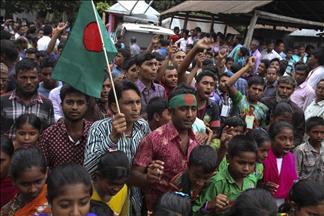
"We have seen mothers trying to cross the river and sea and losing their children," he said as Rohingya fled Muslim violent attacks by security forces and Buddhist-led mobs seek refuge in Bangladesh.
There are 655,000 Rakhine people living in refugee camps in Bangladesh, he said.
"We have sent 150 tons of food in the mountainous areas, where people took shelter after their villages were burnt down by Buddhist mobs," he said, adding that TIKA was currently seeking to rebuild those villages.
Cavusoglu also said Turkey helped relief efforts for Rohingya refugees in camps in Bangladesh, providing food, water, and clothing.
Cavusoglu said, "There are two kinds of civilizations in the world: One that revives, serves people and children, helps and supports, and the other one that kills, colonizes and occupies. We are with the first kind, and we believe this will prevail," he said.
Ethnic cleansing of Rohingya
According to latest UN, 688,000 Rohingya -- who fled violence -- have sought refuge in Bangladesh, since Aug. 25, 2017.
It is estimated that there were around two million Muslims living in Myanmar's Rakhine state in the 1970's, and the number has decreased to under 350,000 due to escapes from systematic attacks.
According to satellite images obtained by international human rights institutions, more than 350 Rohingya villages have so far been burnt in the area.
The refugees are fleeing a military operation in which security forces and Buddhist mobs have killed men, women and children, looted homes and torched Rohingya villages. According to Bangladeshi Foreign Minister Abul Hasan Mahmood Ali, around 3,000 Rohingya have been killed in the crackdown.
Along with all official institutions, Turkey distributed more than $10 million to the Rohingya camps in Bangladesh, according to Mehmet Gulluoglu, the head of Turkey's Disaster and Emergency Management Authority (AFAD).