ANKARA
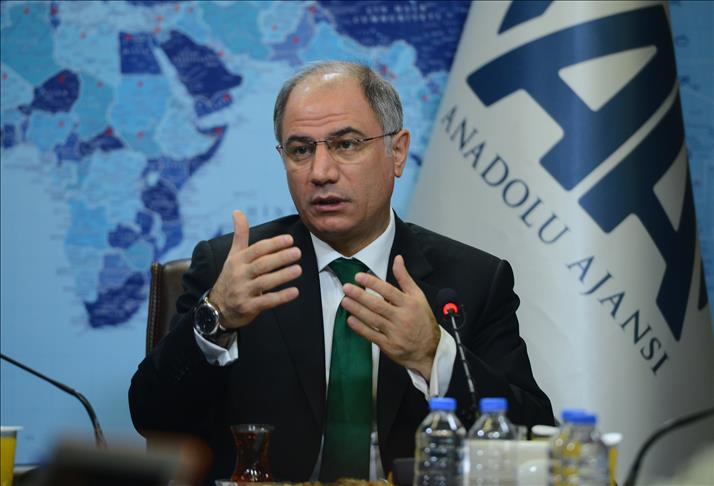
Recent polls suggest that 80% of the public support the new security bill that enhances the powers of law-enforcement officers and modifies domestic security procedures, Turkish Interior Minister Efkan Ala said Wednesday.
"There is great public support for the draft security law. Polls show that 80% of the people approve the new bill," Ala told The Anadolu Agency, where he attended the AA Editor's Desk meeting.
Discussions on the bill, which was approved by the internal affairs commission of the Turkish parliament on Jan. 22, are expected to start in parliament next week.
Ala said that the bill was already anticipated by the Turkish people as "they all know what happened during the Gezi Park protests, and at other times," referring to the protests in summer 2013 when the Istanbul municipality attempted to remove a number of trees in a green space in the city center as part of a redevelopment project.
What began as a seemingly environmentalist movement, with concerned Istanbulites numbering in the dozens occupying Gezi Park to prevent the removal of trees, soon mushroomed into a nationwide wave of protests against the government.
The minister also dismissed criticisms against the bill, saying, "The arguments are not based on research."
The bill was first submitted to the commission in November last year in the wake of last October's protests in the country that resulted in the deaths of dozens of Turkish citizens.
The proposed legislation outlaws possession of fireworks, Molotov cocktails and slingshots during protests. Protesters who cover their faces in demonstrations that take a pro-terrorism tone can now face imprisonment for up to five years.
The bill also gives police enhanced powers to act preemptively in carrying out raids based on intelligence of possible criminal activity. Police will now be authorized to use firearms against those who attack schools, public offices or places of worship with firearms, explosives or other weapons.
Officers will also be able to search a person, their belongings or private vehicles based on oral instructions by police chiefs. The person being searched will be informed of the rationale behind the procedure.
In cases that cause uproar in society -- such as manslaughter, human trafficking or sexual abuse -- Turkish police will have the authority to hold a suspect under custody for 24 hours with the approval of the public prosecutor or the deputy governor and under supervision of their superior officers.
With the new law, all transactions involving the “bonzai” -- a cheap, addictive and potent form of a marijuana-like substance -- will be considered illegal and regarded the same as conducting deals for other drugs.
The bill also says the interior minister will have the power to appoint junior commanders in Turkey's General Command of the Gendarmerie -- the country's paramilitary force -- and the Coast Guard except for admirals in the Coast Guard and generals in the gendarmerie force.
Canceled passport of U.S.-based preacher Fethullah Gulen
"Gulen's passport was canceled because it was based on false information," Ala said. Gulen is accused of trying to topple the Turkish government.
The Turkish government told U.S. authorities on Jan. 26 that it canceled Gulen's passport for providing false statement, a Turkish Foreign Ministry spokesperson said Tuesday.
Gulen used a green Turkish passport to travel to the U.S. in 1999 in March. Such green passports are usually given to government officials like members of parliament and army officials.
On Jan. 26, the governor's office of the southeastern province of Erzurum -- Gulen's hometown -- nullified his green passport because of alleged inaccurate information he provided in 1990.
Ala said that only public officers of certain seniority are eligible to obtain a green passport, and Gulen was not qualified to have one since he was not a high school graduate, which is among the criteria to get a green passport.
"Gulen graduated from primary school. [...] He quit his government job, and retired as a worker. But the papers he submitted for his passport application say that he retired as a public officer," Ala said, adding that the documents are not accurate.
An Istanbul court issued an arrest warrant for Gulen as part of a probe into "parallel state" operations in December 2014, which would pave the way for Turkish authorities to demand a search for Gulen through Interpol’s red notice.
Gulen has been in the U.S. since leaving Turkey in 1999 for “medical reasons.” Shortly after his departure, Turkish prosecutors opened a case against him for incitement to attacking the secular state. He was acquitted in 2008.
The Pennsylvania-based preacher's so-called Hizmet movement is accused of forming a criminal gang -- popularly referred to as "the parallel state" -- within Turkey's key institutions, including the judiciary and the police, in an attempt to undermine the Turkish government.
The Gulen movement denies all charges.