By Charles Newbery
BUENOS AIRES
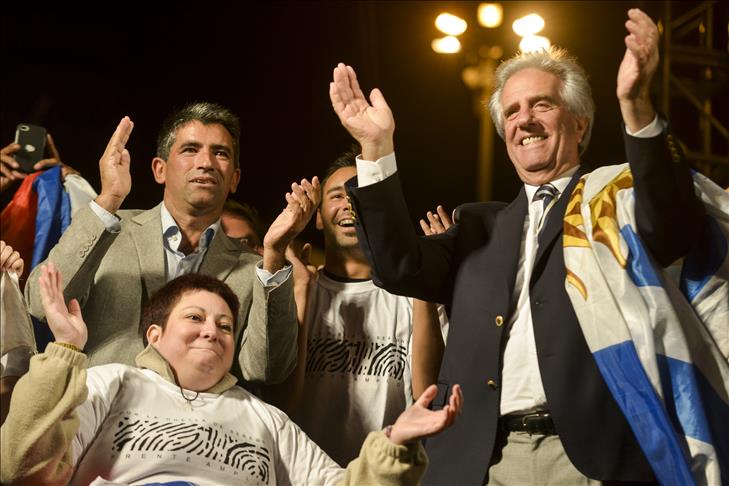
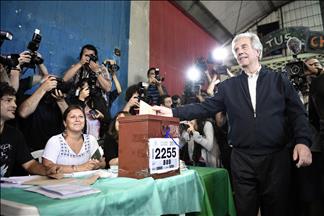
Tabare Vazquez won a second presidential term in Uruguay on Sunday, according to three exit polls.
Vazquez snared 53.5 percent of the votes to beat Luis Lacalle Pou, a young conservative who trailed with 41 percent, according to Cifra Gonzalo Raga & Asociados, a polling company.
The other pollsters, Factum and Equipos Consultores, showed similar results at 53.9 percent versus 40.6 percent and 53 percent versus 42 percent, respectively. Official results will be announced Dec. 2.
If the surveys are correct, Vazquez will return to a job he held from 2005 to 2010, taking office on March 10, 2015.
Vazquez told supporters at a post-election rally in Montevideo that dialogue and consensus will be focuses of his government, together with working on long-term goals.
“We must think more in future generations, and not in the next elections,” he said.
The long-term development of the country will come from working with opposition political parties, he added.
“I must not work alone, nor do I want to,” Vazquez said, adding that he will put together an administration “without ignoring anybody” but at the same time, one that “reflects the majority because that is the soul of democracy.”
Vazquez said that main policy focuses of his government will be on improving education, health, housing, infrastructure, social welfare, innovation, production, the environment, and decent employment.
“History is made day by day,” he said.
The win will extend leftist Broad Front’s decade of rule for another five years following decades of rule by the traditional Colorado and National parties.
Even so, Vazquez, a 74-year-old oncologist and outspoken critic of tobacco, faces a challenging economy as neighboring Argentina and Brazil suffer slower growth due to recessions, limiting trade with its biggest partners.
Vazquez and current president, Jose Mujica, have ruled with largely centrist economic policies, albeit with higher public spending and taxation, that has held the economy steady despite the vicissitudes in Argentina and Brazil.
The International Monetary Fund said in an October economic outlook report that Uruguay’s economy will likely grow by 2.8 percent a year in 2014 and 2015.
“Uruguay has proven quite resilient to the slowdown in Argentina and Brazil – its two key trading partners – thus far,” the Washington-based lender said in the report.
But while Uruguay's economy is expected to expand, Argentina’s economy is expected to shrink 1.7 percent this year and 1.5 percent in 2015, while Brazil’s is due to expand 0.3 percent and 1.4 percent over the same period, according to the IMF.
Vazquez said earlier Sunday that Lacalle Pou is to be a politician to contend with in the future.
Lacalle Pou, a 41-year-old lawyer and son of a former president, thanked his supporters after hearing the results of the exit polls.
“We did things well,” he said in televised comments.
In addition to his stated goals, Vazquez is expected to press forward with the progressive social agenda of the popular Mujica for the country of 3.3 million.
That agenda brought the legalization of marijuana as a way to fight the drug war, as well as the legalization of abortion and gay marriage, and the launch of a $3 million resettlement program for Syrian refugees fleeing civil war.
www.aa.com.tr/en