- Since Valentina Tereshkova reached space in 1963, women have achieved historic milestones in exploration, science and industry
- Gender gaps persist behind the milestones, with women accounting for only about 11% of astronauts in history and 20% of the industry workforce
She called it “Chaika,” the Russian word for seagull. It was the radio call sign used by Valentina Tereshkova when she spoke to Soviet ground control from her Vostok 6 capsule on June 16, 1963, as she became the first woman to travel to space.
Twenty-six years old, a former textile factory worker from a village in Russia’s Yaroslavl region, she had just made history as the first woman in space.
Over the next 71 hours, she completed 48 orbits of Earth, logging more time in space than all American astronauts combined to that point.
Her flight was a major victory for the Soviet Union during the Cold War space race, just two years after Yuri Gagarin’s pioneering orbit.
Trailblazing firsts
The next major breakthrough came in 1982, when Soviet cosmonaut Svetlana Savitskaya became the second woman in space -- and later the first woman to conduct a spacewalk in 1984.
American Sally Ride followed as the first US woman in space in 1983 aboard the Space Shuttle Challenger. Mae Jemison became the first Black woman in space in 1992.
Eileen Collins became the first woman to pilot a NASA mission in 1995.
Peggy Whitson became the first woman to command the International Space Station (ISS) in 2007 and, before retiring, accumulated 665 days in orbit -- a US record for cumulative time in space.
In 2019, NASA astronauts Christina Koch and Jessica Meir stepped outside the ISS together to replace a failed battery charge controller unit -- and performed the first all-female spacewalk in history.
During the mission, Koch and Meir received a congratulatory call from US President Donald Trump.
In the call, Meir described the mission as “just coming out here and doing our job today,” while noting she also recognized the historic nature of the moment. She added there had been a “long line of female scientists, explorers, engineers and astronauts,” saying they had “followed in their footsteps to get us where we are today.”
In April this year, Koch became the first woman to fly around the Moon as part of NASA’s Artemis II mission.
Beyond exploration achievements, women have also taken on prominent leadership roles in the commercial space sector.
The most prominent example is Gwynne Shotwell, president and chief operating officer of SpaceX, the world's most active launch company.
SpaceX's 11th employee, Shotwell joined in 2002 as vice president of business development and has since grown the company's launch manifest to represent tens of billions in contracted business.
She manages day-to-day operations for a workforce of more than 22,000, and was present on the floor of the Nasdaq exchange when SpaceX completed its IPO on Thursday.
Carol Craig, meanwhile, founded and leads Sidus Space, a satellite and data company listed on the Nasdaq. She became the first woman to found a publicly traded space company.
The 'Katy Perry moment' and privatization of space
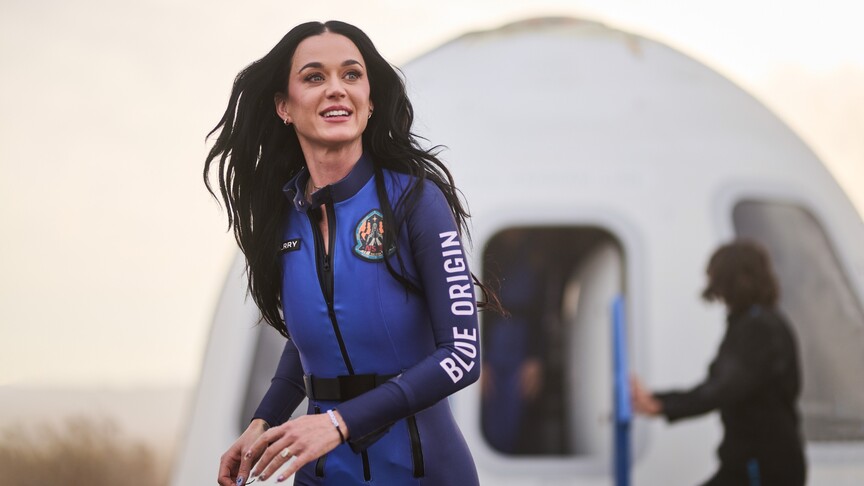
On April 14, 2025, a Blue Origin New Shepard rocket lifted off from West Texas carrying six women on a suborbital flight lasting around 11 minutes.
The crew included pop singer Katy Perry, CBS journalist Gayle King, former TV anchor and Jeff Bezos' wife Lauren Sanchez, former NASA rocket scientist Aisha Bowe, bioastronautics researcher Amanda Nguyen, and film producer Kerianne Flynn.
Blue Origin described the mission as the first all-female crewed spaceflight in more than six decades, framing it as a symbolic moment for representation in the emerging commercial space sector.
The flight reached the edge of space on a suborbital trajectory before returning to Earth, in line with other New Shepard missions designed for short-duration civilian space tourism.
However, the mission also drew criticism.
Critics argued that it was more celebrity tourism and a PR stunt than a genuine advancement for women in science or aerospace careers, describing it as "performative feminism."
They pointed to the high cost of seats, the celebrity-heavy crew composition, and the branding of the mission as an example of how space access has become increasingly shaped by wealth and media visibility.
Numbers behind the names
Behind the milestones, gender gaps persist throughout the sector.
Overall, only about 11% of astronauts in history have been women.
According to the European Union Agency for the Space Program (EUSPA), the industry has a “gender problem,” with women making up only about 20% of the workforce.
Experts point to persistent challenges including the underrepresentation of women in STEM education and technical careers, gender bias in a field historically dominated by men, and unequal access to leadership opportunities. Women have also highlighted how aspects of spaceflight were long designed around male bodies, from spacesuits to onboard facilities.
A landmark study by the United Nations Office for Outer Space Affairs’ (UNOOSA) Space4Women initiative -- the most comprehensive global survey of gender equality in the sector to date, covering 53 public space entities across 46 countries -- found that women hold 24% of managerial positions.
They account for 21% of leadership roles and just 19% of board seats. In technical roles such as engineering, research, and astronautics, women represent fewer than 20%.
At NASA specifically, women make up roughly 35% of the agency’s total workforce.