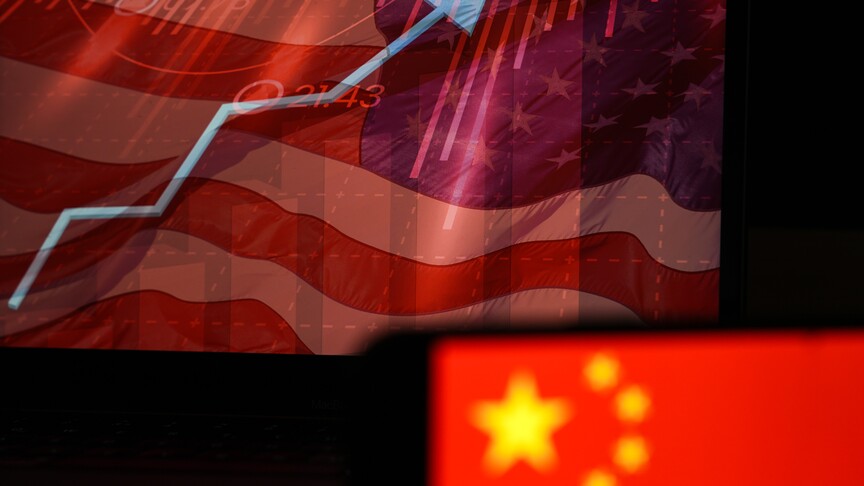
The US is tightening controls on who can access its most advanced artificial intelligence systems, extending its technology restrictions beyond chips and hardware as competition with China intensifies.
As increasingly powerful AI systems raise security concerns, government intervention and selective releases by developers are reshaping who can use the technology – and on whose terms.
"The idea of a completely borderless internet was always somewhat idealized," Antonio Calcara, head of the Geopolitics and Technology Programme at the Centre for Security, Diplomacy and Strategy in Brussels, told Anadolu.
Governments and corporations have long shaped digital infrastructure, he said, but national security concerns increasingly influence how technology is developed, shared and controlled.
That tension surfaced in June when the US government ordered Anthropic to block foreign nationals from accessing its Claude Fable 5 and Claude Mythos 5 models.
The company took both models offline worldwide, saying it could not reliably distinguish users by nationality. The restrictions were subsequently lifted, but the episode demonstrated Washington’s ability to interrupt access far beyond US borders.
Separately, US President Donald Trump in June ordered federal agencies to develop a voluntary framework under which developers could give the US government access to certain advanced AI models for up to 30 days before releasing them to other trusted partners.
Companies have also limited distribution themselves. Anthropic initially offered Claude Mythos to selected partners, while OpenAI released GPT-5.6 to a small group in June at the US government’s request before widening access the following month.
These arrangements differ from export controls, but together reflect growing scrutiny of who gains access to the most powerful systems.
Milton Mueller, a professor at the Georgia Institute of Technology and co-founder of the Internet Governance Project, said barriers are growing even as the internet’s basic infrastructure remains global.
"We have already created certain forms of fragmentation and barriers," Mueller told Anadolu, explaining that the restrictions largely affect the services people can access rather than the underlying internet itself.
Washington has imposed export controls on advanced semiconductors and other technologies to China. Beijing blocks many major US platforms through its so-called Great Firewall and restricts cross-border data transfers.
Economic incentives favor access to global markets, Mueller said, but national security concerns increasingly drive governments to impose restrictions.
Applying traditional export controls to AI models, however, is particularly difficult.
Weapons, advanced chips and other physical goods can be stopped from crossing borders. AI models delivered through online services can be accessed from almost anywhere, making it much harder to control who uses them.
Mueller compared the challenge to earlier US efforts to restrict encryption exports, which became harder to enforce as the technology moved from specialized hardware into widely available software.
Similar restrictions on AI could require extensive monitoring of who is accessing online services and from where, he said. That would be technically possible, according to Mueller, but difficult and costly to enforce on a global scale.
Control over advanced technology can also give countries leverage over their rivals.
The US, home to many of the world's leading technology companies, can use its legal and regulatory power to restrict who has access to their products and services.
Political scientists Henry Farrell and Abraham Newman call the use of control over critical global networks “weaponized interdependence.”
Their research argues that globalization has concentrated important services and technologies in a small number of countries and companies, giving governments power to restrict rivals’ access.
Closer ties between Silicon Valley and Washington also have advocates within the industry. In their book The Technological Republic, Palantir CEO Alexander Karp and executive Nicholas Zamiska argue that such cooperation is essential to US technological and military strength.
But restrictions can carry diplomatic costs.
Calcara said major powers cannot simply keep technological advantages to themselves while expecting to build strong alliances.
Washington needs partners as well as technological superiority in its long-term competition with China, he said. Restricting access too broadly could undermine the strategic advantages it seeks to protect.
The competition also complicates a debate over how quickly AI should advance.
Some technology leaders want developers and governments to slow work on the most advanced systems, warning that capabilities are outpacing safeguards.
In his essay We Must Pace the Frontier, Anthropic CEO Dario Amodei called for greater coordination among AI companies and governments to slow the pace of cutting-edge development.
He also linked safety to competition with China, arguing that restrictions on advanced semiconductor exports could slow Beijing’s progress and give governments more time to introduce safeguards.
Trump has rejected calls to slow development, saying they risk benefiting China.
“There is a sick conspiracy going on against AI and data centers, and the only one that is happy about it is China,” he posted on his social media platform Truth Social earlier this month. “Whoever wins AI, wins!"
Mueller questioned the premise.
"If this is a race, what is the finish line?” Mueller asked.
AI advances do not automatically increase the power of the country where they originate, he argued. Benefits often flow primarily to the companies and people using the technology, although military applications could provide more direct strategic advantages.
He also questioned whether a slowdown could succeed without agreement among competing powers, seeing little prospect of the US, China and Russia simultaneously limiting development.
Mueller remains deeply skeptical of claims that AI could threaten humanity’s survival and questioned whether proposed safeguards could prevent such an outcome even if the risk were real.
The disagreement leaves policymakers facing the competing demands to preserve a technological lead, prevent misuse and decide how much international cooperation either goal requires.
Although Washington largely justifies technology restrictions on security grounds, Mueller said commercial interests also shape policy.
US companies can benefit when foreign competitors face restrictions, creating incentives to frame business concerns as national security imperatives, he said.
Mueller also questioned whether policymakers sometimes overstate the risks of relying on foreign countries for important technologies and other economic inputs.
Companies seeking market protection also find it easy to convince politicians by framing their interests as national security imperatives, he added.
China has repeatedly criticized US technology restrictions as protectionist, accusing Washington of stretching national security arguments to contain its development.
Yet rivalry has not ruled out cooperation.
Senior US and Chinese officials discussed a proposed notification mechanism for AI incidents affecting national security during talks ahead of a meeting between Trump and Chinese President Xi Jinping later this week.
US Treasury Secretary Scott Bessent told reporters Sunday that greater transparency between the two countries was increasingly important as their AI capabilities advanced.
"We think that, just like with any cross-border activity, that moving from opaque to more transparency between the number one and the number two AI powers in the world is very important," Bessent told reporters Sunday.
Whether that concern can produce broader cooperation remains uncertain.
Mueller expressed doubt that the leaders’ meeting would significantly alter the technology rivalry, expecting any agreements to focus on narrower trade issues.
Restrictions could also shape technology choices far beyond the US and China.
Developing the most advanced models requires vast computing resources, infrastructure and investment, concentrating capabilities among relatively few companies and wealthy countries.
Calcara said that concentration risks deepening smaller countries’ dependence on foreign providers.
European allies remain closely tied to American technology and transatlantic security structures. Elsewhere, access and affordability could matter more.
Countries in Africa, Southeast Asia and other parts of the Global South could increasingly turn to Chinese technology if it is cheaper, more accessible or subject to fewer political restrictions than US alternatives, Calcara said.
Chinese developers have released increasingly capable open-weight models, allowing users to download and adapt them under the applicable licenses.
That flexibility could increase their appeal where customers want greater control over the technology they use.
Calcara warned that broader restrictions on American systems could therefore strengthen Chinese alternatives in markets where governments and companies can choose between providers.
The divide could also affect scientific research.
Tighter controls could gradually produce more separate US- and China-centered technology systems, with different standards and fewer opportunities for researchers and talent to move between them, he said.
Mueller said restrictions are already affecting academic exchanges, pointing to tighter US policies toward foreign researchers and international students.
Such barriers could make the technology rivalry harder to reverse, even if the two countries reach agreements in other areas.
For Washington, the challenge is therefore not only whether it can restrict access to advanced AI, but what influence it might lose by doing so.
Mueller, however, expects restrictions to persist as long as Washington views China as a strategic threat, with Beijing responding through measures of its own.
news_share_descriptionsubscription_contact

contact_the_ombudsman
is_there_an_error_in_this_story