By Wallace Mawire
HARARE
In a bid to promote the use of environmentally-friendly renewable power technologies, the Zimbabwean government is intensifying efforts to tap into wind energy for power generation.
The government of Zimbabwe, through the Ministry of Energy and Power Development, has received support from the International Renewable Energy Agency (IRENA) for a preliminary wind mapping desk study to identify areas suitable for wind energy generation, according to Gloria Magombo, CEO of Zimbabwe's Energy Regulatory Authority (ZERA).
"Some of the areas that were identified in the country with potential for wind energy generation include [the towns of] Gweru, Zvishavane, Chivhu and Bulawayo, as well as in the Eastern Highlands," Magombo told The Anadolu Agency.
Magombo added that one of the initiatives involved the installation of windmills to pump water for domestic use at farms located in different areas of the country.
Asked whether the country had enough wind for such projects, Magombo said research was currently underway on technologies aimed at harnessing winds at lower speeds.
A preliminary study has focused on tapping wind energy from eight to ten meters above ground.
The study, supported by IRENA, revealed that wind tapped at about ten meters above ground was suitable for agricultural activities, said Tobias Mudzingwa, the engineer responsible for renewable energies at ZERA.
"The study has revealed that for wind energy electricity power generation, we need to tap wind from a height of 80 meters above ground," Mudzingwa told AA.
"We intend on validating the three-tier data obtained via satellite with ground measurements beginning next year. When we have finished this exercise, then we can talk about wind energy power generation," he said.
According to Magombo, once ZERA completes the relevant mapping exercises, it intends to encourage investors to support the initiatives.
Another organization on the forefront of promoting wind technologies is the Zimbabwe Environmental Regional Organization (ZERO).
According to Wellington Madumira, ZERO's project officer for energy and climate change, his organization initiated the "Power from Wind Project" due to the growing need for renewable sources of energy.
"Over 100 mechanical windmills have been set up on Zimbabwe farms for water pumping. Earlier field tests in the late 1980s suggested that there was potential for wider application of wind energy technologies that could be locally manufactured," Madumira said.
"[Yet] wind data for power generation purposes is still limited to a few surveys at low heights," he added.
According to Madumira, phase one of the ZERO project ran from 1990 to 1993, with wind monitoring and tests.
"Phase one focused on monitoring wind speeds and installing pilot wind generators. Wind speed data collection was done at four sites, namely, Chivhu, Karoi, Mount Darwin and Rusape," said Madumira.
"The first phase resulted in the installation of three 50-watt Marlec 910 wind generators, providing 12 volts of direct current through a charge controller in the Chimanimani district," Madumira added.
"It also resulted in installations at Chayamiti, Chikukwa and Shinja. Another generator was installed at the Dumbamwe clinic in Makoni. The wind turbines at Chikukwa and Dumbamwe were installed with the assistance of the project partners and the Department of Energy," Madumira said.
Phase two of the ZERO project focused on wind monitoring, conducting market studies, the production and installation of wind turbines, local demonstrations, training, technology assessments and the production of publications.
"Year two continued with wind monitoring and other first-year activities. Year three focused on production of publications," said Madumira.
Some of the institutions involved in the initiatives included the Department of Energy, which provided a technical and supportive role; the U.K.'s Manx Wind Energy Services, which provided consultancy services in the development of low-speed turbine generators; and the Meteorology Department, which assisted in wind monitoring and the compilation of Zimbabwe's wind atlas.
Among these institutions were also Power-Vision Ltd., which manufactured and installed wind turbines and was involved in distribution and marketing; and the Rural District Councils, which assisted in the mobilization and installation of district-based pilot demonstration centers.
Madumira said the initiative had so far yielded the following: market surveys to gauge market response; the erection of three monitoring systems in Chimanimani, Chivhu and lower Gweru; the installation of battery charging systems; and a socio-economic study to assess the economic viability of wind-powered water pumping systems.
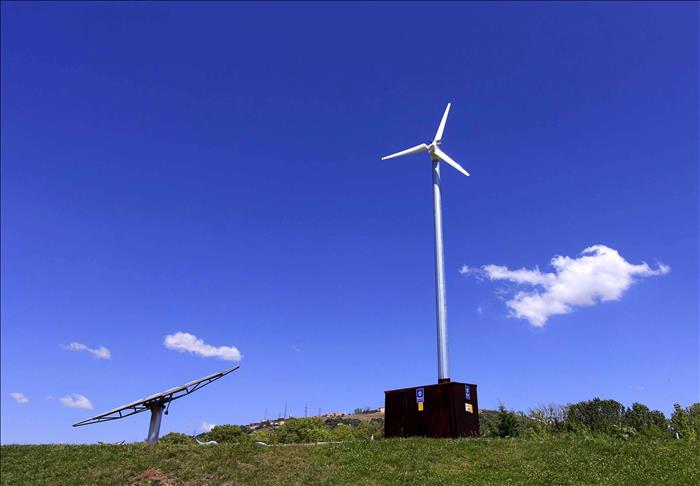
The initiative has also resulted in the production of 1kW and 4kW wind turbines, and the installation of four turbines with a combined capacity of 4kW at the Temaruru Business Center in the town of Rusape, along with two 1kW turbines at the Chikukwa Permaculture Center in the Chimanimani and the Masampa fishing camp on the shores of Lake Kariba, Madumira said.
The initiative also saw the installation of a wind-powered water-pumping system and a larger 4kW wind generator at the Temaruru Secondary School; the training of local personnel in basic repair work and maintenance; publication of an operator's manual for the wind system; the establishment of community trusts to take charge of the project; and the creation of a successful partnership between the government, ZERO and the privately-owned Power-Vision Ltd., he added.
"Despite the successes we've accomplished, the project was destroyed in 2008 by the community," Madumira said, without saying why local residents had destroyed the site.
"So the project is no longer running, but we plan on resuscitating it," he added.
Other challenges he highlighted included limited funding; difficult macroeconomic conditions; and unanticipated inflation that saw drastic increases in the cost of fuel, turbines and auxiliary equipment, which strained the budget during the project's implementation phase.
"This led to two of the sites – Wiltshire Headquarters Clinic in Chivhu and Vungu Secondary School in Lower Gweru – not benefiting from wind power, as the two turbines could not be paid for," Madumira said.
"This despite the fact that both sites showed very high wind speeds, warranting installation of the turbines," he added.
news_share_descriptionsubscription_contact

contact_the_ombudsman
is_there_an_error_in_this_story