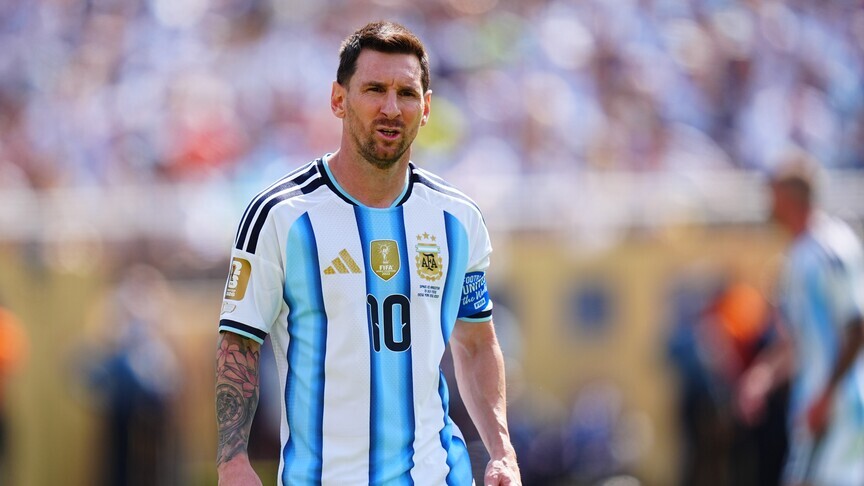
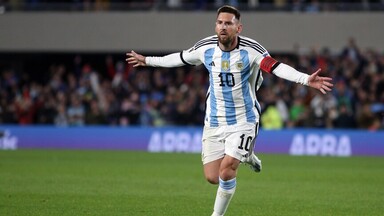
Lionel Messi's international career began with disappointment and ended with him leaving Argentina as the central figure of the most successful era in the country's modern football history.
After more than two decades with the national team, Messi announced his international retirement at 39 after winning the 2022 FIFA World Cup, two Copa America titles and the 2022 Finalissima.
Messi leaves Argentina as its all-time leading scorer and most-capped player, with 125 goals in 207 appearances.
A difficult beginning
Born in Rosario, central Argentina, in 1987, Messi joined Barcelona's youth academy as a teenager and went on to become one of football's greatest players.
His international career, however, took considerably longer to reach the same heights.
He made his senior Argentina debut in 2005 at 18 and was sent off just minutes after coming on against Hungary. He scored his first international goal the following year against Croatia.
Messi made his World Cup debut at Germany 2006, scoring against Serbia and Montenegro.
He subsequently represented Argentina at the 2010, 2014, 2018, 2022 and 2026 World Cups, making a record six tournament appearances across two decades.
The early years were marked by near misses.
Argentina reached the 2007 Copa America final, losing to Brazil, before suffering defeats in the 2015 and 2016 finals.
The biggest disappointment came at the 2014 World Cup, when Argentina reached the final but lost 1-0 to Germany after extra time.
The defeats intensified comparisons between Messi and Diego Maradona, who captained Argentina to World Cup glory in 1986.
After losing the 2016 Copa America final to Chile on penalties, Messi briefly announced his international retirement before returning to the national team.
The breakthrough
The breakthrough finally came at the 2021 Copa America.
Argentina defeated Brazil 1-0 in the final at Rio de Janeiro's Maracana Stadium, giving Messi his first major senior international trophy with the national team.
The victory ended Argentina's 28-year wait for a major men's international title and transformed the relationship between Messi and the Argentine public.
A year later, Argentina defeated Italy 3-0 at Wembley Stadium to win the Finalissima, with Messi providing two assists.
World Cup glory
At the 2022 World Cup in Qatar, Messi led Argentina to its third World Cup title.
He scored twice against France in a 3-3 final after extra time and converted Argentina's first penalty in the shootout as his team won 4-2.
Messi finished the tournament with seven goals and won the Golden Ball as its best player, becoming the first player to receive the award twice.
The victory ended Argentina's 36-year wait for a World Cup and delivered the major international achievement that had eluded Messi throughout his career.
More silverware
Messi continued to lead Argentina after its World Cup triumph.
In 2024, Argentina defeated Colombia 1-0 after extra time in the Copa America final to retain the continental title.
The victory gave Messi his second Copa America trophy and Argentina its third consecutive major international title, following the 2021 Copa America and 2022 World Cup.
The run established Argentina as the dominant national team of the period, with Messi at the center of the country's most successful era in decades.
The final World Cup
Messi arrived in North America for the 2026 World Cup at 39, having strongly suggested it would be his final appearance at the tournament.
He came close to leading Argentina to back-to-back World Cup titles, something no nation had accomplished since Brazil in 1958 and 1962.
Messi produced eight goals and four assists during the tournament, his best combined goals-and-assists output at a single World Cup.
He finished with the Silver Ball as the tournament's second-best player and also claimed his second consecutive Silver Boot.
Argentina reached the final for the third time in Messi's six World Cup appearances, having lost to Germany in 2014 before defeating France in 2022.
The final against Spain, however, brought a painful ending.
Messi failed to score, while Argentina did not register an attempt during regulation time. Spain eventually won in extra time, denying Messi a second consecutive World Cup title.
Messi was left in tears at the trophy ceremony as Argentina's latest World Cup campaign ended in defeat.
Yet the tournament also served as a prolonged farewell, with each game carrying the emotional weight of a possible final World Cup appearance.
The final against Spain added another dimension, with Messi facing 19-year-old Lamine Yamal, widely viewed as a leading candidate to become the next generation's defining football star.
A legacy beyond the trophies
Messi's international legacy extends beyond his collection of medals.
He became Argentina's all-time leading scorer, surpassing Gabriel Batistuta, and its most-capped player.
He also holds the record for most World Cup appearances by an Argentine player and became the first player to win the World Cup Golden Ball twice.
His six World Cup appearances spanned two decades, from Germany in 2006 to North America in 2026.
But his greatest achievement may have been changing the final chapter of his relationship with Argentina.
For years, Messi was judged against Maradona and criticized for failing to reproduce his club success with the national team.
He lost major finals, briefly retired and endured a period in which his achievements for Argentina were overshadowed by what he had not won.
By the 2026 World Cup, Messi was no longer trying to prove that he belonged among Argentina's greatest players.
He was the captain of a team attempting to extend an era he had helped build.
His final tournament ended without another trophy, but his international career closes with Argentina's most important prizes secured and its most significant individual records in his name.
From the 18-year-old sent off on his debut to the captain who lifted the World Cup in Qatar, Messi's Argentina journey ultimately became one of perseverance, redemption and transformation.