Abolition of special courts to help Turkey's peace process: Pro-Kurdish lawmaker
Pro-Kurdish Peace and Democracy Party (BDP) deputy Hasip Kaplan says they are supportive of the closing of special courts as it helps the Kurdish peace process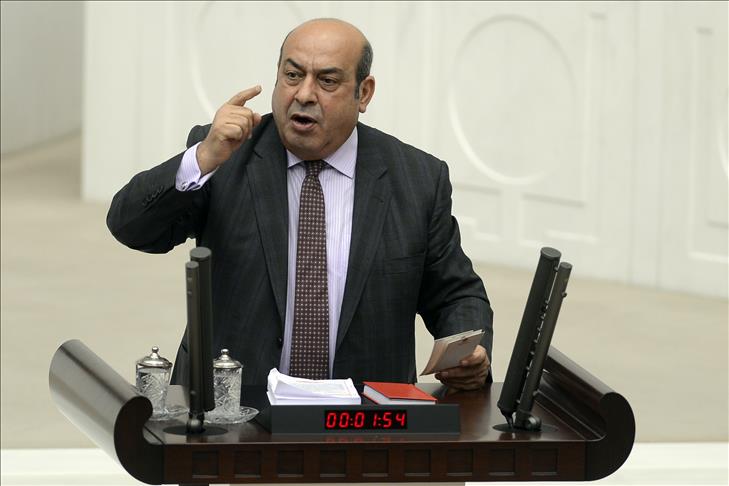
ANKARA
Pro-Kurdish Peace and Democracy Party (BDP) in Turkey is highly supportive of the idea of the abolishment of the widely criticized specially authorized courts and the anti-terror law (TMK) announced earlier this week by Turkish Prime Minister Recep Tayyip Erdogan.
BDP lawmaker Hasip Kaplan underlined that they are supportive of the abolishment of these courts and said that this move would contribute to 'the solution process' of the the Kurdish issue Turkey.
Kaplan said they have even proposed the abolishment of these court five years ago.
"The Turkish Anti-terror Code was passed in 1991, and in 2000s when the Turkish Penal Code was rewritten, all anti-terror articles were included in the penal code. So, indeed, we technically do not need this law any more. But the suspect judged under any of these articles would be judged by two different codes and would be sentenced twice," Kaplan told Anadolu Agency in an interview.
Kaplan noted that the Turkish penal code and other respective laws of Turkey are well equipped to fight terrorism, he added, "Democratic states fight terrorism in line with the law, since our laws in Turkey are well equipped to fight terrorism we don't need any institution above the law to fight terrorism. The Serious Crimes Court in 81 provinces of Turkey should have the authority to fight terrorism," added Kaplan.
Kaplan also emphasized that the abolishment of Specially Authorized Courts would contribute to the solution process on the Kurdish issue in Turkey.
"The government and public opinion in Turkey want 'ideas' to take stage instead of guns. The abolishment process of the TMK and special courts is a good step in opening the way for ideas to take center stage and lead to a political solution for the Kurdish issue in Turkey," Kaplan noted.
"We should stop the guns, and open the way for ideas to take center stage in Turkey through democratic reforms."
The Specially Authorized Courts have long been under fire for controversial cases, especially their handling of the high-profile investigations into the Ergenekon and Balyoz (Sledgehammer) coup plots. A call from prosecutors with special authority for National Intelligence Organization (MIT) head Hakan Fidan to testify about secret talks with the outlawed Kurdistan Workers’ Party (PKK) in February became a breaking point for the ruling Justice and Development (AK) party on the issue.
These courts are tasked with prosecuting terrorism-related crimes and are considered to be a continuance of State Security Courts. Some of the cases that they currently handle are Ergenekon and Balyoz coup plot cases and a 2011 football match-fixing case.
The State Security Courts were established in 1973 and was harshly criticized by public opinion for certain positions were occupied by military judges. The military judges were removed from the court in 1999. In 2004 as part of reforms undertaken within the scope of Turkey's candidacy for EU full membership, these courts were abolished following a constitutional amendment. However, the authority of these courts was transferred to specially authorized criminal courts within an amendment Code on Criminal Procedure (CMK). Technically there is no difference between the specially authorized court and State Security Courts but in name only.
Turkey's parliament already outlawed the special courts on July 5, 2012. However, the courts continue to operate after the resolution as an exception to the bill which stipulated that any cases already open would be completed through the special court.
by Kasım İLERİ
englishnews@aa.com.tr