LONDON
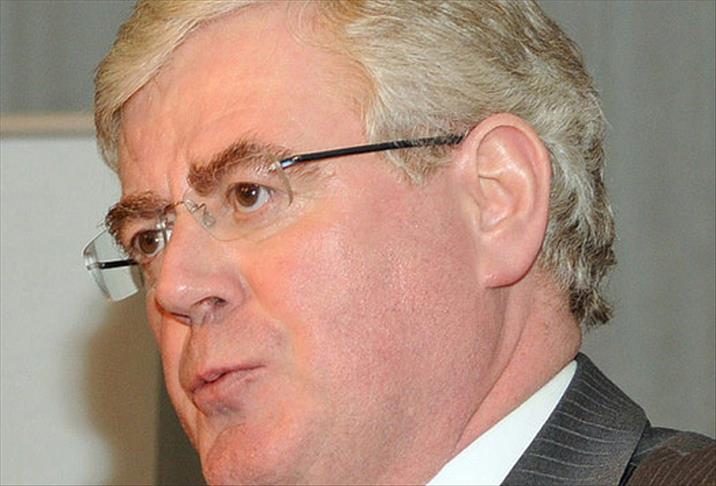
Ireland Deputy Prime Minister and Minister of Foreign Relations and Trade Eamon Gilmore has said membership of the EU was not a question of religion; rather it was a question of satisfying the conditions of membership, and of respecting and promoting the values of the Union.
Ahead of his upcoming Turkey visit on April 7-10 Gilmore talked to AA in London.
He said enlargement was a priority for the Irish Presidency, and they welcomed that the December 2012 EU Council Conclusions recognised was in the interest of both the EU and Turkey that accession negotiations regain momentum. He said they were pleased there has been an opportunity to move forward on Turkey's accession process during the Irish Presidency, and work was continuing at present on Chapter 22 (Regional Policy). He added they would continue to encourage all parties to facilitate further progress on the negotiations.
"Further progress would depend on the efforts of all parties, both the EU and Turkey and enlargement was a conditional process, and Turkey could accelerate the pace of accession by advancing in the fulfilment of benchmarks, meeting the requirements of the Negotiating Framework and by respecting its contractual obligations towards the EU" said Gilmore.
On a question whether he would like to see Turkey in the EU, Gilmore went "Ireland was supportive of Turkish EU accession, provided of course that the conditions of membership are met".
Gilmore said membership of the EU was not a question of religion; rather it was a question of satisfying the conditions of membership, and of respecting and promoting the values of the Union adding that "Any country in Europe which can satisfy the economic and political conditions of membership, and which respects and promotes the fundamental values of the EU, including human dignity, freedom, democracy, equality, the rule of law, and respect for human rights, including the rights minorities, may apply to join the European Union".
"These reforms continue, and the EU that Turkey may join in the future will be very different from that operating now, just as I expect that the Turkey that joins the EU in the future will be different from the country today" noted Gilmore. He said accession was a long, slow process; but it was one that requires continual forward momentum. It was far better to stay on the path, leaving the final decision about membership to the point when the full package was finalised and its benefits could be properly considered.
-Cyprus problem affects Turkey's EU membership prospects-
Responding to a question on if Cyprus issue was an obstacle in front of Turkey's EU membership, Gilmore said it was true to say that the Cyprus problem was affecting Turkey's EU membership prospects. He said the EU was pleased to welcome Greek Cypriot side as a member state in 2004 but of course the EU wishes to see a resolution to the Cyprus problem, which would be for the benefit of all the peoples of Cyprus, for Turkey, and for the whole region. As outlined in the December 2012 Council Conclusions, in order to progress on its EU path Turkey must commit itself unequivocally to good neighbourly relations, the peaceful settlement of disputes, and to normalising its relations with the south of Cyprus. Implementation of the Ankara Protocol could also provide a significant boost to Turkey's accession process, said Gilmore.
-Turkey remains a key trading partner for Ireland-
Reminding that 2013 marks the 40th anniversary of Ireland's EU accession, Gilmore said membership of the EU had been a driving force for social and political change in Ireland, one of the first three "accession" states of the European Union. He expressed that they worked hard to resolve recent difficulties through reforms such as in the area of economic governance and have seen a certain stability return to the region over the past two years as a result. He said Ireland's strong export performance was playing a crucial role in supporting their economic recovery and Turkey remains a key trading partner for Ireland. This trade mission reflects their commitment to further expand trade and economic links between Ireland and the Republic of Turkey, he added.
-Gilmore's Turkey visit-
Gilmore's 4-day Turkey visit has several aspects. He will lead a high-level trade mission to Ankara and Istanbul, with the aim of expanding trade and economic links between Ireland and Turkey. Secondly, he will meet with Foreign Minister Davutoglu and EU Affairs Minister Egemen Bagis to discuss political matters, including Turkey's EU accession process, Irish-Turkish bilateral relations, and current regional and international issues. He will also be paying a courtesy call on President Gul.
Gilmore said "he will also visit some of the Syrian refugees who have fled the violence in their own country and who have been provided with such generous support by Turkey and also by Ireland through the Syria Emergency Response Fund".
Ireland, the first eurozone member, will hand over the rotating presidency to Lithuania in July