Anadolu Ajansı © 2026


ANKARA
Speaking at the Sixth Turkey Sectoral Economy Council meeting held at the twin towers of the Union of Chambers and Commodity Exchanges of Turkey (TOBB) in the Turkish capital of Ankara, Prime Minister al-Jabali noted that he was honored and pleased to be in Turkey.
"We thank the Turkish people for their support to Tunisia and the Tunisian people. We try to carry our relations to the highest quality and figures possible," al-Jabali stressed.
"We are pleased with the developments in bilateral relations. Our horizons in this matter will always be wide. We need to increase contacts to develop common interests," al-Jabali said.
"In accordance with the development in bilateral relations, we have placed the Turkish language among our courses in schools in Tunisia," al-Jabali noted.
"Turkey has provided a loan of 500 million USD to Tunisia. 100 million USD of this figure was donated. Many technical assistance from Turkey have reflected on the Tunisian life," al-Jabali underlined.
"The industrial zone to be erected in our capital Tunis with the contributions of Turkey will be at international standards. I invite Turkish investors to make use of this industrial zone," al-Jabali stated.
"Both sides wish to establish strategic relations and there is great will in this matter," al-Jabali said.
"The Tunisian revolution has affected the world and Tunisia is going through an historic transformation. We attach sensitivity to the democratization process," al-Jabali noted.
"While our country has not reached the desired level, crucial steps have been taken in politics, social and economic fields," al-Jabali stressed.
"We continue our efforts for a new constitution. The new constitution will be one which will open new horizons for Tunisia," al-Jabali emphasized.
"We pay high attention to consensus in Tunisia. Elections will take place by June 2013," al-Jabali expressed.
"We attach high importance to the fight against corruption, development strategy, employment, and the fight against inequalities. Growth figures in Tunisia are going up and unemployment rates are falling," al-Jabali indicated.
"The number of tourists arriving in Tunisia in 2012 surpassed five million. We have assumed a free market economy which attaches importance to the social dimension," al-Jabali noted.
"We have prepared laws related to investments in all fields. We have reviewed the investment and financial systems," al-Jabali said.
"We will extend support to all private initiatives. We attach high importance to investments that promise added value and are on information technologies," al-Jabali indicated.
"We will immediately complete investments on highways, railways and natural gas. New Tunisia will open new horizons for new investments of Turkish brethren," al-Jabali stressed.
"Mutual investments will carry bilateral relations further," al-Jabali also said.
At the end of his speech, al-Jabali invited the participants of the meeting to Tunisia.
Turkish president Gul receives Tunisia's prime minister
Turkish President Abdullah Gul received Tunisian Prime Minister Hamadi al-Jabali in Ankara.
Turkish Foreign Minister Ahmet Davutoglu also attended the meeting which was closed to press at Cankaya Presidential Palace.
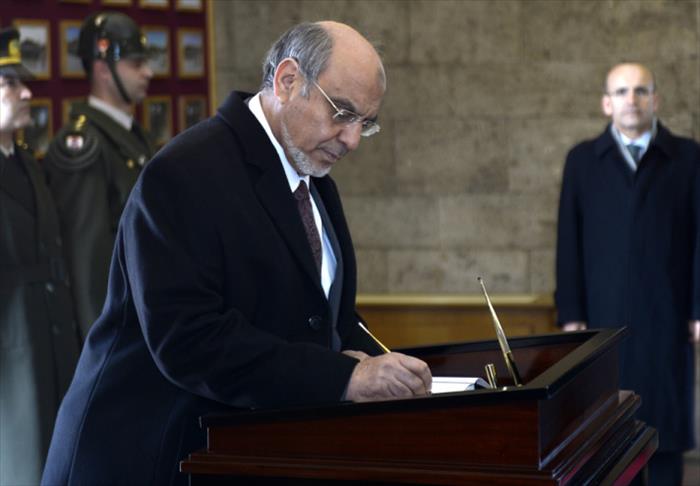
Earlier in the day, Jabali visited Anitkabir, the Mausoleum of Mustafa Kemal Ataturk, where he laid a wreath and observed a minute of silence. He then met Turkish Parliament Speaker Cemil Cicek.
Turkish Prime Minister Recep Tayyip Erdogan will also hold a meeting with Jabali later on the day.
Turkish Parliament Speaker Cicek meets Tunisian PM al-Jabali
"What is important for us is your brotherhood"
Turkish Parliament Speaker Cemil Cicek received the Tunisian Prime Minister Hamadi al-Jabali and an accompanying delegation in the Turkish capital of Ankara.
Speaking while meeting the Tunisian delegation, Cemil Cicek stressed that Turkey and Tunisia were friendly and brotherly countries.
Referring to the 'Arab Spring' in the Arabic world, Cicek underlined that "while Tunisia experienced a spring, many other friendly and brotherly countries turned into winter and winter continues with all harsh conditions."
"We appreciate the positive developments in Tunisia," Cicek noted.
"We know how difficult the process you are going through is and your pain. Certain countries had similar developments compared to Tunisia but they could not finalize their efforts as successfully as Tunisia's," Cicek said.
"We follow the developments and support the legitimate demands of the peoples," Cicek emphasized.
"We are ready to make any contributions that may be necessary. We do hope that all other Muslim brotherly countries reach similar success. There have been times in Turkey when democracy was suspended for a while. Turkey has parliamentary experience since 1876. Our experiences may make your job easier," Cicek stressed.
"We have not looked at the developments in the Arabic world through oil wells or natural gas chimneys. What is important for us is your brotherhood," Cicek also said.
Al-Jabali, in his part, said that he was pleased to be at the Turkish Parliament.
"The Arab Spring began in Tunisia. All incidents in this process were a reflection of the peoples' longing for democracy," al-Jabali noted.
"We were highly pleased to see the support of our Turkish brethren during this process," al-Jabali underlined.
"We believe in responding to the peoples' legitimate demands, including democratic values, freedom, modernism and societal development," al-Jabali said.
"We were successful with the first revolution on January 14 and ended the dictator's rule. However, we have an obligation to complete the second and third revolutions by responding to the demand of our people for development and all other legitimate demands," al-Jabali also stated.
news_share_descriptionsubscription_contact