ISTANBUL
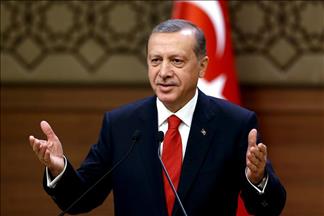
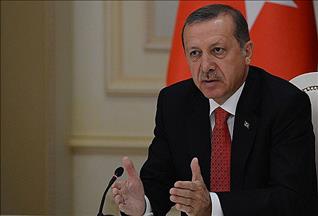
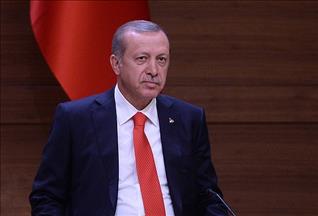
Turkish President Recep Tayyip Erdogan said Turkey “will not excuse those who said ‘despotism started in 1453’ and [claimed that there was an] ‘Armenian genocide’ and a ‘Pontic genocide.’”
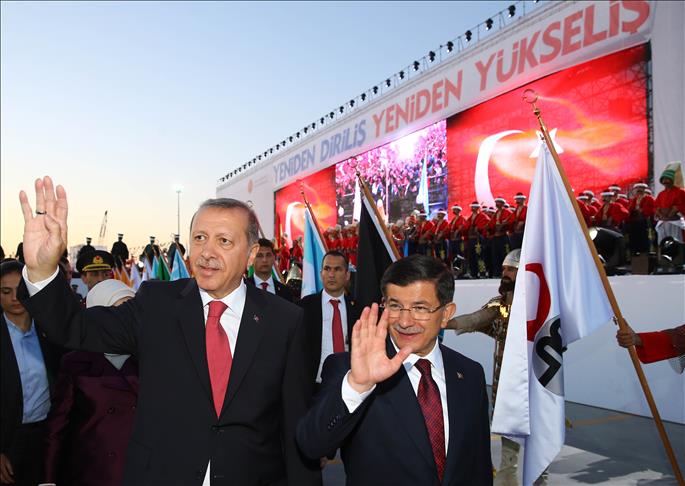
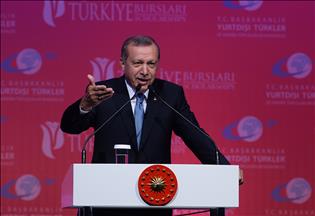
Delivering a speech during Istanbul's 562nd conquest anniversary at Istanbul’s seaside Yenikapi area on Saturday, Erdogan said, "We will not allow those who want to put the conquest's fire out of our hearts, which has been burning for 562 years."
Erdogan, in his speech, talked about the allegation that Turkey's National Intelligence Service trucks were loaded with ammunition, a day after a national daily published alleged photos showing some boxes filled with weapons on a truck and claimed the photos were taken during an operation conducted in 2014.
"They interrupted the help we were delivering to our brothers in Syria and stole their lives," Erdogan said. "Without any shame, they speculated about the help we were sending to Bayır Bucak Turkmens (Turkmens in the Bayir Bucak region in northern Latakia province of Syria). This is spying. They will answer to this."
On Friday, a court accepted the Istanbul prosecutor's request to ban access to online content showing the trucks.
In January 2014, several trucks were stopped by local gendarmerie in southern Adana and Hatay provinces on grounds that they were loaded with ammunition, despite a national security law forbidding such a search.
The case saw the arrest of 26 soldiers.
Turkey's Interior Ministry said at the time, that the trucks, which were claimed to be carrying arms into northern Syria, were in reality conveying humanitarian aid to the Turkmen community in the war-torn country.
Erdogan: "New York Times is trash"
Turkey's President Erdogan also slammed The New York Times again.
"There is a trash called The New York Times in the U.S. What are they saying? There are dark clouds over Turkey. They wrote the same stuff about [Sultan] Abdulhamid in 1896," referring to the 34th Sultan of the Ottoman Empire.
Erdogan also said that The New York Times is "close to the Armenian lobby" and is "in a close relationship with Pennsylvania," referring to Pennsylvania-based preacher Fethullah Gulen, who Turkish authorities accuse of leading a clandestine “parallel state” within state institutions to undermine the Turkish government.
On May 22, The New York Times said: "Mr. Erdogan appears increasingly hostile to truth-telling. The United States and Turkey’s other NATO allies should be urging him to turn away from this destructive path."
Davutoglu's speech
Speaking at the ceremony, Prime Minister Ahmet Davutoglu pointed out Istanbul's ever-sheltering role for people from different religions or countries throughout the Turkish history on Anatolian soil.
He was drawing an analogy between Turkey's current helping-hand to Syrian and Iraqi refugees and a decree by Ottoman Sultan Mehmed II after the conquest of Istanbul where he said that the lives of all Christian residents of the former Byzantium capital would be under his own protection, along with the freedom to live their religious beliefs freely and to conduct trade activities as long as they accepted to obey his rule.
"Istanbul has always been a haven city for all those in trouble, they have always strived to reach Dersaadet [former name of Istanbul, which means 'Door to Felicity, Welfare' in Ottoman Turkish]," he said.
Davutoglu stressed that the decree of Sultan Fatih is still in effect in Istanbul.
He pledged to Istanbulites to preserve Istanbul as the heart of the world, just as it was throughout history.
"The world's eyes will be on Istanbul, and all will take their steps according to Istanbul," he added.
Turkish Parliament Speaker Cemil Cicek said Turkey is nothing without Istanbul, which he describes as entrusted to the Turkish people.
"We protect this trust and appreciate its value. It is a duty upon us to protect this memory to the end," he said.
"Rise and revival" are the themes of the ceremony at the Yenikapi venue, which was furnished with advanced technology.
During the event, a 3D film about the conquest was shown on a giant screen.
An Ottoman janissary band, which consisted of 562 people for this anniversary, played conquest songs.
Turkey’s national aerobatic team – the Turkish Stars – performed a special show in the sky.
Speeches delivered during the event were translated into English, Arabic, Spanish, French, Russian and sign language.
The coastline and historic walls of Istanbul, which were built by the Byzantines to protect the city, were illuminated. Fireworks and laser shows colored the area and pyrotechnics were used during the celebrations.
The Panorama 1453 History Museum, near the city's historic walls, which depicts the conquest with a 360-degree panoramic painting, also presented commemorative coins to every visitor on the anniversary day.
On May 29, 1453, Ottoman Sultan Mehmed II conquered Istanbul, formerly called Constantinople, from where the Byzantines had ruled the Eastern Roman Empire for more than 1,000 years.
The conquest transformed the city, once the heart of the Byzantine realm, into the capital of the new Ottoman Empire.
With the conquest of Istanbul, a new era started politically and administratively in Turkey and the wider world and Sultan Mehmed II became the commander that Prophet Mohammed mentioned hundreds of years ago.