Gokhan Ergocun
08 May 2026•Update: 08 May 2026
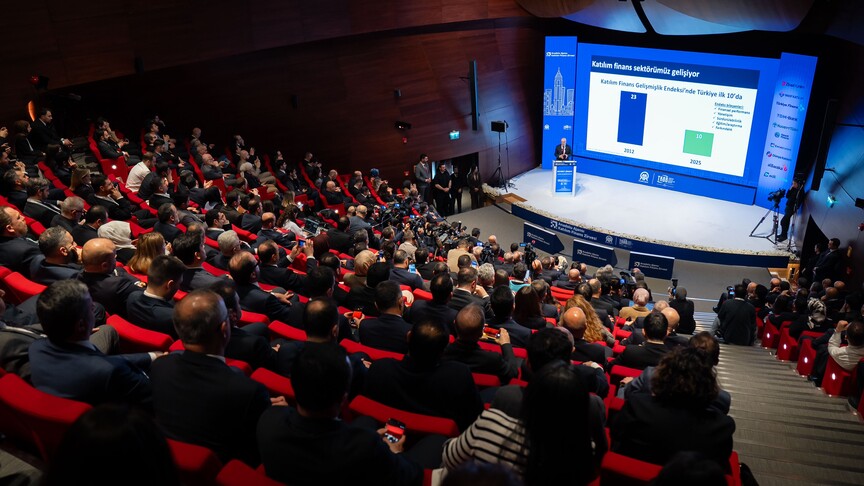
Managers of Turkish participation finance institutions addressed digitalization's role in the sector's future as part of the Participation Finance Summit organized by Anadolu at the Istanbul Financial Center on Thursday.
The summit included panels on future strategies for participation banking and Türkiye’s participation economy, participation-based investment products, and the role of digitalization in the future of participation finance.
The event was organized through a collaboration between Anadolu and the Participation Banks Association of Türkiye, with contributions from Turkish participation banks Vakif Katilim, Kuveyt Turk, Ziraat Katilim, Emlak Katilim, Albaraka, Türkiye Finans, Dunya Katilim, Hayat Finans, TOM Bank, and Adil Katilim.
As part of the summit, the panel titled “The Role of Digitalization in the Future of Participatory Finance,” moderated by Yusuf Ozhan, deputy director general and editor-in-chief at Anadolu, featured presentations by Onur Ozkan, general manager of participation lender TOM Bank, Murat Yonac, general manager of participation lender Adil Katilim Bankasi and Ozer Baran, acting general manager of participation lender Hayat Finans.
In his opening remarks, Yusuf Ozhan said digitalization is no longer merely a complementary part of banking but a transformative force at the center of the business model.
“If we have a digital presence, our business expands."
"How can we establish a digital presence? The most critical issues revolve around this question,” he said.
He added: “As we explore this question, we are particularly examining subtopics such as regulations and AI-powered solutions. We continue our efforts to establish a digital presence and, in particular, to highlight the importance of this issue for the future of participatory finance.”
Onur Ozkan said between 20%-25% of Türkiye’s population does not use banking services, while another 15% to 20% use banks but cannot access the credit limits or credit card products they seek.
“We want to be the bank for those without a bank. We want to be the bank for people who want to use banking services through digital channels in a much more advantageous and cost-effective way,” he said.
“Today, in the industry, only 40 or 45 out of every 100 people applying for a credit card are approved,” said Ozkan, noting that 60 out of every 100 people over the age of 18 who apply for a credit card are rejected.
“With us, this rate rises to approximately 85%-90% based on our focus on inclusivity,” he added.
Murat Yonac said that AI is undoubtedly another technology that will play a decisive role in the digital future of participation finance, adding that many banks are currently investing in this area.
He noted that many banks are developing projects that allow customers to perform banking transactions intuitively through chat with an AI assistant or agent, using banking products, services, or instructions.
Regarding AI, he stated that major banks are investing in hyper-personalization models that instantly analyze customers’ financial behaviors, make predictions before needs arise, and offer proposals and solutions.
“The goal is for customers to encounter a financial intelligence that recognizes and understands them when they interact with the bank,” he said.
Over Baran said Hayat Finans, which began operations in 2023, is focused on reaching customers across all age groups and areas underserved by traditional digital banking systems.
The bank thinks differently and are working with a team of 425 people to expand inclusivity, he added.
Baran emphasized that they apply the principles of equality and transparency — charging no fees and distributing profits fairly — regardless of whether the savings are small or large, and highlighted the importance of customer satisfaction.