Meiramgul Kussainova
14 May 2026•Update: 14 May 2026
Kazakh President Kassym-Jomart Tokayev said Thursday that around 3,800 Turkish companies are operating in his country, inviting Turkish investors to take a more active role in Kazakhstan’s strategic projects.
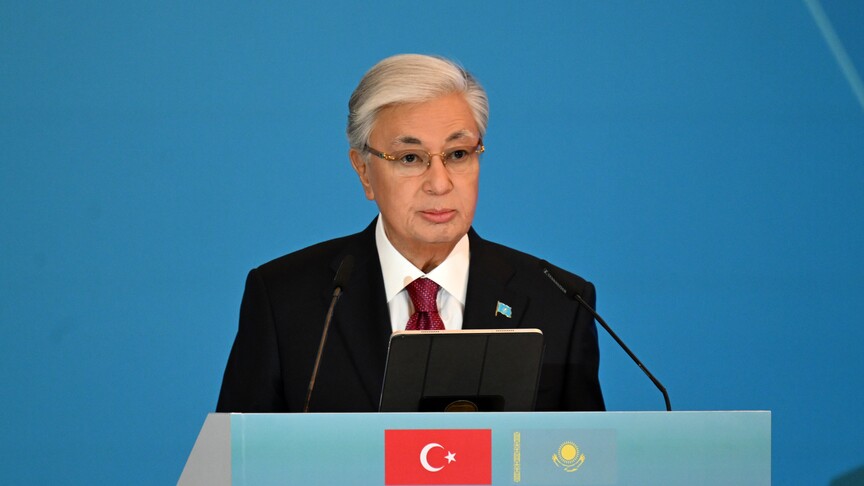
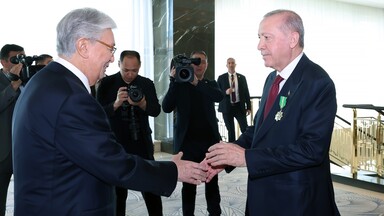
Tokayev made the remarks at the closing session of the Türkiye-Kazakhstan Business Forum, which he attended alongside Turkish President Recep Tayyip Erdogan.
Describing the forum as productive and comprehensive, Tokayev thanked the Turkish side for its support in organizing the event.
Stressing that Kazakhstan provides extensive support to Turkish companies, he said: “Today, around 3,800 Turkish companies are successfully operating in our country. Thousands of new jobs have been created through our joint efforts. Deepening cooperation in the industrial sector is of great importance to increase investment volume.”
Expressing confidence that the forum would further expand the number of joint ventures, Tokayev underlined that the Intergovernmental Commission between Kazakhstan and Türkiye should play a key role in this process.
Reviewing Kazakhstan’s economic performance, he noted that the country remains the largest economy in Central Asia, with GDP growing 6.5% last year to surpass $300 billion.
He added that Kazakhstan prioritizes education, science, and innovation, while constitutional reforms have guaranteed all forms of property ownership and strengthened investor protection.
Tokayev also highlighted Kazakhstan’s “Golden Visa” program, saying it offers investors tax and migration advantages.
Kazakh, Turkish business communities implement projects worth $7.6B
He noted that Kazakhstan's and Türkiye’s business communities have implemented 142 joint projects worth a total of $7.6 billion to date.
Among them, he cited projects by Turkish firms, including YDA Holding, Panelsan, Betek Boya, and Aksa Energy, which commissioned a modern power plant in the Kyzylorda region.
Tokayev said the Astana International Financial Centre has become one of the leading financial hubs in the region, hosting more than 5,600 companies from around 90 countries, including 73 Turkish firms.
Emphasizing the importance of transport and logistics cooperation, he said Kazakhstan serves as a key transit hub between China and Europe, with about 85% of cargo traffic passing through the country.
Middle Corridor freight volumes increase fivefold
He also noted that freight volumes along the Trans-Caspian International Transport Route, known as the Middle Corridor, have increased fivefold in recent years.
Container transportation rose by 36% in 2025, while capacity is expected to reach 10 million tons in the near future.
Tokayev said Kazakhstan is developing a “Smart Cargo” digital platform to improve transit management and highlighted plans to integrate the Middle Corridor with the TRIPP initiative.
He noted Turkish involvement in transport infrastructure, including the modernization of Almaty International Airport by TAV Airports Holding and a planned logistics center by S System Logistics at Aktobe Airport.
On agriculture, he said Kazakhstan is among the world’s largest grain exporters, producing 27 million tons last year, with exports up 1.8 times over five years.
He also cited planned Turkish investments in grain processing, gelatin, and greenhouse projects and said Kazakhstan is ready to export halal-certified meat products to Türkiye.
Turning to health care and pharmaceuticals, Tokayev said Turkish pharmaceutical firms have opened production facilities in Kazakhstan, while YDA Group is building hospitals in Turkistan and Petropavl.
He highlighted Kazakhstan’s focus on digitalization and AI, including a new ministry, two supercomputers, and the Alem AI center in Astana, adding readiness for joint projects with Turkish companies in AI, fintech, cybersecurity, and digital services.
He also noted Kaspi.kz’s acquisition of Hepsiburada’s majority stake and Freedom Holding’s expansion in Türkiye.
*Writing by Fatma Zehra Solmaz from Istanbul