The Mecca defense agreement has launched a process to establish a "new security and cooperation architecture" in the region, Turkish Foreign Minister Hakan Fidan said Monday.
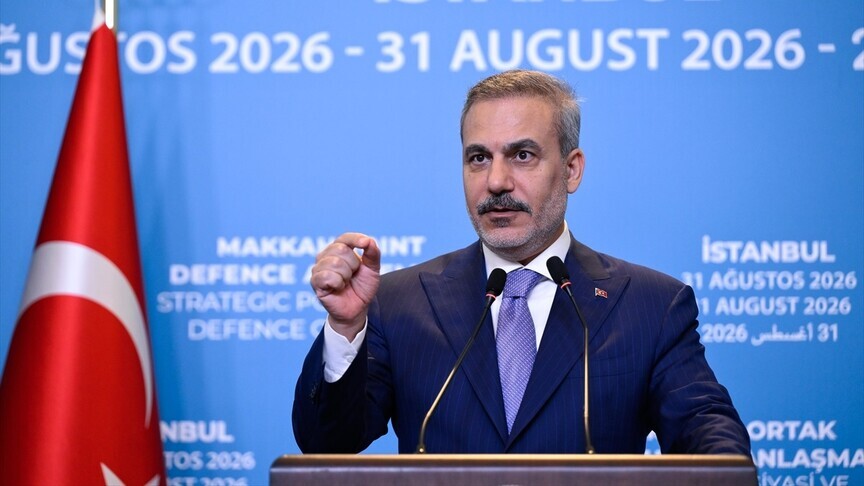
"With this agreement, the process of testing a new security and cooperation architecture in our region has begun," Fidan said, speaking at a news conference in Istanbul following the first meeting under the trilateral agreement between Türkiye, Pakistan and Saudi Arabia.
Regional countries urgently need to act together for security, stability, prosperity and lasting peace, he added.
Fidan attended the meeting at Istanbul's Ciragan Palace alongside Turkish National Defense Minister Yasar Guler and Chief of General Staff Gen. Selcuk Bayraktaroglu.
Pakistan's delegation included Foreign Minister Mohammad Ishaq Dar, Defense Minister Khawaja Muhammad Asif and army chief Field Marshal Asim Munir.
Saudi Arabia was represented by Foreign Minister Faisal bin Farhan, Defense Minister Khalid bin Salman and Chief of General Staff Gen. Fayyadh bin Hamed Al-Ruwaili.
Fidan said the agreement was signed by Türkiye, Pakistan and Saudi Arabia under the leadership of President Recep Tayyip Erdogan, describing it as a historic step based on regional ownership.
"The agreement is a product of the understanding of regional ownership. As we have always stated, attempts to bring solutions to our region from outside do not provide remedies to our problems; on the contrary, they can lead to heavy costs being paid," he said.
The minister said the first meeting of the Strategic Political and Defense Committee, established under the Mecca Joint Defense Agreement, brought together the foreign and defense ministers and chiefs of general staff of all three countries. The participants discussed concrete steps to implement the agreement, he said.
"As of today, we have also begun work to establish the institutional structure envisaged by the agreement. First of all, we agreed on the official name of our alliance. The official name of our alliance is the Mecca Defense Alliance," Fidan said.
The alliance's secretariat is planned to be established in Riyadh, while the countries agreed that its first secretary-general would be Pakistani, Fidan said. He added that the meeting produced preliminary decisions on when and how steps toward institutionalizing the alliance would be taken.
Fidan said the agreement allows other countries to join the alliance, but discussions would be needed with both prospective members and existing members on the conditions, procedures and standards for accession.
He said work is underway on a roadmap for the accession process.
"The alliance was established with the aim of expanding. But at the outset, its foundations need to be laid very well, and its institutionalization also needs to be carried out very well," Fidan said, adding that Saudi Arabia and Pakistan also share this sensitivity on the issue.
Fidan said the three countries agree on the need to build a strong and institutionalized structure capable of addressing challenges and bringing stability, peace and prosperity to the region, while also expanding the alliance over time.
He stressed that the alliance is not directed against any country and is open to all regional states that respect its core principles.
"With a vision of a safe, stable and prosperous future, this alliance is defense-based. The alliance is based on international law principles such as respect for the sovereignty and territorial integrity of states and non-interference in their internal affairs. We want to emphasize once again here that the alliance is not against any state; on the contrary, it is open to all states in our region that adhere to these fundamental principles," Fidan said.
He said alliance members hope to advance its peaceful vision together with other friendly countries that share the principles at the heart of the agreement.
Fidan also stressed that the alliance does not remove or replace Türkiye's obligations arising from NATO and other alliances and agreements. "I would like to state that the alliance does not eliminate or replace our country's obligations arising from NATO in particular and other alliances and agreements. It is complementary to all of them," he said.
A potential new ally should join a well-established and effectively functioning structure, he said.
"We are now working together to complete the difficult part, which is the establishment phase," Fidan added.
Fidan added that greater stability would create an environment conducive to more investment and development.
He said the three countries had demonstrated through the meeting that they were prepared to assume responsibility for regional peace, security and stability, adding that Türkiye would continue close cooperation and coordination with friendly countries, particularly Pakistan and Saudi Arabia.
Asked about Israel viewing Türkiye as a "strategic threat," Fidan said Israeli Prime Minister Benjamin Netanyahu and his supporters have increasingly used rhetoric targeting Türkiye, President Recep Tayyip Erdogan and other Turkish officials as Israel heads into election period.
"We have been following this from the beginning," he said.
Fidan described Netanyahu as having become a "common enemy of humanity, the international community and security," calling him a "criminal" and a "perpetrator of genocide" who should not be taken seriously.
He said Netanyahu, his "mentality" and those acting alongside him pose a threat not only to Türkiye but to global security.
"It would be a major mistake to think of this as only Türkiye's problem," Fidan said.
He called on the international community to stop Netanyahu, arguing that his policies are harming the region, Israel, the Jewish people and the wider world.
Fidan said Netanyahu's remarks indicate that he does not want the establishment of a Palestinian state or an end to ongoing occupations in countries across the region.
"He wants the genocidal and occupying approach, which endangers regional and international security, to continue," Fidan said.
"This is a major threat not only to us, but to the entire region and the international community. The international system must fight against this threat, this Netanyahu threat," he added.
Asked what role the Mecca Defense Alliance could play in addressing regional security problems, Fidan said the absence of genuine alliances and trust in the region had created numerous areas of instability.
"When there is no genuine alliance and trust in our region, there have been many problem areas arising from the climate of distrust, particularly regarding regional security. The regional security problems that emerge in our region unfortunately also have a global impact. Therefore, events suddenly become situations in which global actors, in addition to regional actors, become involved," he said.
Fidan said the solution was for regional countries to take ownership of these problems.
"When the countries in the region come together, respect each other's sovereignty, territorial integrity and security, and make commitments to this effect, and go further by establishing a structure that will protect these commitments, there will no longer be a problem in terms of regional trust and alliance relations," he said.
The minister said that if countries sincerely committed to these principles, "85-90%" of the region's problems should be resolved immediately.
Fidan said the region had abundant resources and opportunities but that its people continued to suffer because of a lack of stability and trust. "We see this alliance as the key to peace, stability and prosperity. Our intention is in this direction, and God willing, our actions will also be in this direction," he said.
Fidan was also asked about threats to navigation safety in the Black Sea and attacks on commercial vessels.
"This really continues to be a major problem. It is becoming a major problem not only for Black Sea security but also for global food security," he said.
He said many countries had sought Türkiye's support in resolving the issue because grain products that should be coming from Russia and Ukraine were unable to reach global markets.
"We have prepared a study. We are in contact with both sides on the basis of this work. As we did in the past, God willing, if the necessary conditions are created, we are working to reach another agreement similar to the Grain Deal," Fidan said.
He said the Russia-Ukraine war had evolved from a war of attrition into a war of destruction, stressing the need to prevent the increasingly destructive damage inflicted by the two sides on each other and the wider region.
The minister offered condolences to the relatives of the victims who lost their lives after a passenger ship capsized off Girne Port in the Turkish Republic of Northern Cyprus (TRNC) and wished a speedy recovery to the injured. He also extended condolences to the Turkish people and the people of the TRNC.
news_share_descriptionsubscription_contact

contact_the_ombudsman
is_there_an_error_in_this_story