Turkish Ambassador to the Vatican Fahrettin Altun said Türkiye’s mediation initiatives and the Vatican’s humanitarian efforts complement one another, highlighting broad convergence between Ankara and the Holy See on major international issues.
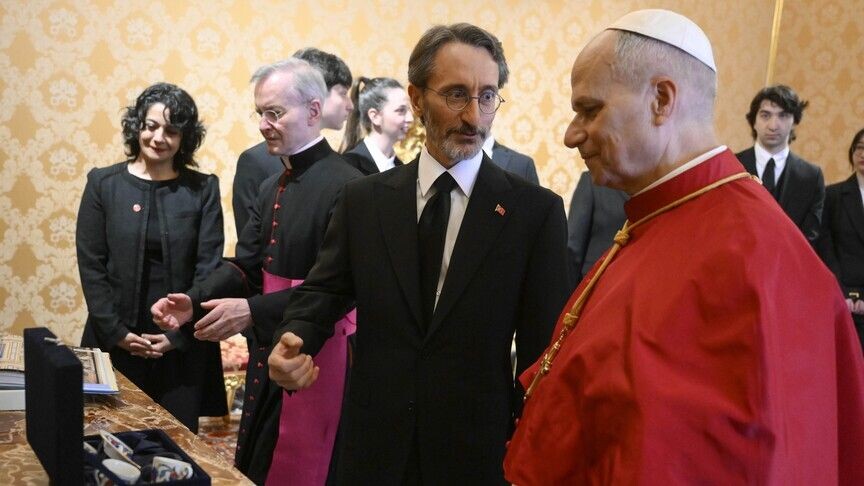
Altun, who was appointed by President Recep Tayyip Erdogan as Türkiye’s ambassador to the Vatican in March and formally assumed his post after presenting his credentials to Pope Leo XIV in April, spoke to Anadolu about bilateral relations and shared diplomatic priorities.
“It is a great honor and an equally great responsibility to serve as the Republic of Türkiye’s ambassador to the Vatican,” Altun said.
He noted that Türkiye-Vatican relations rest on a long-established foundation, which provides an important advantage for bilateral ties.
Altun said Türkiye’s foreign policy vision places significant emphasis on engaging influential global actors in efforts to resolve major international crises, including the war in Gaza, the Russia-Ukraine conflict and tensions between Iran and the US.
“The Vatican is one of these actors. The Pope is not only the head of the Vatican State but also the spiritual leader of approximately 1.4 billion Catholics worldwide,” he said.
According to Altun, the Vatican also sees value in strengthening relations with Türkiye as an increasingly influential regional and global actor.
He pointed to Pope Leo XIV’s decision to make Türkiye his first official foreign destination as evidence of the importance the Vatican attaches to bilateral ties.
“Following that visit, bilateral relations gained significant momentum and created opportunities for cooperation on regional and global issues,” he said.
Altun said the embassy would continue working to deepen relations, promote joint initiatives aimed at peace, environmental protection and humanitarian values, and increase awareness of Türkiye’s cultural and historical heritage within Vatican circles.
Warm reception from Vatican officials
Altun said he presented Erdogan’s letter of credence to Pope Leo XIV only 10 days after arriving in Rome, describing the swift process as a reflection of the Pope’s goodwill toward Türkiye and its president.
Following the ceremony, he held a private meeting with the Pope in what he described as a constructive and positive atmosphere.
“We exchanged views on bilateral relations, ongoing wars, conflicts and crises around the world, as well as the erosion of the rules-based international order,” Altun said.
He also praised the reception he received from senior Vatican officials, including Cardinal Pietro Parolin, the Vatican secretary of state; Archbishop Paolo Rudelli, secretary for general affairs; and Archbishop Paul Richard Gallagher, secretary for relations with states and international organizations.
“They welcomed me very warmly from the moment I arrived in Rome and provided a secure and peaceful working environment,” he said.
Altun added that Türkiye’s peace initiatives are closely followed in the Vatican and that the Holy See’s positive assessment of Türkiye’s regional peace efforts and humanitarian activities provides an encouraging basis for deeper cooperation.
Shared views on global challenges
Asked about the similarities between Türkiye’s and the Vatican’s approaches to international issues, Altun said the two sides largely share common perspectives.
“We are in agreement on the need for lasting peace in the Middle East, the protection of the status of holy sites and safeguarding civilians’ right to life,” he said.
“Türkiye’s mediation efforts in the Ukraine war and the Vatican’s humanitarian initiatives are complementary in nature.”
Altun also said both Türkiye and the Vatican view the spread of disinformation and the decline of reliable information as a growing threat.
He noted that both sides are concerned by the rise of racism, far-right extremism, xenophobia, Islamophobia and anti-Christian sentiment.
Vatican appreciates Türkiye’s foreign policy
Altun said Turkish foreign policy is guided neither by passive neutrality nor by rhetoric that irresponsibly escalates tensions.
Instead, he described it as a policy centered on humanitarian law, strategic autonomy, regional ownership and active diplomacy aimed at building a fairer international system.
“Turkish foreign policy, which plays a stabilizing role in its region and seeks a more just world, is generally appreciated by the Vatican,” he said.
He added that Pope Leo XIV’s recent remarks on the need for a rules-based international order closely align with President Erdogan’s long-standing message that “a fairer world is possible.”
Pope thanks Türkiye for hospitality
Altun said Pope Leo XIV personally expressed his gratitude for the hospitality shown during his visit to Türkiye, describing the trip as an unforgettable experience.
“The Pope said he was very pleased with the visit and conveyed his sincere thanks to President Erdogan and the Turkish people,” Altun said.
He argued that the Pope’s visit demonstrated to the world that interaction among different religions and cultures can translate into a practical model of coexistence based on tolerance.
At a time when the international system is facing profound crises involving peace, justice, truth and faith, Altun said cooperation between Türkiye and the Vatican could contribute positively to global stability.
He also emphasized the importance of joint efforts against discrimination, intolerance and growing Islamophobia worldwide.
Recalling first lady Emine Erdogan’s visit to the Vatican last year for a conference hosted by the Pontifical Academy of Social Sciences, Altun said Vatican officials continue to remember the meeting positively and that high-level contacts between the two sides are expected to continue in the future.