Şeyma Erkul Dayanç
24 September 2026•Update: 24 September 2026
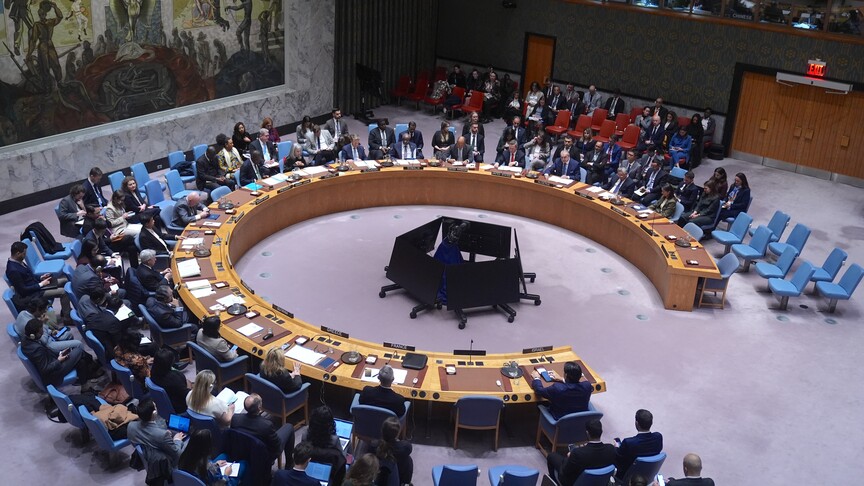
The Uniting for Consensus group on Thursday reiterated its opposition to creating new permanent seats on the UN Security Council, calling instead for an expansion of elected membership, including longer-term rotational seats.
The group, comprising Argentina, Canada, Colombia, Costa Rica, Italy, Malta, Mexico, Pakistan, South Korea, San Marino, Spain and Türkiye, issued a joint statement during the high-level week of the 81st session of the UN General Assembly.
“Our shared goal is to work for a more representative, democratic, transparent, accountable, and effective Council, capable of responding to today’s global challenges,” the statement said.
The group said expanding elected membership would “contribute to the maintenance of international peace and security while preserving the principle of sovereign equality.”
“Such expansion would be the fairest and most democratic way to address Africa’s historical underrepresentation,” as well as that of other underrepresented regions, including Asia-Pacific, Latin America and the Caribbean, it said.
The group “reiterates its opposition to the creation of new permanent seats,” according to the statement.
It also reaffirmed its support for the Intergovernmental Negotiations (IGN) process, calling it “the only legitimate and inclusive platform led by Member States to discuss Security Council reform.”
“The path forward must be based on dialogue, flexibility, and compromise,” the statement said, calling for the reform process to address the “five sets of interconnected issues” and seek “the broadest possible political consensus.”
On the veto, the group said it supported its abolition but called for immediate steps to limit its use in specific circumstances.
“While supporting the abolition of the veto … we should act jointly immediately to move toward its limitation in specific circumstances, including but not limited to mass atrocities and war crimes,” it said.
The statement cited the Franco-Mexican Initiative and the ACT Code of Conduct as existing initiatives aimed at limiting the use of the veto.
The group said it was ready to work with the UN General Assembly president, future IGN co-presidents and all member states during the 81st session to advance comprehensive Security Council reform.