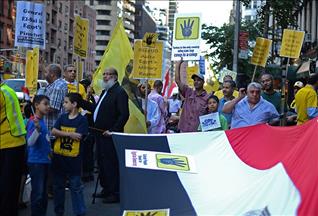
9 weeks on, Morsi supporters remain defiant
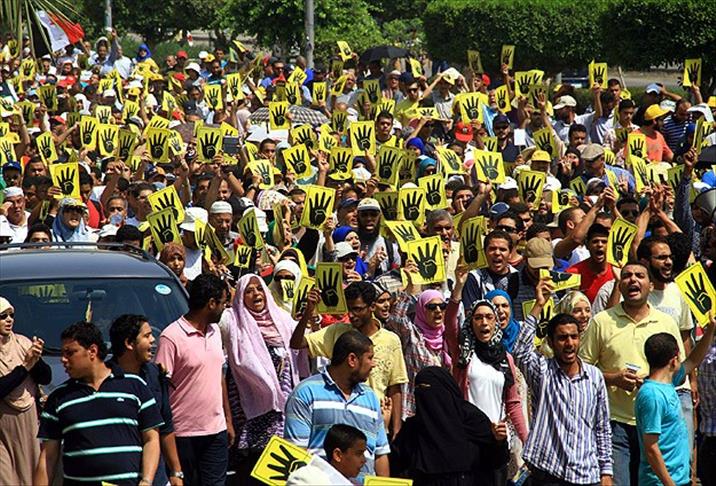
CAIRO (AA) – As their protests enter their ninth consecutive week, thousands of opponents of the Egyptian military's July 3 ouster of elected President Mohamed Morsi showed no signs of backing down as they flooded the streets on Friday.
"I'm here for my vote, which has been stolen," Eman al-Shayeb, a 21-year-old Cairo University student, told Anadolu Agency.
She joined thousands of determined marchers who set out from Giza's Imbaba district through a number of main streets to the heavily-barricaded upscale Mohandiseen neighborhood.
There was an air of perseverance as most protesters proudly waved the now-famous bright yellow signs bearing the symbol of Rabaa al-Adawiya Square – the site of a major pro-Morsi sit-in that was violently dispersed by security forces on August 14.
Hundreds of protesters were killed and thousands injured in the several-hour dispersal of Rabaa and Nahda Square, another major protest site.
Some protesters held posters depicting Morsi, Egypt's first democratically elected president, who was ousted by the military on July 3.
Al-Shayeb, who spent a nightmarish day in detention after being arrested during the violent Nahda dispersal, said she would go on protesting "as long as it takes."
"I saw death with my own eyes; I'm not afraid anymore," she added defiantly.
Like her, many protesters have been taking part in rallies for several weeks now with the hope, and confidence, that they will eventually win – even if it takes some time.
Manal, a 50-year-old science teacher, is ready to keep up the fight "for years."
"Military regimes destroyed this country for the last 60 years," she told AA.
"During Morsi's year in office, the Mubarak regime continued to defy his rule."
"But we have a right and we will win it back eventually," she insisted.
"As long as there are protests on the streets against the disgrace of deposing an elected president this way, I will be there."
- Biased
As the hours-long march proceeded, one protester beat a drum to give rhythm to the chants, most of which blasted Egypt's new military-backed rulers.
Thirty-seven-year-old Sherif believes the protesters are being subjected to grave injustices, not least of which is being ignored – even ridiculed – by the pro-army media.
"If [Defense Minister Abdel-Fatah] al-Sisi came on television and called on whoever opposes the interim government to hit the streets – and promised not to barricade the streets or hurt or arrest anyone, and that the media wouldn't downplay their numbers – everyone would see our true weight," he told AA.
"They can't pretend to ignore our influence for long," agreed Ahmed, a 24-year-old engineering student.
Several pro-Morsi demonstrations have turned violent after being attacked by security forces or unidentified assailants.
Ahmed Fathi, 42, complains about stereotyping by both the army-installed administration and the pro-army media, both state-run and private.
Like many at the demonstration, he insists their struggle transcends the ousted president.
"I never even supported the Brotherhood," he told AA, dismissing the misperception that all protesters are members of Morsi's Muslim Brotherhood.
"But to support al-Sisi is to dip your hand in your brother's blood," Fathi insisted.
He cites a government decision to close down the Qatar-owned Mubashir Misr satellite news channel and other channels that used to cover their rallies.
"Why would the government shut down these channels if it didn't have anything to hide?" he asked.
Coverage of pro-Morsi rallies – and estimates of their size – is difficult to get from state and private media, which generally ignore the protests or downplay their numbers.
The media has, instead, launched a campaign of its own against Morsi supporters, lumping them together as "terrorists" along with the unknown militants who have attacked police stations and army facilities in recent weeks.
"They deceived you into thinking your next-door neighbors were terrorists," protesters chanted as they looked up at people watching them from their balconies.
"I deleted all the pro-Mubarak satellite channels from my receiver," said Manal, the science teacher. "I can't stand even coming across them."
- Self-restraint
As the 7pm curfew approached, the air became tense at the march's front lines.
Some demonstrators formed a chain with their bodies and tried to push back a group of protesters to prevent them from coming too close to a police barricade.
It was a recurring scene for those used to being on the front lines.
"Every week they [police] would send infiltrators to the front lines to incite demonstrators to attack the barricade," one member of the human chain told AA.
"We don't want to fall into the trap," he asserted. "Last week they beat us here and the media accused us of eliciting the attack."
Some 500 meters away, a few policemen – along with dozens of plain-clothed men – stood in anticipation.
But protesters dispersed into smaller groups and marched their own way, chanting less loudly.
"We try to get people to leave before the curfew to distance ourselves from the thugs," said Fathi, the 42-year-old protester, as he began to move.
He said he would be back the coming Friday, however.
"One day, the people will be united again," he said as he looked back to see if police were approaching.
"I have faith; I'm sure of God's victory."
englishnews@aa.com.tr