By Mainul Islam Khan and Kaamil Ahmed
DHAKA, Bangladesh
Bangladesh's Jamaat-e-Islami party have called for a shutdown after one of their most senior leaders was executed for war crimes on Saturday.
Mohammad Kamaruzzaman, the party's former Assistant Secretary General, was executed on Saturday after choosing not to seek a presidential pardon.
His execution was met with celebrations by many in Bangladesh who believed it delivered justice for people killed by the Pakistani army and local allies, which allegedly included Jamaat-e-Islami, during Bangladesh's war of independence in 1971.
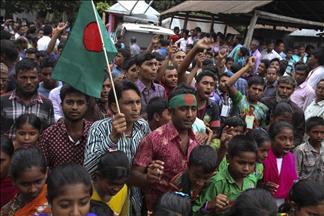
Gonojagoron Mancho, or national awakening platform, a group of activists that supported the execution, welcomed Kamaruzzaman's hanging at celebrations in the capital, Dhaka.
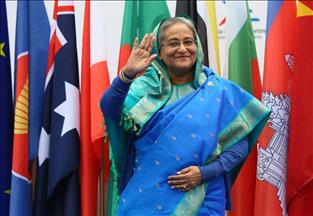
"I thank the prime minister for executing death penalty of two war criminals braving all sorts of pressures, local and international," said one of the group's leaders Imran H Sarkar, referencing the execution of another Jamaat-e-Islami figure, Abdul Quader Molla, in 2013.
A statement released by Jamaat-e-Islami and signed by their acting leader Maqbul Ahmed called for a day of prayers on Sunday followed by a nationwide shutdown -- or hartal -- on Monday.
They said the hanging of the former Assistant Secretary General Mohammad Kamaruzzaman was a "malign conspiracy" and claimed that he had not been given a fair trial.
They said he wasn’t responsible for the crimes he was accused of, including mass murder in the village of Shohagpur, which has since been described as the "village of widows."
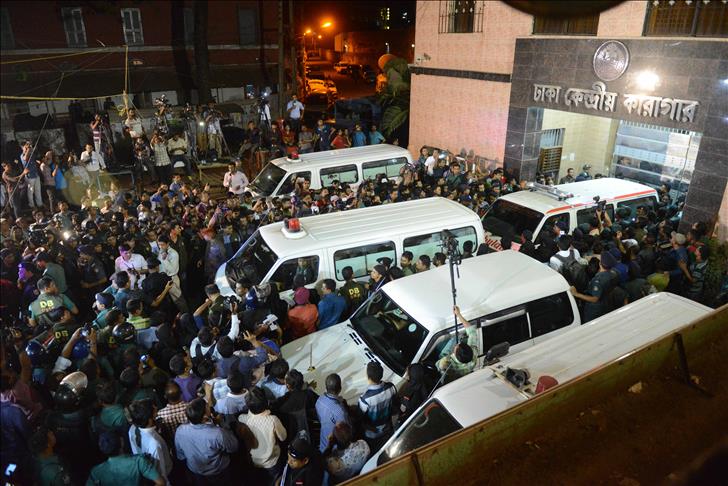
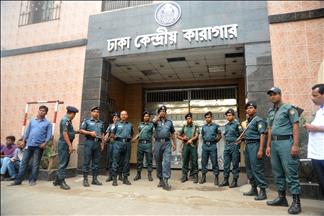
Local online newspaper bdnews24 quoted Dhaka Metropolitan Police Commissioner Asaduzzaman Mia saying the execution was carried out at 10.01 p.m. in Dhaka Central Jail.
Televised images from outside the jail have shown an ambulance leaving to take Kamaruzzaman's body to its burial site.
The execution took place after Kamaruzzaman chose not to confess to committing war crimes, a condition for being granted mercy, after his petition for a trial review was rejected by the Supreme Court on Monday.
"He told us that only God can take or give a life, not a human being. That's why he chose not to ask for the president's mercy," Kamaruzzaman's son Hasan Iqbal told The Anadolu Agency.
Iqbal said they were not informed by jail authorities that the execution had been carried out but learnt about it through the media.
He said the body will not be handed over to the family until it is taken to Kamaruzzaman's home district of Sherpur, north of the capital Dhaka, for burial.
"We are not happy about it. It is the standard procedure to be handed the body. We have not been able to contact [jail authorities]," he said.
Locals in Sherpur who fought for independence from Pakistan had earlier objected to Kamaruzzaman being buried in the area but later withdrew their complaints.
After it became clear Kamaruzzaman would be executed, he was inspected by doctors and then visited by a religious cleric before the execution was carried out.
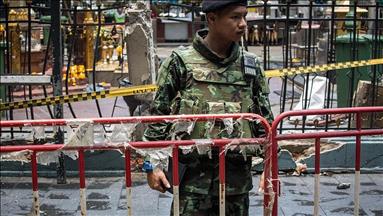
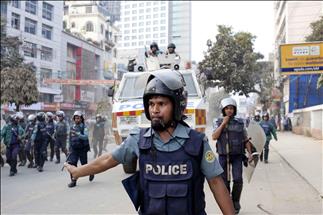
Units of the Bangladeshi Border Guard, a paramilitary security force, have been deployed to prevent feared disturbances in the country's second-largest city Chittagong while police and elite Rapid Action Battalion forces were stationed outside Dhaka Central Jail.
Kamaruzzaman was sentenced to death in May 2013 by the International Crimes Tribunal, a domestic court formed to investigate 1971 war crimes, and had an appeal rejected by the Supreme Court in November.
He was the second person executed for war crimes after another leading Jamaat-e-Islami figure, Abdul Quader Molla, was hanged in December 2013.
The party's leader Motiur Rahman Nizami was also sentenced to death in November, as was another leading senior official, Mir Quasem Ali.
Up to 3 million people were killed by the Pakistani army and local allies during the independence war, according to Bangladesh's official statistics.
The tribunal has come under heavy criticism from opposition political parties and human rights organizations that claim the process was unfair and politically motivated.
Shortly before the execution on Saturday, the U.S. State Department released a statement saying that while the tribunal's procedures had improved, there were still improvements to be made to meet the obligations of international agreements.
"Until these obligations can be consistently met, it is best not to proceed with executions given the irreversibility of a sentence of death," said the statement.
Human Rights Watch, who have previously criticized the tribunal, had earlier called on Bangladesh's government to stop the execution.
“Human Rights Watch has long supported justice and accountability for the horrific crimes that occurred in 1971, but these trials need to meet international fair trial standards to properly deliver on those promises for the victims,” the organization's Asia director, Brad Adams, said in a statement released on Monday.
“The death penalty is an irreversible and cruel punishment that is made even worse when the judiciary fails to fully review such sentences,” he said.