Bees prove robust tool in warding off Kenyan elephants
A new weapon in human-elephant skirmishes helps save lives and livelihoods on both sides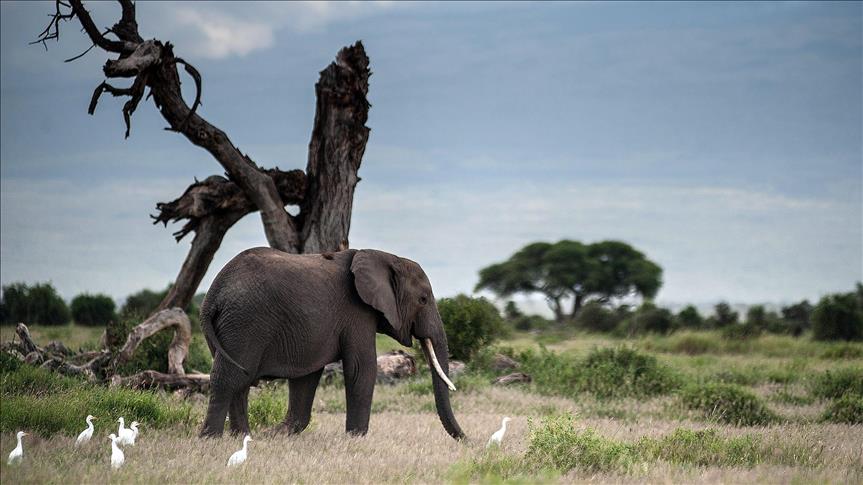
By Magdalene Mukami
NAIROBI, Kenya
In central Kenya, farmers live in constant fear of raiders – not your normal marauders, but 6-ton water- and plant-powered bulldozers that raid farms, destroying everything in their path.
Since time immemorial, farmers and elephants in Africa and India have always clashed. Elephants stray into villages in search of food and water due to harsh climatic conditions. In Kenya elephants are not confined to parks, but are allowed to roam in the wild, often running into humans who farm close to their migration routes.
“I’ve seen an elephant fell a tree just to eat its green leaves at the top, I mean not even a car has such destructive force. She folded her trunk around the tree, shook it violently until all the birds flew away, and then it just fell. It ate the leaves and within minutes it had vanished,” John Mwangi, a farmer in Laikipia who has clashed with elephants, told Anadolu Agency.
There is a saying among farmers in Kenya’s Nanyuki and Laikipia counties that elephants are “nature’s bulldozers.”
Last month, the Kenya Wildlife Service was called in to help disperse a herd of 35 elephants which had invaded farms in the town of Voi, and once they had destroyed all the remaining crops in the area.
Rangers from the Kenya Wildlife Service were able to drive the herd back to the Tsavo National Park, a place well known for constant human-wildlife conflict.
“They used to attack us at least two times a week,” Mwangi said. ”They would smash water tanks, drink the water, and then go the farms. There they would eat everything, and some people have been unlucky during such crop raids, and lost their lives.”
The World Wide Fund for Nature (formerly World Wildlife Fund or WWF) says that in the past seven years, over 200 people in Kenya have been killed by elephants.
Farmers and conservationists have come up with a range of techniques to reduce human-wildlife conflict in Laikipia. One of the cheapest and most beneficial has been to erect beehive fences.
“Elephants are afraid of bees. Since we started this project, there have been few to no attacks in this area,” farmer Mary Wanjiru told Anadolu Agency.
“Yes the elephants are at times seen but they never cross to this side of my farm. They can see the plants, they can see the water, but they are just afraid to cross the fence posts which have beehives,” she added.
"The poor farmers from Laikipia are killing two birds with one stone. From erecting beehive fences, they are able to get additional income from honey sales and also deal with the problem of marauding elephants which used to destroy their only source of livelihood."
“My children are in school because of my farm and because of the money the honey gives me. We love elephants, we want them here. They are our pride and heritage. If every farmer was to do this, I doubt that you would ever hear of cases where elephants are killed by farming communities ever again.”
Myth or fact?
To confirm whether this was myth or fact, Anadolu Agency spoke to 73-year-old zoologist Iain Douglas Hamilton, a prominent elephant researcher, on whether elephants have a strong fear of bees.
Douglas, the founder of Save the Elephants, an organization which has served as a protector for elephants since 1993, confirmed to Anadolu Agency that elephants have indeed helped to reduce conflict between elephants and humans.
“Farmers need to protect their crops in some way. A number of ideas have been tried, but the one that farmers connect with is the amazing work of exploiting the fact that elephants fear honeybees,” the researcher, who has worked with the animals for 50 years, told Anadolu Agency.
“It is a curious fact that elephants avoid trees which have beehives, and when we noticed that we did some scientific work to prove it, and then a brilliant scientist known as Dr. Lucy King set up an experiment to see if she could create beehive fences. She tried this first in Samburu (North Kenya) and then later in Tsavo (the largest park in Kenya), and it has been very successful,” Douglas added.
Elephant crop raids have led communities living near elephant corridors to resort to shooting and poisoning the animals who stray from their natural territory in an effort to protect their livelihood and families.
Iain says that it is a fact that honeybees in Kenya are saving the lives of numerous elephants while also changing the lives of poor farmers for the better.
Farmers link these beehives together and connect a wire. If the elephants come at night and shake the fence, the bees come rushing out. Once they hear the bees buzzing, they run away in fear of getting stung.
The researchers have tried different sounds, including music and natural sounds, but only the buzzing of bees has proven to work as pachyderm deterrent.