Merve Aydogan
08 July 2026•Update: 08 July 2026
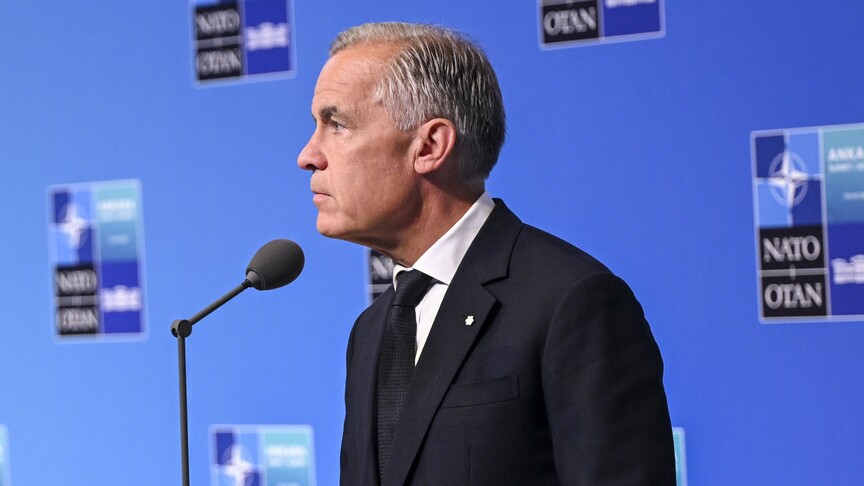
Canadian Prime Minister Mark Carney on Wednesday backed the latest US response to Iran, calling Tehran's actions "irresponsible" and claiming Washington "has responded as appropriate" to restore conditions for a ceasefire during a news conference on the sidelines of the NATO summit in Ankara.
Arguing that Iran violated a ceasefire reached as part of a peace deal by attacking infrastructure in Qatar and Saudi Arabia and threatening shipping, Carney said,"That's irresponsible. It's not right, and the United States has responded as appropriate to look to stop this behavior and put in place these conditions to reestablish ceasefire," describing the situation as “evidently a fragile situation.”
Asked whether there was a mismatch between NATO leaders' focus on strengthening the alliance's capabilities and US President Donald Trump's emphasis on allied participation in the Iran war, Carney stressed that NATO “is a defensive alliance, it's not an offensive alliance.”
He said Canada was not directly asked to support the US operation against Iran and lacked the capabilities to play a role in that theater.
"The President of the United States had a desire for more offensive support with respect to the Iran conflict, and it wasn't a direct ask of Canada. We didn't have the capabilities. We're not relevant from a base perspective in that theater, and that's between him and specific NATO allies," he said.
Carney also said NATO is undergoing "a process of shifting burdens" away from the US toward Europe and Canada, arguing that allies increasingly recognize the need to assume greater responsibility for collective defense.
"It's not just that (Trump) he's winning the argument, he's won the argument. Countries recognize that they need to take more responsibility," said Carney.
“Obviously, with greater capacity, we have to spend more. We have to build these capacities.”
Meanwhile, Canada concluded its participation at the summit in Ankara on Wednesday, with Carney announcing new defense partnerships, industrial investments and support for Ukraine.
According to a statement from his office, Canada and its allies signed a declaration at the summit reaffirming their commitment to NATO and transatlantic security.
The statement said Canada is on track to meet NATO's target of investing 5% of GDP in defense by 2035, with investments including a new submarine fleet, the world's second-largest fleet of icebreakers and new aircraft, missiles and cyber defenses.
Carney underlined new defense partnerships and contracts, including an agreement-in-principle with Telesat to provide military satellite communications in the Arctic, expected to result in a multibillion-dollar investment in Canada's defense sector.
Canada also signed an $800 million contract with Norwegian company Kongsberg Defence and Aerospace to procure Joint Strike Missiles for the Royal Canadian Air Force, updating its Light Utility Vehicle procurement strategy to limit the tender to two Canadian suppliers.
Ottawa also agreed to open technical negotiations to join the NATO Innovation Sub-Fund and will host the 2027 NATO Industry Forum, said the statement. Carney also announced the launch of negotiations toward a Canada-Germany Strategic Partnership Agreement and a comprehensive Canada-Türkiye free trade agreement, with trade between Canada and Türkiye reaching $4.3 billion in 2025.
The statement noted that eight countries expressed support for the Canadian-led "Defence, Security and Resilience Bank."
Carney also announced that a portion of Canada's approximately $2 billion in military assistance for Ukraine will fund $475 million in ammunition, nearly $400 million for 35 armored combat support vehicles and $50 million for IT and engineering equipment.
"The threats facing us today are real and they will be met by a Canada prepared to defend our interests, our citizens, and our Allies. We are rapidly scaling our capabilities through historic investments in new submarines, icebreakers, aircraft, and cyber defences and strengthening our partnerships with Allies around the world," Carney said in the statement.
"Today, we are a stronger, more capable member of NATO with greater ability to advance its mission of collective security. This is a strong, confident Canada taking full responsibility for our defence, for a more secure and more prosperous world," he added.