Fresh threats from US President Donald Trump toward Cuba have brought renewed attention to one of the Western Hemisphere’s longest-running geopolitical standoffs, with tensions once again centering on regime change, sanctions and strategic influence.
Trump has escalated his rhetoric in recent weeks, saying he could “have the honor of taking Cuba,” as the country struggles with severe fuel shortages that have crippled infrastructure and public services.
The energy crisis, triggered by a US-imposed oil blockade and the collapse of Venezuelan support, has pushed the island into widespread blackouts and economic disruption.
The crisis has raised humanitarian concerns. The World Health Organization has warned that fuel shortages are disrupting hospital operations, including emergency and intensive care, as the country’s energy system falters.
Much of Trump’s current foreign policy has been characterized by unpredictability and aggression — he has threatened a NATO ally with invasion, suggested withdrawing from the alliance altogether, threatened Iran with civilizational destruction hours before announcing a ceasefire and floated making Canada the 51st state.
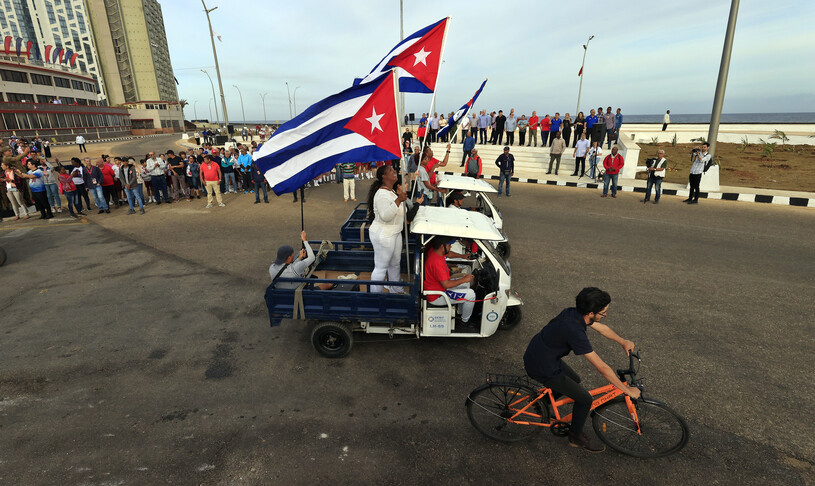
Although the Cuban government asserts it will not bow to US pressure, analysts say the island’s leadership is facing one of its most precarious moments in decades.
While policy approaches may shift, the underlying tensions between the two countries remain deeply rooted. Almost every US president since the Cuban Revolution has pursued some form of regime change policy toward Cuba.
From colonial-era ambitions to Cold War confrontation and intermittent attempts at rapprochement, US-Cuba relations have been defined by cycles of pressure and brief openings — dynamics that continue to shape the current moment.
US interest in Cuba dates back to the early 19th century, when the island’s proximity — just 90 miles (145 kilometers) from Florida — made it strategically significant.
As Washington expanded its regional influence with the Monroe Doctrine, US leaders increasingly viewed Cuba as a natural extension of their sphere. In 1823, founding father and US President Thomas Jefferson said it would be a “most interesting addition” to the country.
At the time, Cuba remained under Spanish rule.
Madrid rejected US offers to purchase the island in 1848, but unrest among Cuban nationalists and growing American economic interests deepened US involvement.
Tensions escalated in 1898 after the explosion of the USS Maine in Havana harbor, prompting the US to declare war on Spain.
The ensuing conflict and American victory saw Spain relinquish control over Cuba and American forces occupy the island until 1902. The US only formally granted independence under conditions that preserved its influence.
The Platt Amendment, embedded in Cuba’s constitution, gave the US the right to intervene militarily and secure naval bases, including Guantanamo Bay, effectively making Cuba a de-facto colony of the US.
Although the newly-proclaimed Cuban Republic was formally independent, the Platt Amendment caused repeated interventions. US troops were deployed to Cuba three times between 1906 and 1922 to quell protests, protect American economic interests and stabilize favorable governments.
The interventions fueled Cuban hostility towards perceived US imperialism.
In 1934, President Franklin D. Roosevelt repealed the Platt Amendment as part of a broader effort to improve relations in Latin America. This ushered in a period of closer economic ties, with trade and tourism expanding rapidly.
The 1940s and 1950s saw hundreds of thousands of American tourists visit the island annually. By 1958, approximately 67% of Cuba’s exports were destined for the US and US products accounted for 70% of the island’s imports.
However, that influence also brought controversy, particularly over corruption, inequality and the growing presence of organized crime in Havana.
After Cuban dictator Fulgencio Batista took power in 1952, he effectively allowed the mafia to transform Havana into a hub of gambling and racketeering in exchange for bribes.
This corruption and the inequality it helped exacerbate, combined with Batista’s consolidation of power and violent repression of dissent, bolstered support for the revolutionary opposition led by Fidel Castro.
The American government disapproved of Batista’s methods and imposed an arms embargo on Cuba in March 1958.
When Castro came to power the following year, the US quickly recognized his government. Relations deteriorated quickly, however, as Cuba began to nationalize US-owned assets without compensation.
Washington responded with sanctions, breaking diplomatic ties in 1961 and backing the failed Bay of Pigs invasion by Cuban exiles.
The confrontation deepened in 1962, when the US imposed a full trade embargo — still largely in place today — and the Soviet Union stationed nuclear missiles on the island, triggering the Cuban Missile Crisis, which brought the USSR and the US to the brink of war.
Although a nuclear confrontation was avoided, the episode cemented Cuba’s role as a key Cold War flashpoint and entrenched hostility between Washington and Havana. Cuban intelligence has said it foiled hundreds of CIA-backed plots to assassinate Castro.
Throughout the Cold War, the US sought to isolate Cuba diplomatically and economically, adding Cuba to the list of state sponsors of terrorism in 1982 due to its support of revolutionary movements in Latin America and Africa.
The period also saw waves of Cuban migration to the United States, driven by both political repression and economic hardship. As of 2022, over 2.4 million people of Cuban descent lived in the United States.
The collapse of the Soviet Union in 1991 plunged Cuba into a severe economic crisis, as it lost key trade and financial support.
Rather than easing pressure, the US tightened sanctions in the 1990s, targeting foreign companies doing business with Cuba and conditioning any relief on political change.
Despite economic hardship, investment in tourism and the Venezuelan alliance of the early 2000s helped Cuba’s political system endure.
Tensions remained high but stable until the presidency of Barack Obama, who moved to normalize ties.
Beginning in 2014, Washington eased travel and financial restrictions, restored diplomatic relations and removed Cuba from the list of state sponsors of terrorism. Obama’s 2016 visit to Havana marked the first by a sitting US president since 1928.
However, the rapprochement proved short-lived.
Under Trump, many restrictions were reinstated, and Cuba was redesignated as a state sponsor of terrorism. The Biden administration largely maintained pressure, with only limited adjustments.
Now, Trump’s return to office has coincided with renewed pressure on Havana, including a crippling oil blockade earlier this year and calls for leadership change. His administration’s broader regional strategy, including actions against Venezuela, has further heightened tensions.
Diplomatic negotiations designed to encourage de-escalation are underway, but the specter of regime change, which has haunted Cuba since the victory of the Cuban Revolution, remains.
news_share_descriptionsubscription_contact

contact_the_ombudsman
is_there_an_error_in_this_story