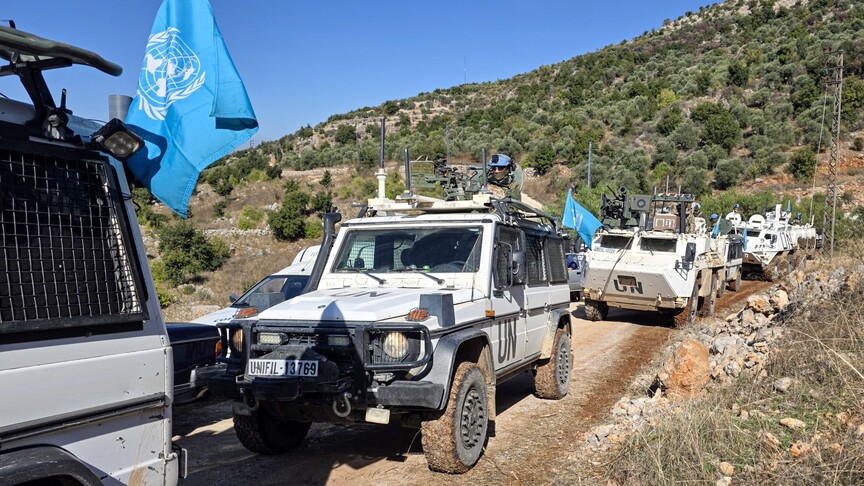
Security arrangements in southern Lebanon face growing uncertainty as the mandate of the UN Interim Force in Lebanon (UNIFIL) nears its end later this year, with no agreed mechanism yet in place to replace its monitoring and coordination functions.
Beirut insists that any future international presence remain under a UN umbrella, while Washington is pushing for changes to UN Security Council Resolution 1701 and a new arrangement with a different structure and mandate.
Amid divergent Lebanese, US and Israeli positions, analysts speaking to Anadolu warned of a potential security and operational vacuum if UNIFIL's mandate expires without an agreement on a successor mechanism.
US Ambassador to the UN Mike Waltz said during a visit to Beirut on Sunday that Resolution 1701 must be amended as discussions continue over a new international mechanism with a different structure and responsibilities.
He also said Lebanon could not function with two armies and expressed hope that Hezbollah would voluntarily surrender its weapons.
Hezbollah maintains that it is a “resistance movement” confronting Israel's occupation of Lebanese territory.
Waltz made the remarks after meeting Lebanese President Joseph Aoun, Parliament Speaker Nabih Berri and Prime Minister Nawaf Salam.
The talks focused on options for the post-UNIFIL period, the role of the Lebanese army, the US-sponsored Framework Agreement between Lebanon and Israel, and efforts to bring all weapons under state control.
Lebanese army commander Gen. Rodolph Haykal did not meet Waltz, despite the military's central role in any future security arrangements.
Asked about the omission, Waltz cited time constraints, saying he had prioritized meetings with UN officials and political leaders.
Aoun said Nov. 14 that Lebanon's priority was to renew UNIFIL's mandate but that Beirut remained open to discussing an alternative mechanism under UN sponsorship if the mission could not continue in its current form in 2027.
He stressed that Resolution 1701 should remain the legal basis for any future international arrangements in southern Lebanon.
Two days later, Salam told Waltz that any international presence should continue under a UN Security Council mandate.
He said its responsibilities should include monitoring, reporting, coordination and liaison between the parties, as well as supporting the Lebanese army in extending state authority across the country.
Berri, during his meeting with Waltz the same day, said continued Israeli occupation and attacks remained the main obstacles to deploying the Lebanese army along the international border and allowing displaced residents to return to their villages.
Israeli attacks on Lebanon since March 2 have killed more than 4,300 people, injured over 12,400 and displaced more than 1 million, according to Lebanese authorities.
Political analyst Ghassan Rifi told Anadolu that uncertainty persists over who could fill the security and operational gap left by UNIFIL.
He said a decision on any replacement force had become urgent, as establishing, organizing and deploying such a mission would take considerable time.
Rifi described Waltz's visit as part of efforts to discuss the issue with Lebanese officials, while Beirut remained firm on its conditions for any body replacing UNIFIL.
He argued that Washington does not favor deploying another international force in southern Lebanon, a position he said aligns with Israel's preference for only the Lebanese and Israeli militaries to remain in the area.
Rifi said the eighth round of the Tampa talks had taken on a military dimension, with efforts to pressure Lebanon into accepting joint Lebanese-Israeli security and military committees that would assume some of UNIFIL's functions.
Beirut, however, rejected the proposal, he said.
Rifi argued that Washington was seeking to present the Lebanese army with a fait accompli.
He also said US Secretary of State Marco Rubio had raised the possibility of using civilian entities to monitor the border, including the controversial private security company Blackwater, an idea rejected by Beirut and Hezbollah.
Rifi questioned whether Washington was genuinely seeking a replacement for UNIFIL or whether prolonged negotiations, diplomatic visits and obstacles could delay an agreement until the mission expires, leaving the Lebanese army to coordinate security directly with the Israeli military.
He warned that the absence of a replacement mechanism could heighten border tensions, either between the Lebanese and Israeli militaries or between Hezbollah and Israel if hostilities resume.
Political analyst Wael Najm said UNIFIL's mandate would expire Dec. 31, with withdrawal operations beginning Jan. 1, 2027, and potentially continuing until the end of that year.
Najm told Anadolu that UNIFIL could continue performing some functions during the withdrawal period.
Nevertheless, he warned of a possible security and operational vacuum, particularly as the Lebanese army rejects Israeli conditions for guarding the border or serving as a border force protecting Israel's security interests.
Israel also demands specific coordination mechanisms before agreeing to any such arrangement, he said, adding that previous security arrangements had failed to deliver the desired results.
Najm said discussions were underway on a possible multinational force involving European countries such as France, Italy and Spain.
Such a force would require coordination with both Lebanon and Israel, along with a clear agreement on its mandate and authority, issues that continue to face obstacles, he added.
He warned that the absence of a broadly accepted, internationally backed replacement force could increase border tensions if no body remained to monitor developments and help maintain stability in areas vacated by UNIFIL.
Najm also linked the prospects for stability in southern Lebanon to broader regional developments, particularly tensions involving the US and Israel on one side and Iran on the other.
“Renewing UNIFIL’s mandate is Beirut’s first option,” political analyst Maysa Abdel Khalek told Anadolu.
She said Lebanon insists that any UN or international force replacing UNIFIL operate under UN sponsorship.
Abdel Khalek said Salam's position during his meeting with Waltz reflected Beirut's determination to maintain an international presence authorized by the Security Council.
She warned of a dangerous security vacuum if UN forces withdraw while Israeli violations continue and Israeli troops remain on Lebanese territory.
Lebanese security forces, particularly the army, are not deployed in several occupied southern villages and towns, she said.
The army had also been forced to withdraw from some positions to avoid attacks, despite suffering casualties among its personnel, Abdel Khalek added.
The UN Security Council established UNIFIL in 1978 under Resolutions 425 and 426 following Israel's invasion of southern Lebanon.
Its original mandate included confirming the withdrawal of Israeli forces, restoring international peace and security, and assisting the Lebanese government in reestablishing its authority in the area.
The mission's responsibilities were significantly expanded under Security Council Resolution 1701 following the 2006 war between Israel and Hezbollah.
The resolution established a framework for the cessation of hostilities, called for stronger Lebanese army deployment in the south alongside an Israeli withdrawal, and stipulated that the area between the Blue Line and the Litani River remain free of armed personnel, assets and weapons other than those of the Lebanese government and UNIFIL.
UNIFIL monitors the cessation of hostilities and the Blue Line, reports violations, coordinates between the Lebanese and Israeli militaries, and assists the Lebanese army in carrying out its duties.
On Aug. 28, 2025, the Security Council adopted Resolution 2790, extending UNIFIL's mandate for the final time until Dec. 31, 2026.
The resolution provides for an orderly and safe withdrawal over one year, in coordination with the Lebanese government and troop-contributing countries.
Under the resolution, UNIFIL's field presence will be gradually reduced throughout 2027, while the force may continue performing limited tasks during the withdrawal.
As the mandate nears its end, the future of border monitoring, reporting of violations and coordination between the parties remains uncertain, with no agreed replacement mechanism in place and Israeli violations continuing.
Implementation of Resolution 1701 also remains incomplete, including Israel's withdrawal, full deployment of the Lebanese army and bringing all weapons under exclusive state control.
On Oct. 13, UN spokesman Stephane Dujarric said the organization had not been informed of any agreed plan to maintain an international presence in Lebanon after UNIFIL, adding that any new arrangement would require a Security Council decision.
news_share_descriptionsubscription_contact

contact_the_ombudsman
is_there_an_error_in_this_story