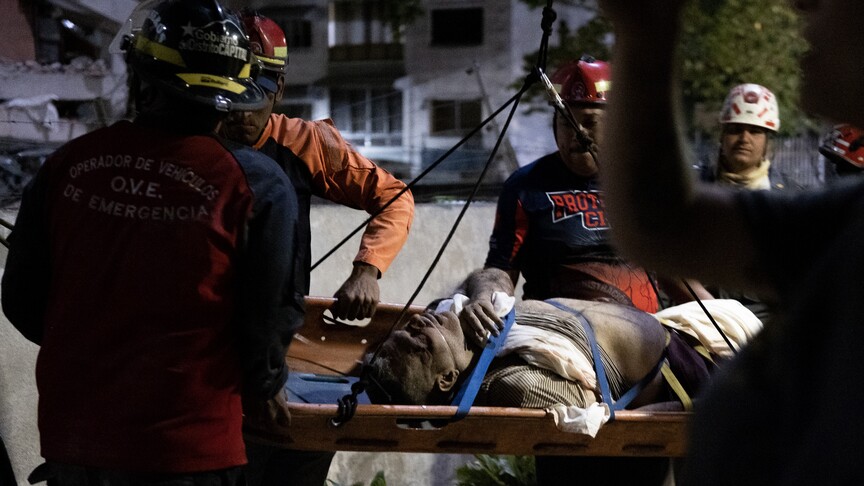
The two devastating earthquakes that struck Venezuela within less than a minute have put the spotlight on a rare but dangerous seismic phenomenon known to scientists as "doublet."
Late Wednesday, a magnitude 7.2 earthquake struck near San Felipe in northwestern Venezuela. Thirty-nine seconds later, a stronger magnitude 7.5 earthquake struck southeast of nearby Yumare.
Acting President Delcy Rodriguez declared a national state of emergency after the earthquakes caused widespread damage and triggered tsunami warnings and advisories across the region.
Officials have put the death toll at 164, with 971 others injured, while warning the toll could rise.
What is an earthquake doublet?
An earthquake doublet is a pair of earthquakes of similar magnitude that occur close together in time and location.
According to the US Geological Survey (USGS), "a doublet sequence – defined as two earthquakes of similar magnitude that occur close in time and proximity – likely indicates a complex, rupture-interaction process."
Unlike a typical aftershock sequence, the second earthquake in a doublet is not simply a smaller aftershock.
Scientists say the first earthquake can relieve stress on one fault while increasing it on a nearby fault. If that second fault is already close to breaking, the extra stress, or seismic waves generated by the first earthquake, can trigger another major rupture.
As a result, two separate but related earthquakes can strike within seconds, minutes, hours, days or, in some cases, even longer intervals.
Doublets are especially dangerous because they prolong strong ground shaking, widen the area of destruction and can cause buildings weakened by the first earthquake to collapse during the second event or subsequent aftershocks.
The phenomenon also complicates rescue operations, as damaged structures that remain standing after the first quake may collapse during the second, increasing risks for survivors and emergency responders.
Was the Venezuela earthquake a doublet?
The USGS classified the Venezuela sequence as an earthquake doublet.
"This event was the mainshock of a severe seismic doublet sequence, occurring just 39 seconds after an M 7.2 foreshock," the agency said on its website.
The USGS said the region also experienced a doublet in September 2025, consisting of magnitude 6.2 and 6.3 earthquakes that affected Venezuela's Zulia and Lara states.
Where have earthquake doublets occurred before?
Earthquake doublets have been recorded in several seismically active regions around the world.
One of the most destructive recent examples occurred in Türkiye on Feb. 6, 2023.
A magnitude 7.8 earthquake struck southern Türkiye, followed about nine hours later by a second major earthquake measuring about magnitude 7.5 to 7.6 roughly 90-95 kilometers (56-59 miles) to the north.
The earthquakes devastated 11 provinces, killing tens of thousands of people and causing widespread destruction.
Another well-known example was the 1987 Superstition Hills sequence in southern California, when two large strike-slip earthquakes struck intersecting faults in the Imperial Valley about 11 to 12 hours apart.
Iran also experienced notable doublets in 2012, when magnitude 6.4 and 6.2 earthquakes struck East Azerbaijan province within minutes, killing hundreds of people.
In 2021, Hormozgan province was hit by two strong earthquakes within about 90 seconds, killing at least two people and injuring dozens.
Afghanistan's Herat region experienced a series of destructive magnitude 6.3 earthquakes over several days in 2023, illustrating how fault systems can rupture in cascading sequences rather than through a single isolated event.
Are earthquake doublets rare?
Scientists say earthquake doublets are uncommon but not exceptional.
According to the USGS, there is about a 5% chance that the two largest earthquakes in a sequence during the first week will be within 0.2 magnitude units of each other.
The agency also says earthquakes can trigger additional seismic activity within a few hundred miles, including aftershocks clustered around the main earthquake.
"There is also evidence that some major earthquakes manage to trigger seismicity over much greater distances (thousands of miles), but these triggered quakes are small and very short lived," the USGS said.