- Leaders from across Asia, Africa, Middle East, Latin America expected to attend including China's Xi, Russia's Putin and Iran's Pezeshkian
- Agenda could include Iran-US conflict, de-dollarization, India-China relations
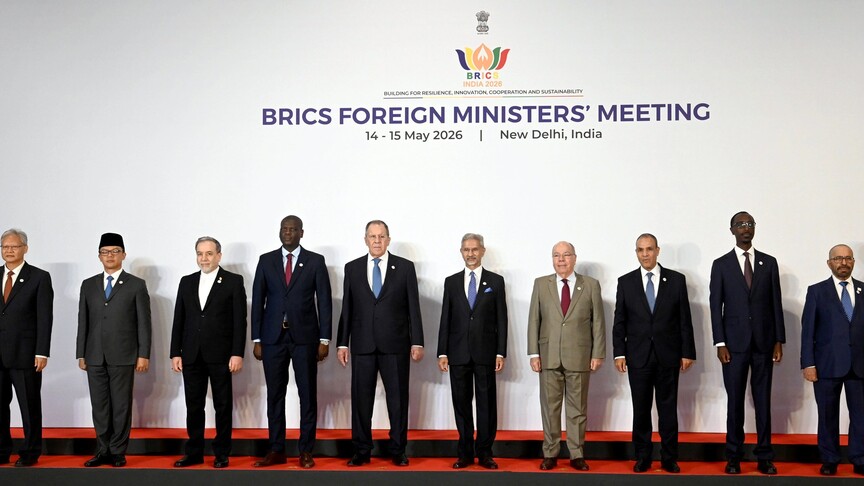
BRICS leaders will gather in the Indian capital New Delhi this weekend for a two-day summit as the expanded grouping seeks to strengthen its role in global political and economic affairs.
The 18th edition of the BRICS Leaders’ Summit, scheduled for Sept. 12-13 and hosted by Indian Prime Minister Narendra Modi, will bring leaders together from across Asia, Africa, the Middle East and Latin America.
Who is attending?
Russian President Vladimir Putin, Chinese President Xi Jinping and Iranian President Masoud Pezeshkian are among the leaders expected to attend.
South African President Cyril Ramaphosa, Belarusian President Alexander Lukashenko, Egyptian President Abdel Fattah el-Sisi, Kazakh President Kassym-Jomart Tokayev and Indonesian President Prabowo Subianto are also expected to be there.
The expanded BRICS membership comprises Brazil, China, Egypt, Ethiopia, India, Indonesia, Iran, Russia, Saudi Arabia, South Africa and the United Arab Emirates.
The group has also partner countries, including Belarus, Bolivia, Kazakhstan, Cuba, Malaysia, Nigeria, Thailand, Uganda, Uzbekistan and Vietnam joining the framework.
Malaysian Prime Minister Anwar Ibrahim, Thai Prime Minister Anutin Charnvirakul and Ethiopian Prime Minister Abiy Ahmed are also expected to attend.
Cuba, Nigeria and Uzbekistan are likely to be represented by their presidents, Miguel Diaz-Canel, Bola Tinubu and Shavkat Mirziyoyev, respectively.
United Nations Secretary-General Antonio Guterres is also expected to attend.
Brazilian President Luiz Inacio Lula da Silva is expected to be represented by Foreign Minister Mauro Vieira, while the UAE is expected to send Abu Dhabi Crown Prince Sheikh Khaled bin Mohamed bin Zayed Al Nahyan in place of President Sheikh Mohamed bin Zayed Al Nahyan.
Agenda and key points
The agenda is generally expected to focus on trade, development financing and reform of global institutions.
However, the summit comes amid the conflict between Iran and the US, and its broader impact on the global economy, including an energy crisis that has particularly affected Asia. The issue is therefore likely to emerge as a major point of discussion among members.
Iran may push for a summit declaration reflecting its position on the conflict, while the organization requires full consensus to reach an agreement.
The summit could also provide an important backdrop for India and China’s complex relationship.
If Chinese President Xi attends, it would be his first visit to India since his 2019 informal summit with Prime Minister Modi.
The two countries are among the world’s largest economies and are major BRICS members, but their relationship continues to be shaped by unresolved border and sovereignty disputes.
Eerishika Pankaj of Australia’s Lowy Institute has described BRICS and the India-China strategic dialogue as institutional mechanisms that allow the two sides to maintain communication despite their differences.
“Cooperation and unresolved sovereignty disputes coexist,” Pankaj wrote, arguing that BRICS should be viewed as a means of maintaining dialogue rather than evidence that India and China have resolved their disagreements.
Beyond bilateral issues, BRICS is also expected to address reform of global institutions, an issue the bloc has repeatedly raised in relation to institutions such as the UN, IMF and World Bank.
De-dollarization
Another key area of BRICS cooperation has been the use of national currencies in trade and finance, reflecting efforts by members to reduce their dependence on the US dollar.
Egyptian Prime Minister Mostafa Madbouly said last year that BRICS member states were increasingly adopting local-currency settlements in bilateral financial transactions as part of a broader strategy to reduce reliance on foreign currencies and strengthen economic cooperation within the group.
However, despite discussions about expanding local-currency settlements in trade, members have stopped short of establishing a common BRICS currency.
The New Development Bank, the bloc’s multilateral development bank, has also made local-currency financing a strategic priority.
According to its 2024 report, 43.5% of its approvals that year were denominated in member countries’ currencies, primarily the South African rand and Chinese yuan.
A short history of BRICS
As these leaders gather in New Delhi, their meeting underscores the bloc’s dramatic expansion since its creation in 2006.
BRIC was formalized at a meeting of foreign ministers on the sidelines of the UN General Assembly in New York in 2006, bringing together Brazil, Russia, India and China.
The first leaders’ summit of the then BRIC was held in Yekaterinburg, Russia, in 2009.
South Africa joined in 2010, transforming BRIC into BRICS. The grouping subsequently underwent another major expansion, bringing in countries from the Middle East and Africa and, most recently, Indonesia.
According to figures cited by BRICS, the grouping now represents about 49.5% of the world’s population, 40% of global GDP and 26% of global trade.
BRICS describes itself as a platform for consultation and cooperation on global and regional issues, including international political and economic governance.
The last BRICS summit was held in Rio de Janeiro, Brazil, in 2025 while China is due to host the 2027 summit.