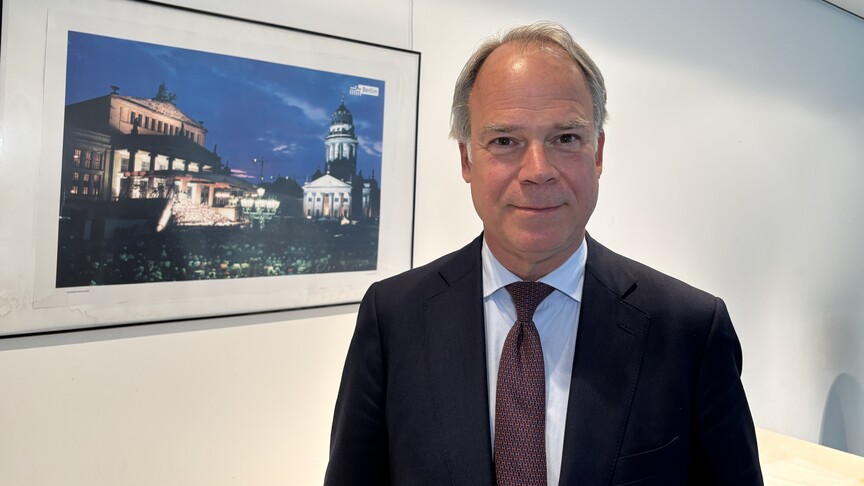
- 'The conflict has a tremendous effect,’ says Nikolaus Schues, CEO of F. Laeisz, one of Germany’s leading shipping companies
- Johann Killinger, chairman of energy and logistics company Buss Group, says Europe should play a more active role in finding a peaceful solution and take stronger steps to diversify energy sources and develop renewables
- 'We should try to contribute to finding, comi
Germany’s shipping and energy executives, alarmed by the Iran war and escalating Gulf tensions, are urging urgent diplomacy and policy action to safeguard transport and energy security.
Nikolaus Schues, CEO of F. Laeisz, one of Germany’s leading shipping companies, said the conflict and ongoing uncertainty about the US-Iran ceasefire are hitting the industry hard and rippling through the wider economy.
“The conflict has a tremendous effect on international shipping. Tanker rates are going up, bulk carriers' rates are going up. Ammonia carriers' rates are going up,” he told Anadolu.
Schues warned that a prolonged conflict would hit not only shipping but nearly every sector, raising the risk of a global economic slowdown.
Even if Washington and Tehran agree to extend the ceasefire, he said, repairing damaged energy infrastructure and restoring output would take time, keeping markets on edge.
“The medium-term impact of this conflict will be extremely negative. Energy prices are going up, global GDP will be heavily affected.
“That means that there is less trade. And shipping is living off international exchange and not off protectionism,” he said.
Germany, Europe should pursue active diplomacy
Over the past seven weeks, the US-Israeli war with Iran has severely disrupted shipping and energy flows through the Strait of Hormuz, a critical maritime chokepoint handling vast volumes of oil and gas bound for global markets.
The disruptions have pushed energy costs higher and strained supply chains far beyond the Middle East.
In Germany, Europe’s largest economy and a major exporter, the effects have been particularly acute. Nine out of ten industrial companies said that the Iran war has negatively affected their business, according to a survey conducted by Munich-based Ifo Institute.
Schues called on Germany and its European partners to pursue more active diplomacy.
He said the Strait of Hormuz should remain open to international navigation, in line with the 1982 United Nations Convention on the Law of the Sea (UNCLOS).
“Iranians do not respect UNCLOS, which is of great concern. And it is totally forbidden internationally to block international passages at sea,” Schues said.
“And that now, even the US, although they are not signatories to UNCLOS, but that they as a free country, as a democratic country, act against UNCLOS is of great concern. And we do not know what that means for future developments in politics.”
Despite expectations for a second round of talks between the US and Iran in Islamabad this week, renewed tensions between Washington and Tehran over the Strait of Hormuz have fueled uncertainty.
On Sunday, US President Donald Trump said US forces seized an Iranian-flagged cargo ship near the strait after it attempted to break through the US naval blockade.
Iran said Sunday that the US demands, a continued naval blockade, and threatening rhetoric have hindered progress in negotiations, adding that there are no clear signs of a breakthrough under current conditions.
Diversifying energy supplies
Schues said the ongoing conflict has delivered a stark lesson for Germany, showing that energy resilience is vital for any country in the world.
“The European governments, especially the German government as a very big energy importer, has to make sure that we have ships registered under German registry, so in a case of crisis, we have access to tonnage, supporting our own necessary logistics,” he said.
Ship-tracking data shows hundreds of ships have been stuck in the Persian Gulf since the end of February.
Johann Killinger, managing director of the energy and logistics company Buss Group, said the war in Iran and rising tensions in the Gulf region have hit German companies hard.
Buss Group has investments in wind power and other renewables, and is among the shareholders in a planned LNG terminal near Hamburg, which would be one of Europe’s largest.
“Energy costs are significantly up, this is harming our economic development in the country and I think the forecasts are already lowering for the remainder of the year,” he told Anadolu.
Killinger warned that a longer crisis would cause even more serious damage.
He expressed hope that European governments and Germany would step up efforts toward a diplomatic solution, including initiatives such as mine-sweeping to help secure passage through the Strait of Hormuz.
Killinger urged European countries to stand together and abandon what he sees as excessive passivity, noting they are all “in the same boat” and equally affected by the war.
“That doesn't mean that we need to heavily engage militarily, but we should try to contribute to finding, coming to a peaceful end quickly,” he said.
He also voiced hope that tensions between the Trump administration and European governments would de-escalate and that transatlantic relations would normalize for the benefit of both sides.
“I hope, and I believe that the relationship is not breaking up. Because that would be also very unwise for Europe, but also for the US,” he said, underscoring the deep political and economic ties that bind the large Western market.
Killinger also stressed the need for Europe and Germany to accelerate efforts to diversify energy supplies, strengthen independence and expand renewable power.
“The conflict makes it clear again for Europe, Germany, and also the other countries, that we need to become energy-wise more independent,” he said. “It means to focus on renewables, wind and solar.”