By Ainur Romah
JAKARTA, Indonesia
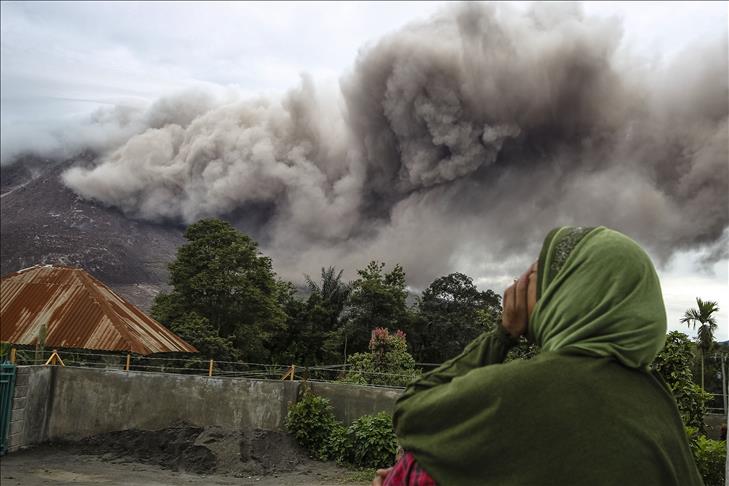
Volcanic ash from Mount Sinabung has reached the capital of Indonesia’s North Sumatra province amid a record number of daily eruptions Wednesday.
A data service official at the meteorological agency of Medan – located 88 kilometers from the volcano -- told Anadolu Agency that strong winds had carried ashes out of Karo regency, blanketing several cities on North Sumatra’s east coast.
"Volcanic ash fell around the morning in Medan and surrounding areas,” Rika Karyani said. “If there is an eruption again tonight, it is likely more ashes will fall tomorrow [in Medan]."
According to data from the Sinabung Monitoring Post, the volcano erupted as much as 29 times Wednesday morning – the most since its alert status was raised to the highest level June 2.
The report also showed that there had been nine tremors at the mountain.
The people of Medan continued their routine activities despite wearing face masks to protect themselves from ash amid the increasingly warm weather.
Hermansyah, a 36-year-old resident who like many Indonesians uses one name, was quoted by the Suara Pembaruan news website as saying, "I was surprised because when I woke up in the morning and headed to work, there was a lot of dust on my car."
Meanwhile, farmers in Deli Serdang regency to the east of Medan also awoke to volcanic ash covering their fields.
"It’s possible that farmland was damaged by volcanic ash," said Anto, 40.
Over the last two weeks, more than 10,700 people near Sinabung have been evacuated to nearby shelters, according to the local administration.
Karo's regent Terkelin Brahmana had told Anadolu Agency that 7,500 people were evacuated in army vehicles Tuesday alone.
The volcano erupted for the first time this month on June 12, less than 14 days after the heightened warning status.
The eruption triggered pyroclastic flows -- fast-moving current of hot gas and rock -- that reached as far as 3 kilometers south of the mountain and spewed volcanic ash around 500 meters into the sky.
The Geological Agency is concerned about a massing of lava at the peak of Sinabung’s crater. With a volume of 3 million cubic meters, it could flow around 6 kilometers down the volcano’s slopes.
It also set a 7-kilometer danger zone to the south and southeast of the volcano.
Since erupting in Sept. 2013, Sinabung has never entirely stopped flowing.
The eruptions have killed at least 17 people and destroyed thousands of hectares of farmland.
National Disaster Mitigation Agency spokesman Sutopo Purwo Nugroho had told Anadolu Agency on Tuesday that the impact of losses since the 2013 eruption is estimated to be more than Rp 1.49 trillion ($104 million).
"No one knows when it will end," he added.