By James Shimanyula
NAIROBI
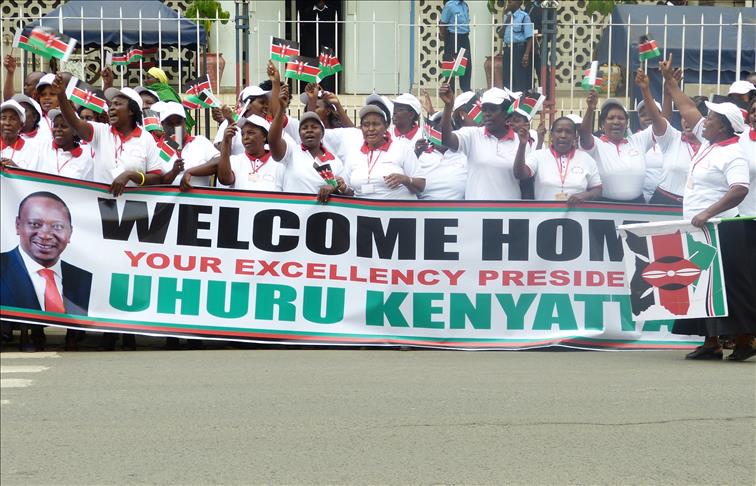
Kenyan President Uhuru Kenyatta has been given a rousing welcome by a huge crowd that converged on his office in capital Nairobi upon his return from The Hague.
Kenyatta returned home on Thursday from The Hague, where he attended a pre-trial meeting before three judges on Wednesday over charges of crimes against humanity.
Instead of taking a direct route to his office from Nairobi's Jomo Kenyatta International Airport, Kenyatta's convoy meandered through the capital's populous Eastlands residential area, where people clapped, ululated and whistled as the president waved.
Many people left their workplaces to give the Kenyan leader a cheering welcome in one of the most colorful receptions seen in the East African nation in years.
Standing in an open car, Kenyatta was accompanied on his tour by his deputy, William Ruto, who faces similar charges in a related trial.
The Kenyan leader had handed the reins of power to Ruto before traveling to The Hague, in accordance with the Kenyan constitution.
But by the time Kenyatta's plane touched down at the airport, he had already resumed his position as head of state.
Addressing a crowd that had gathered outside his office, Kenyatta thanked Kenyans for praying for him while he was at The Hague.
"With God ahead of us, victory is in sight. You have prayed for me, for our country – we shall succeed. The tribulations… we are facing are larger than an individual. Let's unite," Kenyatta said.
Appealing to Kenyans to remain calm and collected, Kenyatta said: "I assure you that Kenya is strong and stable. Don't panic or fear. In Kenya, we shall never go backward but forward. Let the world know that we are strongly united."
Kenyatta has denied that he committed crimes against humanity in the wake of violence that erupted in Kenya following disputed 2007 presidential poll results.
At the pre-trial meeting at The Hague, Kenyatta was not required to say anything, as his British lawyers argued his case during the four-hour session.
Nor were any questions directed at him personally. The judges are yet to deliver their final ruling, derived from submissions made by the prosecution, defense and lawyers representing Kenya's post-election victims.
Shortly after the 2007 elections, then rivals president Mwai Kibaki and prime minister Raila Odinga accused one another of vote-rigging, which set off ethnic violence countrywide.
Ruto at the time had been a member of parliament and a senior member of Odinga's Orange Democratic Movement (ODM).
Prosecutors accuse Kenyatta, a Kibaki ally at that time, of enlisting a criminal gang to carry out attacks on ODM supporters.
Some 1,300 people were killed and dozens maimed while over 300,000 were driven from their homes in the post-poll mayhem.
Since then, none of the victims or relatives of the slain have reportedly received any compensation.
www.aa.com.tr/en