Diyar Guldogan
14 May 2026•Update: 14 May 2026
Here’s a rundown of all the news you need to start your Thursday, including US President Donald Trump's meeting with his Chinese counterpart Xi Jinping in Beijing and the United Arab Emirates denying that Israeli President Benjamin Netanyahu held a secret meeting with the Emirati president in the UAE during the Iran war.
TOP STORIES
- Trump-Xi meeting in Beijing
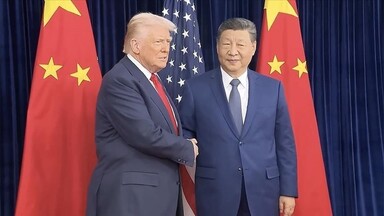
China's President Xi Jinping hosted a welcoming ceremony for US President Donald Trump at the Great Hall of the People.
Trump told Xi that ties between the two countries are poised to become “better than ever before.” Trump repeatedly praised Xi’s leadership and China’s development under his rule.
Xi, for his part, told Trump that Washington and Beijing should be "partners, not rivals."
"We should help each other succeed, prosper together, and find the right way for major countries to get along in the new era," he said.
- UAE denies claim of secret Netanyahu visit during Iran war
The United Arab Emirates on Wednesday denied claims by Prime Minister Benjamin Netanyahu’s office that he had paid a “secret visit” to the Gulf country to meet President Sheikh Mohammed bin Zayed during the US-Israeli war on Iran.
In a statement, the Emirati Foreign Ministry rejected reports about Netanyahu visiting the UAE or any Israeli military delegation being received on Emirati territory.
The ministry stressed that relations between the UAE and Israel are “public and known” within the framework of the 2020 Abraham Accords and “are not based on secrecy or hidden arrangements.”
NEWS IN BRIEF
- Israel's ruling coalition submitted a bill Wednesday evening to dissolve the Knesset (parliament) amid a crisis over the military conscription of ultra-Orthodox Jews, in a move seen as an attempt to thwart a similar step from the opposition.
- The World Food Program (WFP) said Wednesday that severe funding shortages are forcing it to sharply reduce food assistance operations in Syria, warning that millions remain at risk of worsening hunger.
- Lebanon's current priority in direct negotiations with Israel is to reach a lasting truce, while Tel Aviv “is demanding the prior disarmament of Hezbollah," the Lebanese foreign minister said Wednesday.
- Gina Romero, the UN special rapporteur on the rights to freedom of peaceful assembly and of association, urged the UK on Wednesday to respect its international human rights obligations, warning that new legislation and political demands to ban pro-Palestinian protests risk undermining democratic freedoms.
- Iran’s Foreign Minister Abbas Araghchi accused Kuwait on Wednesday of “unlawfully” attacking an Iranian boat and detaining four Iranians in the Gulf, demanding their immediate release.
- The UN peacekeeping force in Lebanon (UNIFIL) expressed concern on Wednesday over the activities of Lebanese group Hezbollah and the Israeli army near its positions, citing risks to peacekeepers over the increased use of drones.
- Contacts are underway to stop the ongoing Israeli escalation in Lebanon, on the eve of a third round of talks in Washington between Beirut and Tel Aviv, a senior Lebanese source told Anadolu.
- The 10th and latest edition of the Black Sea and Balkans Security Forum, held in the Romanian capital Bucharest, concluded on Wednesday.
- Vietnam's foreign minister on Wednesday said his country is seeking to strengthen ties with North Korea in a "more practical way."
- British Prime Minister Keir Starmer did not directly address mounting calls for his resignation during a speech on Wednesday, instead focusing on his government’s legislative agenda as internal Labour Party tensions intensify.
- The Pentagon announced Wednesday that it inked agreements with several arms firms to acquire 10,000 low-cost containerized missiles, as the war against Iran eats badly into existing missile stocks.
- Belgian Defense Minister Theo Francken said Türkiye and Ukraine are leading the transformation of modern warfare through innovation in drone technology, artificial intelligence, and defense systems, arguing that other countries must adapt to the changing nature of conflict by following their example.
- Slovakia closed all border crossings with Ukraine on Wednesday over unspecified security concerns, authorities said.
- Following talks in Ankara with Belgian Deputy Prime Minister and Foreign Minister Maxime Prevot, Turkish Vice President Cevdet Yilmaz said on Wednesday that Türkiye and Belgium aim to deepen cooperation in trade, defense, energy, and digital transformation.
- President Vladimir Putin said Wednesday that Russia will continue to develop missile systems capable of overcoming all current and future missile defense systems.
- Lithuania will not allow any foreign power involved in armed conflict in Europe to use its territory or airspace to launch drone strikes against another state, President Gitanas Nauseda said Wednesday.
- Gunshots were heard at the Senate of the Philippines on Wednesday, where Senator Ronald dela Rosa remains under protective custody after facing an arrest warrant from the International Criminal Court, according to local media reports.
- King Charles III said Wednesday that Britain faces growing risks from an “increasingly dangerous and volatile world,” citing the conflict in the Middle East as a recent example.
- Türkiye has completed bureaucratic preparations to launch direct trade with Armenia as part of the ongoing normalization process between the two countries, the Foreign Ministry said Wednesday.
BUSINESS & ECONOMY
- US Senate confirms Kevin Warsh as Federal Reserve chair
The US Senate confirmed Kevin Warsh on Wednesday as new chair of the Federal Reserve for a four-year term, placing President Donald Trump’s nominee at the helm of the US central bank at a time of heightened scrutiny over interest rates and the Fed’s independence.
The Senate voted 54-45 to confirm Warsh to succeed Jerome Powell, whose term as Fed chair ends this week.
Warsh’s elevation comes as the Trump administration presses for lower interest rates, tax cuts and deregulation, putting the Fed’s policy direction and institutional independence under close market scrutiny.
- Oil flows through Strait of Hormuz fell nearly 30% in first quarter: EIA
Oil flows through the Strait of Hormuz fell nearly 30% in the first quarter of 2026 compared with the previous quarter, the US Energy Information Administration (EIA) said Wednesday.
The volume of crude oil, condensate, and petroleum products transported through the strategic waterway dropped to 14.6 million barrels per day in January-March, down from 20.7 million barrels per day in the fourth quarter of 2025, according to the EIA’s newly released Global Energy Security Data.
Flows were also sharply lower compared with the same period last year, when 20.4 million barrels per day moved through the strait.
- World oil production down 1.8M barrels per day in April, Int'l Energy Agency says
Global oil supply fell by a further 1.8 million barrels per day (mb/d) in April to 95.1 mb/d, taking total losses since February to 12.8 mb/d, the International Energy Agency (IEA) said on Wednesday.
"Output from Gulf countries affected by the closure of the Strait of Hormuz was 14.4 mb/d below pre-war levels," the IEA stated.
The agency added that higher production and exports from the Atlantic Basin provide some relief, assuming flows through the strait gradually resume from June, global oil supply is projected to decline by 3.9 mb/d on average in 2026, to 102.2 mb/d.