By Kyaw Ye Lynn
YANGON, Myanmar
Hundreds of people including monks and artists gathered Friday outside the Thai embassy in Yangon to protest a Thai court’s sentencing of two Myanmar migrants to death for the murder of two British tourists.
Among the 500 people were those lifting signs saying “We ask for justice”, “Stop discrimination against Myanmar nationals” and “Free our citizens”, while others held pictures of the two 22-year-olds, Zaw Lin and Wai Phyo, who were handed death sentences Thursday.
“We are here just to ask justice for our fellow countrymen,” Khin Hlaing, a famous comedian who joined the protest, told Anadolu Agency. “The Thai nationals here don’t need to worry about anything as we are just protesting the Thai government and the failure of the Thai judiciary system.”
On Thursday, the Samui Provincial Court found the two guilty for the rape and murder of Hannah Witheridge, 23, and the murder of David Miller, 24, on Koh Tao in September last year.
Since the two migrant workers were arrested in October last year after Thai police conducted blanket DNA testing across the island -- focusing particularly on migrants – following weeks of pressure, the case has drawn widespread criticism amid allegations of mishandling of DNA and police torture.
Though both initially confessed to the crime, they later recanted alleging they had been tortured during interrogation.
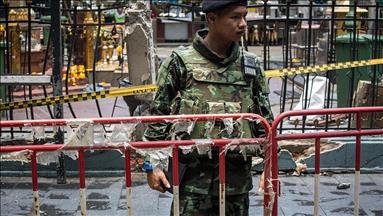
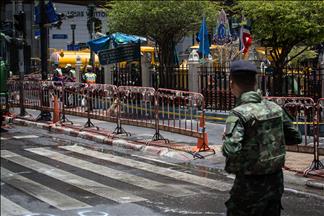
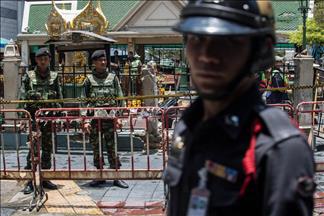
Myanmar police set up barriers in front of the Thai embassy since before the protest started at 10 a.m. (0530GMT) Friday, creating a restricted area around the diplomatic mission.
In Bangkok, Myanmar’s ambassador to Thailand met with senior ministry of foreign affairs officials.
U Win Maung told reporters that he doesn't expect the verdict to affect bilateral ties, and would continue following the case and offering the defendants consular services.
Around a dozen people had also protested outside of the Thai embassy in Yangon hours after Zaw Lin and Wai Phyo were sentenced.
In a statement before Thursday’s trial in Thailand, Andy Hall of the Migrant Worker Rights Network had argued that an independent inquiry into the DNA evidence found flaws in police forensics investigation.
He also called into question the early confessions of the defendants, pointing to a National Human Rights Commission investigation that found evidence of torture and coercion.
Rights group and the defense team are planning to appeal the ruling.
Aung Myo Thant, a Myanmar lawyer who had been defending the convicted, told the Irrawaddy news service that the verdict was “saddening,” and showed that “much needs to be done for Burmese [Myanmar] migrant workers to receive fair hearings.”
Meanwhile, Miller’s family released a statement expressing their utmost respect for the court, saying they “believe that the result (...) represents justice for David and Hannah.”
Rights group Amnesty International has expressed it is “deeply concerned” by Thursday’s death sentence.
“Thai authorities must ensure that any alleged confession or other statement obtained as a result of torture is not admitted as evidence in court in any retrial of the case, unless against those accused of torture to prove that the statement has been taken,” its international director for Southeast Asia and the Pacific said.
Champa Patel called for an independent investigation that is not conducted under the police force, adding that the "Thai police force has a long and disturbing track record of using torture and other forms of ill-treatment to extract ‘confessions’.”
The group stressed the need for Thai authorities to “ensure the truth in a retrial that respects international human rights law and standards, so that the families of Hannah Witheridge and David Miller get the justice and peace of mind they deserve".
Human rights activists have underlined the prejudices they say the case illustrates against migrant workers, who make up the bulk of the workforce in the resorts of southern Thailand.
Myanmar figures and organization have also been writing letters calling on Thais to seek “justice” following the sentencing.
A renowned student leader of the 1988 Uprising who now leads the Peace and Open Society activist coalition penned a letter to Thailand’s premier saying that the case “proves that the Thai judiciary has weaknesses and there is a significant ground for international criticism”.
“Hence, we, THE 88 GENERATION (Peace and Open Society) hereby object those death sentences of two Myanmar migrant workers,” Min Ko Naing said. “We urge you to pay an utmost attention to review this case and the verdict.”
Meanwhile, the Myanmar Journalists Association urged its Thai counterpart Friday to cooperate more closely “in seeking the truth behind the bureaucratic and judicial juggernaut”.
“Let’s show the world that Myanmar and Thai journalists will fight together for justice, human rights and democratic values,” it said in its letter.