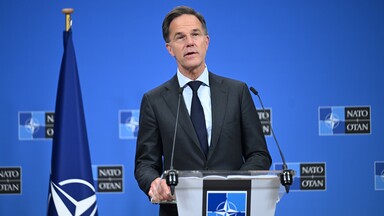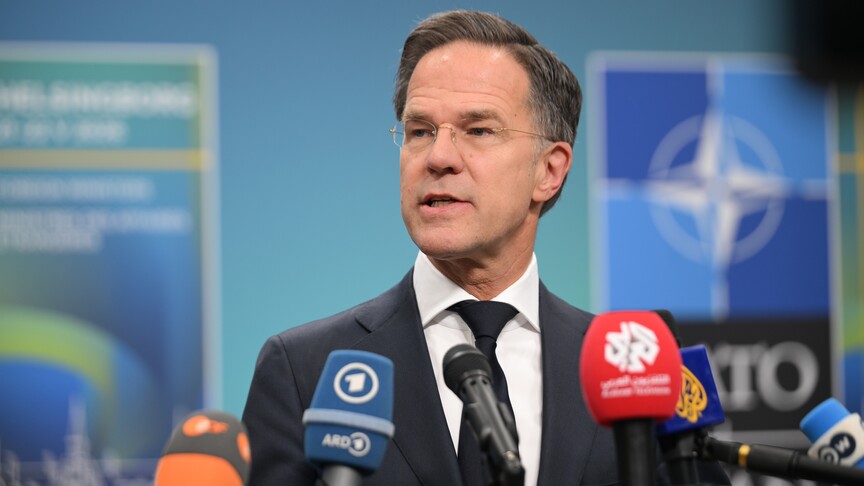
NATO is ready to support a European-led effort to secure freedom of navigation in the Strait of Hormuz following the US-Iran agreement aimed at ending months of conflict in the Middle East, Secretary General Mark Rutte said, signaling that the alliance is ready to step in if requested by participating nations.
Speaking ahead of a meeting of NATO defense ministers on Wednesday, Rutte said the alliance's involvement would depend on whether assistance is sought by countries already coordinating the initiative.
"Whether NATO will play a role there, yes or no. If helpful, of course, we will play a role, but if they can do it without us, also okay. So, we are always ready to help if so wanted," he said in response to a question from Anadolu.
His remarks come as Britain and France are showing their readiness for a multinational naval mission intended to facilitate the reopening of the Strait of Hormuz, through which roughly one-fifth of global oil supplies pass.
Rutte said extensive military preparations had already been undertaken by European allies and partners over the past two months, with specialized capabilities moved closer to the region in anticipation of a potential stabilization effort.
"This is legally and literally speaking outside NATO territory, but it is absolutely clear that we have case United Kingdom and France are coordinating all of this," he said.
"We are really seeing massive pre-deployment of assets over the last two months by European allies and others close to theater, particularly when it comes, for example, to demining, radar, and other technologies necessary," he added.
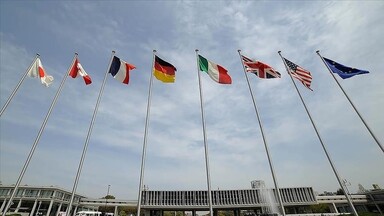
According to Rutte, leaders attending the G7 summit in France have discussed how a broad coalition could help implement the commitments contained in the newly announced US-Iran agreement.
He said the leaders had a conversation on "what could this UK-French-led initiative, with so many countries involved, what they could do post this whole deal, which has been struck between the United States and Iran, to make sure that they help to deliver on this commitment of making sure that the freedom of navigation is fully restored."
"The good news is that these discussions are ongoing," Rutte said.
France and Britain have spent months assembling a maritime coalition designed to restore confidence among shipowners and facilitate the safe transit of thousands of vessels currently waiting to leave the Gulf.
French President Emmanuel Macron has said around 20 countries have made concrete contributions to the initiative, with several already maintaining assets in or near the region.
France has positioned its nuclear-powered aircraft carrier Charles de Gaulle near the Arabian Peninsula since mid-May and has indicated that fighter aircraft could begin surveillance missions within 48 hours, while frigates and mine-clearance units could deploy within days.
Britain has dispatched the destroyer HMS Dragon to the area, while Italy has made minehunter vessels available. Germany has indicated that a minehunter currently stationed in the Mediterranean could join demining operations once the cessation of hostilities is deemed durable.
European officials say warships could eventually escort around 2,000 tankers and cargo vessels awaiting passage through the waterway.
Despite the readiness of European militaries, officials have stressed that naval deployments will only proceed once confidence grows that the agreement between Washington and Tehran is holding.
Italian Defense Minister Guido Crosetto recently warned that demining vessels are particularly vulnerable and cannot operate without guarantees that they will not become targets.
Prime Minister Giorgia Meloni has likewise said any Italian participation would require parliamentary authorization and would be carried out alongside international partners.
For his part, Macron has repeatedly described the planned operation as an "offer" rather than a predetermined intervention.
"This is an offer; we stand ready to assist," he said on Monday on the sidelines of the G7 summit in Evian, alongside US President Donald Trump.
"It demonstrates the support of the international community, our determination to reopen the Strait, ... perhaps it will not be requested and perhaps it will not be necessary," Macron added.
The US leader has struck a more cautious tone regarding the need for a multinational presence, saying he believes the US-Iran agreement itself will guarantee open navigation.
"I don't think we're going to need much help because we have an agreement where it's going to be open and it's toll-free," he said.
Still, he acknowledged that participation by several countries "would not be a bad idea."
"You never know what happens," he said.
Differences have already emerged between Washington and Tehran regarding the future status of the strait.
While Trump has said shipping would remain permanently toll-free, Iranian officials have suggested that fees or service charges for vessels passing through the strategic waterway remain under consideration.
The memorandum of understanding reached between the US and Iran reportedly provides for the reopening of the strait within 30 days and grants negotiators an additional 60 days to pursue a broader settlement, leaving uncertainty over the longer-term security environment.
The US-Iran deal is expected to be formally signed in Switzerland on Friday.
news_share_descriptionsubscription_contact