By Lauren Crothers
PHNOM PENH, Cambodia
Two years ago, Sok Chenda’s best swimming abilities amounted to a doggy paddle.
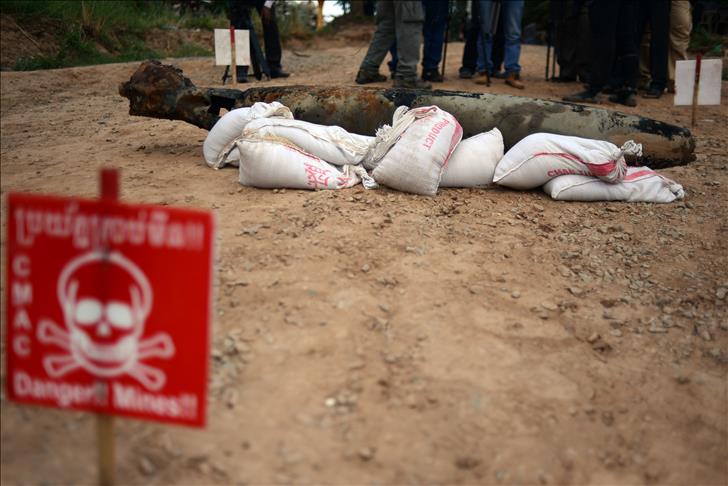
On Thursday, however, he was one of two newly trained divers who salvaged -- by hand -- a live 500-pound bomb that was dropped over Cambodia about 40 years ago and landed on the bed of the Mekong River.
The salvage of the Mark 82 bomb, a U.S.-manufactured device that was dropped from a plane most likely in the late 1960s or early 1970s, marks a turning point in Cambodia’s efforts to clear its land and waterways of munitions. An estimated 2,000 square kilometers of land are affected by ordnance, several thousand tons of which can could be found in Cambodia’s rivers.
Until Thursday, Cambodian Mine Action Center dive unit leader Chenda was used to land clearance of war remnants, having spent 16 years demining around the country.
After two years of intensive training provided by the Golden West Humanitarian Foundation, however, he attached the imposing weapon — cleared from the riverbank by a diver before him -- to an inflatable device that brought it to just under the surface. From there, it could then be taken to land and safely defused.
“I wasn’t scared,” he told Anadolu Agency.
“But it was difficult to see. I focus while I am underwater… the training was very difficult -- we need to be strong, smart and clever.”
The process included night dives, intensive exercise and swimming lessons.
“The first time we were really scared at night time, but diving in the river is the same, because we cannot see,” Chenda added.
He said the retrieval of the bomb went without a hitch.
Mike Nisi, Golden West Dive Technical Advisor and Chief of Underwater Operations, described the procedure as “textbook,” even though it is the country’s first.
The hope, he told Anadolu Agency, is that the Cambodian team will now be able to provide training to other groups who want to learn how to salvage underwater ammunitions.
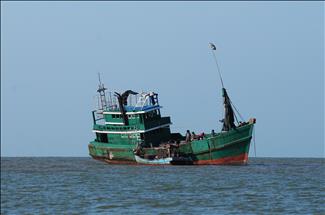
The bomb was found late last month by fisherman Yor Dieb, 42, who said his net became entangled by something below.
He told reporters Thursday that after diving into the murky water to free it, he felt what he instinctively knew to be the body of the bomb, and reported it to the Center.
“I was scared,” he said of the moment he found it, but added that his fears had subsided by Thursday, when he was tasked with steering the boat that brought the dive team to the site.
Him Vandy, the Center’s director of operations, told Anadolu Agency that the organization now plans to carry out more in-depth studies to assess contamination levels in the country’s rivers.
Despite years of demining efforts, the full extent of Cambodia’s contamination is still unknown. Decades of war in neighboring Vietnam, the Cambodian civil war, the brutal Khmer Rouge regime that followed, and the around 1 million tons of explosives dropped on it by the United States left the country one of the most contaminated in the world.
According to the Cambodia Mine/ERW Victim Information System, a total of 64443 casualties have been recorded since 1979 - 19701 of whom died, 35789 of whom were injured and 8953 had to have limbs amputated.