Merve Aydogan
30 April 2026•Update: 30 April 2026
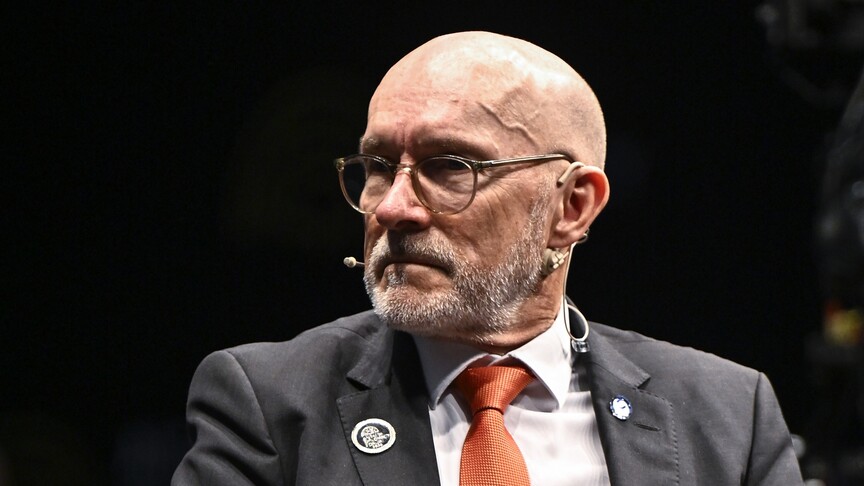
The head of the Comprehensive Nuclear-Test-Ban Treaty Organization (CTBTO) warned Wednesday that rising geopolitical tensions and stalled ratifications are threatening decades of progress in limiting nuclear weapons testing.
"The geopolitical context is certainly worrying, a lot of uncertainty," said Robert Floyd, executive secretary of the CTBTO, during a news conference ahead of the 2026 Review Conference of the Parties to the Treaty on the Non-Proliferation of Nuclear Weapons.
The CTBTO operates a global monitoring network designed to detect nuclear explosions anywhere in the world. The Comprehensive Nuclear-Test-Ban Treaty has been signed by 187 countries and ratified by 178, but has not entered into force because several key states, including the United States, Russia, and China, have yet to ratify it.
"We see multilateralism under intense pressure, various elements of treaties that are important for international security under pressure, arms control treaties, bilateral expiring conflicts in various parts of the world, rhetoric about threats of nuclear testing, returning to testing, and even concerns about possible use," Floyd said.
Addressing misinformation surrounding seismic events, Floyd said social media users sometimes incorrectly claim earthquakes are secret nuclear tests. He cited events in northern Iran in late 2024 as a recent example.
"Social media got very excited, as people were claiming those seismic events to be nuclear tests," he said, adding that "the analysis done by my colleagues showed that those events were entirely consistent with natural seismic events, earthquakes in northern Iran."
Regarding the organization’s monitoring capabilities, Floyd said: "We are very confident that a nuclear test explosion, or a nuclear explosion of a magnitude equivalent to 500 tons of TNT chemical explosives or higher, would be detected and could be characterized and known."
Speaking about the prospects for the treaty entering into force, Floyd said progress depends on coordinated movement by major nuclear powers.
"I think it's fair to say that we need to see that the United States of America, the Russian Federation, the People's Republic of China, might be able to address the treaty and its ratification together."
"It is, I think, quite unlikely that any one of them would move on that without the others simultaneously moving together," he added.
"I don't have good news to report to you on that matter at the moment," Floyd said, adding that while significant progress has been achieved, further work remains.