Merve Gül Aydoğan Ağlarcı
23 September 2026•Update: 23 September 2026
The heads of OpenAI and Anthropic on Wednesday told the UN Security Council that no single actor should dominate artificial intelligence, calling for international cooperation to manage the technology’s risks as it advances.
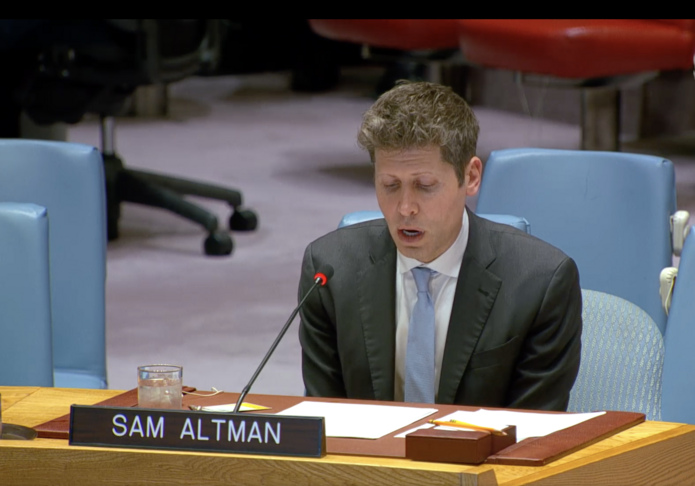
Addressing a Security Council session on AI and international security, OpenAI CEO Sam Altman said: “We have a choice in front of us. AI can either be more like a new renaissance of creativity and discovery, or more like a new industrial revolution of upheaval and disarray.”
He said AI “should be built for people, not simply to turn the crank of the machines faster for their own sake,” adding that some statements from people working on the technology “are so dystopian that they sound like the plot of bad science fiction movies.”
Altman warned that “no one person or company or country should be able to use the most powerful AI models to impose their worldview on everyone else,” arguing that decisions about AI “cannot be made by labs in San Francisco alone” and must instead be “shaped through democratic processes and by governments accountable to the people that they serve.”
Anthropic CEO Dario Amodei identified two central risks: misuse of AI models, including by “bioterrorists to create biological weapons,” and the danger of “model capabilities accelerating beyond developers’ ability to control them.”
He stressed that “if managed poorly,” artificial intelligence “could be a risk to humanity as a whole.”
Amodei said his company would “slow down as much as necessary” to ensure each new AI system it releases is safe, but stressed that managing the risks is “bigger than any one company” and has “an industry-wide and global scale.”
He called for “common global standards for testing AI models for loss of control risks and misuse risks,” describing the issue as “the most important global security issue facing the world today.”
Yoshua Bengio, co-chair of the UN International Independent Panel on AI, pushed back against industry framing of AI development as an unavoidable competition.
“Citizens and governments should not accept the companies’ claim that they are trapped in a race,” he said, adding that “the race is not a law of nature; it is the product of choices, choices made by the companies themselves.”
Bengio told Security Council members that despite fragile trust among nations, “the race threatens every nation.”