By Alex Pashley
LIMA, Peru
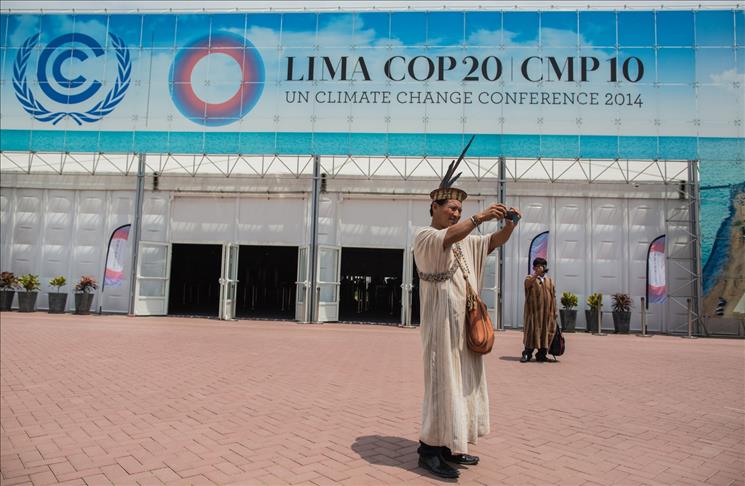
Thousands took to the historic streets of the Peruvian capital Wednesday, directing calls for “climate justice” at envoys hammering out a deal at the nearby annual UN climate talks.
Trade unionists and environmentalists joined indigenous peoples to channel the spirit of the New York People’s Climate March in September, which drew more than 400,000 participants.
The march sought to accelerate negotiations here over a draft text, which will morph into a global pact to be signed next year in Paris to rein in global warming.
Divisions between rich and poor countries over the scope of the agreement – set to replace the Kyoto treaty beginning in 2020 – may see it miss its Friday deadline, observers said.
Rosa Cachi was one of 40 female farmers from the Puno region on the Bolivia frontier who made a day’s journey to protest the impacts of climate change.
“In the Andean plateau, we don’t know if we’re in spring or summer. Heat comes as well as hail this season. We want the authorities here in Lima to sign an agreement lowering pollution.”
Moses Quispe from Peru’s Andean region of Cuzco came in “defense of Pachamama” – a goddess in Andean cosmology, akin to Mother Earth.
“The glaciers are melting, there’s a shortage of water and the land is turning to desert. We need special funds for climate change,” he added.
The march drew as many as 15,000 participants, according to organizers – the civil activism group Avaaz and the People’s Summit. Requests made to authorities for a confirmation of the numbers went unanswered.
The People’s Summit is an alternative to the UN’s Conference of the Parties, or COP, focusing on indigenous issues, which were being ignored by ministers, said chief organizer Ibis Hernandez.
“People are rising and saying this is about our rights today, not later,” according to Winnie Byanyima, executive director for Oxfam International.
“What we have seen are politicians postponing, procrastinating, failing to respond to an urgent call to stop the world roasting to protect lives in the future,” Byanyima added.
Gill Stein, who ran for U.S. president in 2012 on the Green Party ticket and polled about 470,000 votes, told The Anadolu Agency that a shift in the economic system was needed.
“We will not solve this issues independently or without deep systemic change, which is why we are here to organize a mobilization for people, planet and peace, over profit.”
The United Nations Framework Convention on Climate Change has urged a shift to a low carbon economy, phasing out fossil fuels to reach zero net emissions by the end of the century.
Nations must collectively reduce emissions to between 40 to 70 percent by 2050 on 2010 levels, to avoid temperatures rising above 3.6 F (2 C) by 2100, a level scientists called “dangerous,” according to the Intergovernmental Panel on Climate Change.
Nations are due to report their voluntary emission reductions by next March though experts suspect collective decreases won’t be sufficient to rein in climate change.
The Peruvian government has sponsored the side event “Voices For The Climate,” raising awareness on climate change for the general public.
www.aa.com.tr/en