By Roy Ramos
ZAMBOANGA CITY, Philippines
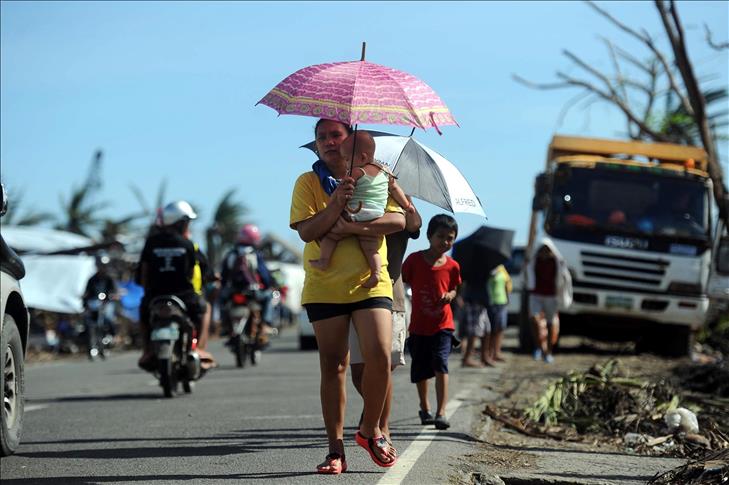
Power lines were downed as strong winds lashed the central Philippines ahead of Typhoon Hagupit’s arrival Saturday.
More than 600,000 residents living in coastal and hilly areas have been evacuated amid warnings of high waves, heavy rain and landslides, the country’s disaster agency said.
The National Grid Corporation of the Philippines said power was shut off in northern and eastern areas of Samar province.
The country's weather agency said that as of 16.00 local time (08.00 GMT) Saturday Hagupit was 62 miles (100 kilometers) east of the central city of Dolores, with sustained winds of 108 mph (175 kph) at its center and gusts of up to 130 mph (210 kph).
The eye of the typhoon is expected to hit the central Philippines at 22.00 local time (14.00 GMT).
The typhoon has weakened slightly since Friday but is still expected to cause widespread damage.
Hagupit, which means whiplash in the local Tagalog language but has been renamed Ruby in the Philippines, will make landfall in the same region hit by a super typhoon that caused thousands of deaths last year.
Filipinos have stocked up on essential supplies in anticipation of the typhoon’s destructive appearance, with long queues forming at shops and gas stations on Friday.
Although the storm is not as powerful as last year’s Typhoon Yolanda, which left more than 6,300 dead with a further 1,000 still missing, it has seen hundreds of thousands seek shelter in schools, government centers, churches and sports centers.
Flights in central and southern Philippines were cancelled and ports on the eastern seaboard closed, stranding thousands of passengers on Friday and Saturday.
In Tacloban City, the epicenter of Yolanda, residents took shelter in the Tacloban Astrodome. Many people are still living in temporary shelter more than a year after the last typhoon.
President Benigno Aquino III has ordered food supplies to be sent to affected areas as well as troops and police to be deployed to prevent looting in the typhoon’s aftermath.
Local media quoted Aquino as saying there was "no indication" that Hagupit, would be as strong as Yolanda, the most powerful typhoon ever recorded on land and known internationally as Haiyan. The typhoon left more than 4 million people homeless in November last year, according to government figures.
"It's better to evacuate early… We don't want to experience what we went through during Yolanda," Gigi Calne, one of 3,000 sheltering at a school in Basey, Samar province, told the GMA News website. "It was difficult to save our family and ourselves because we moved too late."
A public storm warning has been issued for at least 36 areas in Luzon, the Visayas and Mindanao, the Philippines weather service reported.
The U.S. military’s Joint Typhoon Warning Center had classified Hagupit as a super typhoon but downgraded it Friday. It is still the strongest storm to hit the Philippines this year.
The Global Disaster Alert and Coordination System said 26.8 million people in the Philippines could be affected by the typhoon and the government said earlier this week that it had set aside 4.69 billion Philippine pesos ($105 million) to respond to Hagupit.
Typhoons and tropical storms are types of cyclones classified by wind speed. Typhoons have a sustained wind speed of 74 mph (119 kph) or greater while tropical storms rotate at 39 to 73 mph (63 to 118 kph).
www.aa.com.tr/en