CAIRO (AA) – Shortly before Friday noon prayers ended in Cairo's eastern Nasr City district, Amal, 50, got dressed and waited by the door as has been her custom for several weeks now.
Within minutes, she heard the chants – now music to her ears – emanating from an approaching pro-democracy demonstration. It was the signal that the weekly march had finally reached her home, and she eagerly prepared to join it.
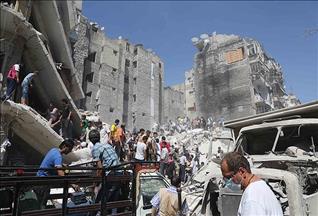
This has been Amal's routine for the past six weeks, ever since security forces violently dispersed a pro-democracy sit-in in Rabaa al-Adawiya Square – located only a few kilometers from her home – killing hundreds of supporters of ousted President Mohamed Morsi and injuring thousands of others.
Amal, a retired college professor, meets her friends and neighbors at the weekly protests, which continue to take place across the country.
They spend the day marching from one street to the next in Nasr City, until just before – sometimes even after – a strictly-enforced army-imposed curfew goes into effect at 7pm.
- 'Smarter' approach
After the bloody August 14 sit-in dispersals and the ensuing crackdown on Morsi supporters, the pro-democracy rallies appear to have taken a more decentralized, neighborhood-focused approach – in contrast to earlier mass mobilizations in the nation's public squares, now heavily barricaded by security forces.
A Facebook page dubbed "Nasr City_AntiCoup" is now responsible for organizing and documenting pro-democracy protests and activities in Amal's densely-populated middle-class neighborhood.
The page boasts nearly 19,000 members.
"At first I thought it was strange that the protests were not converging on the main street, but I realized this is much smarter," 29-year-old engineer Hisham Fouad told Anadolu Agency.
Fouad says he has noticed an increase in protester numbers since he first began demonstrating in his Nasr City neighborhood following the Rabaa sit-in dispersal.
The young engineer, who lives near Rabaa Square, was propelled to join the protests after seeing first-hand the extent of the violence employed to clear the now-iconic square of demonstrators.
"Trucks packed with bodies passed through my street on their way from the square," he recalled painfully.
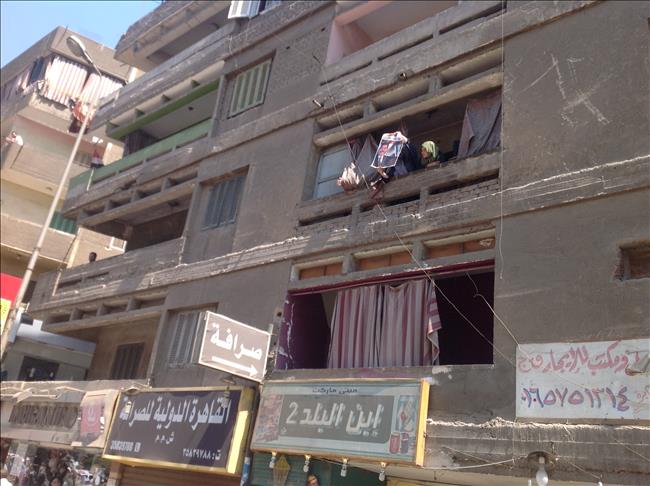
Fouad says the neighborhood-focused protests, which take place throughout the week albeit on a smaller scale than the Friday demos, bring the pro-democracy cause right to the people's doorstep – and under their windows.
This, he believes, renders their protests more effective in garnering sympathy and attracting supporters, especially in view of the unprecedented level of political polarization and biased coverage by Egypt's pro-army media.
"This way, people see the protests and the diversity of protesters from their balconies every day, as local television channels air footage of empty streets," Fouad explained.
The pro-democracy protesters recognize that it will be a long-term struggle to win back those who have been "brainwashed" by the skewed media coverage.
"With time, people who don't agree with us will begin to question what the media is telling them about us," Fouad hopes.
He believes that the neighborhood-focused approach is also a more effective way of avoiding clashes with security forces, which now heavily barricade main streets and squares on Friday.
"After the extent of violence used to disperse the Rabaa sit-in, many people were afraid to join the protests," he said. "But keeping the protests away from security checkpoints has been an effective way to avoid provocations, which has encouraged more people to join."
The meeting points for protests, mostly in front of prominent mosques, are now known around the neighborhood – but the exact itinerary of the marches is seldom revealed until the last minute.
"This is another way to confuse the security forces," 31-year-old protester Mohamed Refaat told AA.
Nasr City is an especially sensitive area in terms of potential violence.
Security forces drew up a strict cordon around Rabaa Square following the sit-in dispersal to prevent any attempt by pro-democracy elements to return to the symbolic square.
- 'Some peace'
After almost three months of protesting against what they see as a military coup against an elected president, pro-democracy protesters are defying predictions by critics that their rallies would soon die out.
Fouad, who was traumatized by the violence he saw during the Rabaa dispersal, now looks forward to Friday protests each week.
"I still haven't been able to live normally since that day," he said. "It's only when I'm here at the protests and I see the people, diverse but still united like they were on 25 January, that I find some peace of mind."
For Amal, the retired professor, hope is restored every Friday when she hears the unwavering chant, "Down, down with military rule."
"The streets are all we have," she said. "These are the people, and for as long as it takes, they will stand for what they believe against the military rule that will drive this country into further deterioration."
Refaat, for his part, sees signs that the protests are drawing more support for their cause.
"On my way here, a man stopped his car when he saw my Rabaa t-shirt and debated with me for half an hour," he told AA.
"But this is good," he added. "This is a sign that people are starting to look beyond what they know, away from the biased media."
By Nada Rashwan – Anadolu Agency
englishnews@aa.com.tr