
SHANGHAI
An expert on China-Japan relations, Wu Jinan said on Tuesday that it was to the interest of all sides for countries to jointly administer the region based on mutual confidence and cooperation.
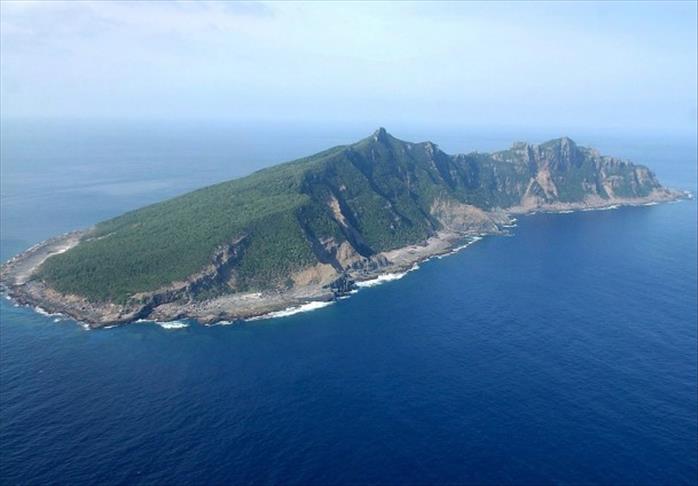
Wu Jinan, an expert working for the Shanghai International Researches Institute, spoke to the Anadolu Agency (AA) on the crisis concerning uninhabited islands in East China Sea between Beijing and Tokyo from an historic and political perspective.
"Japan discovered the uninhabited islands for the first time in 1884. The uninhabited islands are 350 kilometers away from China's east and 370 kilometers away from the Okinawa Islands in Japan's south. Having won the China-Japan war of 1890-1895, the Tokyo administration took a decision and claimed that the uninhabited islands were part of the Japanese Empire," Wu stated.
"While the Japanese took such a decision, they overlooked the fact that the uninhabited islands were discovered by China 700 years ago," Wu noted.
-"Diaoyu and Okinawa are separate"-
"Diaoyu Islands are actually a continuation of Taiwan," Wu argued.
"Japan considers the Diaoyu Islands as an extension of Okinawa Islands within its continental shelf. However, there is a distance of 370 kilometers between the Okinawa Islands and Diaoyu Islands. As such, Diaoyu and Okinawa are separate islands," Wu underlined.
"The Okinawa administration, tied to the Japanese Empire, never publicized internationally their claim to the uninhabited islands. As the Okinawa administration never publicized its decision to claim the uninhabited islands, Japan's claims are baseless," Wu stressed.
-"Problem did not come up by coincidence"-
"There are large fields of oil and natural gas around the Diaoyu Islands. The rich energy sources are a reason as to why China, Japan and the international community attach high importance to the islands," Wu stated.
"Debates on claiming the uninhabited islands never caused a tension affecting diplomatic and commercial relations in the past. Tension rose high in the region for the first time. There are also other factors affecting the tension," Wu said.
"The Japanese economy is in a serious stagnation in recent years. Aside from a slow economy, Japan needs natural resources. Japan seeks formulas for development by opening up to oceans," Wu underlined.
"Seeking sources of energy, Japan is experiencing serious problems with Russia, South Korea and China. In light of all these developments, one can see that the problem of Diaoyu Islands did not come up by coincidence," Wu expressed.
-"One prime minister per almost each year"-
"In recent years, Japanese leaders have been insensitive to China-Japan relations. The continuation of friendly and peaceful relations are extremely important and should not be jeopardized by a difference in opinions," Wu stated.
"For the past 20 years, Japan keeps changing prime ministers each year. The Japanese people are highly concerned about this reality. Prime Minister Noda has taken some drastic measures in order to hide his failure in certain domestic issues and increase in consumption taxes. Diaoyu Islands is only one of the issues Noda has brought up," Wu said.
-"US begins focusing on Asia Pacific"-
"In the past decade, the United States gave high priority to the Middle East and Central Asia. By pulling troops out of Iraq and now Afghanistan, the US is making preparations to focus more on Asia Pacific," Wu emphasized.
"Japan is the country where the US has most troops and bases in the region. In an agreement signed with Japan in 1960, the US assured Japan that it would defend the Japanese in a possible war with a foreign country. Japan is a door for the US to enter the region. In this context, the US seems to have a stance that supports Japan on the Diaoyu Islands. Relying on the US, Japanese leaders have no concerns in causing tension with China. Unfortunately, Tokyo's attitude led to the present state of China-Japan relations," Wu indicated.
-Is US neutral?
"The US administration is not neutral on the issue of uninhabited islands. The problem of the uninhabited islands was triggered by the US," Wu noted.
"Following the official recognition of the People's Republic of China by the United Nations, the US handed over the Diaoyu Islands to the Okinawa administration tied to Japan. China never accepted such a decision and continued to underline that the uninhabited islands belonged to them," Wu stressed.
"US attitude is full of contradictions today. After arguing that the problem of the uninhabited islands should be solved between the two countries, the US now began making remarks which support Japanese arguments on the islands," Wu noted.
"While telling China that they were not a side on the matter, the US assured the Japanese that it was with them," Wu stated.
"In a process that began with Chinese fishermen getting arrested by Japanese coast guard teams around the disputed islands two years ago, the US and Japan co-organized a military exercise in the region," Wu stressed.
"Just recently, the US sent F-22 war jets to its bases in Japan. The fact that the US Secretary of Defense Leon Panetta signed a missile defense system agreement with Japan in a recent visit shows US's stance," Wu indicated.
-"A solution through legal means impossible"-
"Neither Tokyo nor Beijing administration wishes to solve the problem of the uninhabited islands by resorting to international courts. It seems almost impossible to have a solution through legal means," Wu said.
"While the two sides have made shows of force towards each other, the possibility of a hot clash seems to be unrealistic. Both China and Japan will pay a heavy price in the case of a comprehensive war in the region," Wu underlined.
"In case China and Japan decide to have a war, the international community would not let this happen," Wu argued.
"Diaoyu Islands" are on an important sea route, Wu stated.
A war in the region would (negatively) affect many countries, Wu stated.
Accordingly, the possibility of a war seems to be slim, Wu noted.
"The only valid path for the solution of the problem seems to be political negotiations. My personal wish is to see China and Japan administer the region jointly in mutual confidence and cooperation. This is a wish of the peoples of both countries and the international community," Wu added.
Reporting by Tevfik Durul
news_share_descriptionsubscription_contact

contact_the_ombudsman
is_there_an_error_in_this_story