By Huseyin Erdogan, Selen Tonkus
ANKARA
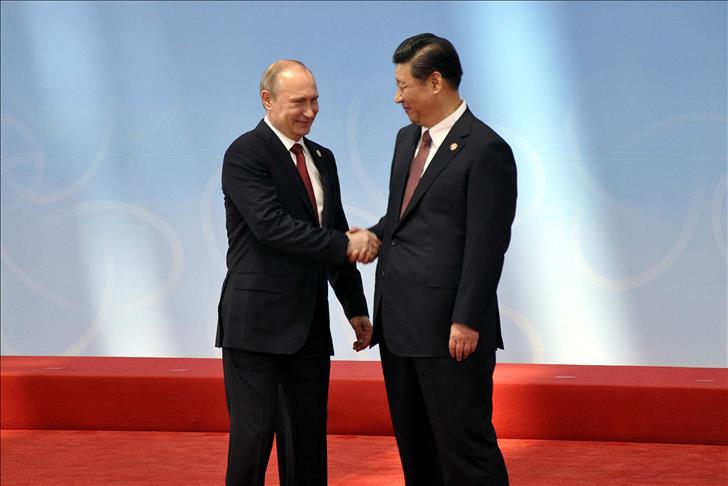
On the same day that Europe announces new sanctions against Russia - blocking loans for five big state banks and curbing EU business with oil and defence firms - an Eurasian organisation meets, signalling experts believe, China's support for Russia.
The Shanghai Cooperation Organization (SCO) summit, begun Thursday is a two-day meeting in Tajikistan's capital, Dushanbe, attended by China, Russia, Kazakhstan, Kyrgyzstan, Tajikistan, and Uzbekistan.
It can be seen as a symbol of strategic support for Russia, said Professor Selcuk Colakoglu, the Vice President of USAK- an Ankara based think tank.
Colakoglu stated, since China sees Ukraine issue part of the wider competition between the West and the East, supporting Russia is important, as it will help Moscow compete with the West on a more equal basis.
Professor Colakoglu also touched upon the latest seaport agreement between Russia and China, and said it is an outcome of Russia's new strategy to expand cooperation with China along its southeastern cost, on Chinese border.
In May, China and Russia agreed on a 30-year, $400 billion deal to supply China with natural gas from fields in Eastern Siberia, which will further increase Russian export revenues. Last week, Russia's state owned industrial giant Rostec and China's public coal company Shenhua signed a $10 billion deal this week to supply coal to China. Finally, yesterday Moscow and Beijing agreed to build a seaport, 18 km far from Russia-China border on Japanese Sea cost of Russia. The port is said to be able to handle some 60 million tons of cargo a year, further strenghtening the two states' economic and energy relations.
Professor Mesut Hakki Casin, an expert from Caspian Strategy Insitute, an Istanbul-based research center said EU's sanctions against Russia, will in turn hurt EU as Russia possibly will cut the gas flow into Europe this winter.
Casin added that the EU sanctions push Russia closer to China.
In order to put pressure on the Russian government over its aggression during the Ukraine crisis, the EU announced restrictions to Russia's three biggest oil companies- Rosneft, Transneft and Gazprom Neft, and banned them from raising long-term capital from European financial markets.
EU meets around 30 percent of its natural gas need from Russia.
www.aa.com.tr/en