CAIRO
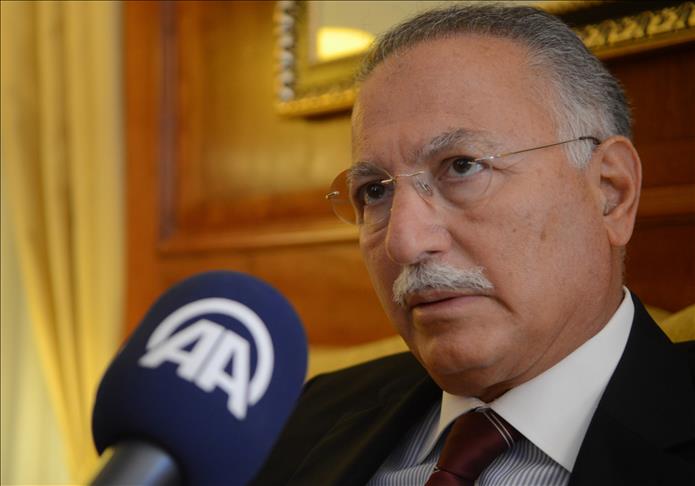
The Secretary General of the Organization of Islamic Cooperation (OIC), Ekmeleddin Ihsanoglu on Sunday said that a military intervention in Syria would make things worse in that country.
Speaking to the Anadolu Agency (AA) after meeting the Egyptian President Muhammad Mursi and Foreign Minister Mohamed Kamel Amr in Cairo, Ihsanoglu made a call on the Syrian administration to leave power to "end the bloodshed" and the crisis.
"The Arabic countries define the existing situation as the 'Arab Fall'. Spring does not come easily. There is need for more work and sacrifice," Ihsanoglu stressed.
"President Mursi and I exchanged views on an Islamic Summit to take place on the 26th day of Ramadan in Mecca," Ihsanoglu noted.
"The Palestinian issue and the worsening situation in Syria were our agenda items. We held a very fruitful discussion. An OIC summit will take place in Egypt at the beginning of next year," Ihsanoglu indicated.
"In the Mecca summit, we will discuss Palestine, Syria and Myanmar, a country in which many Muslims have been massacred in recent days. As the OIC, we will try to take the most appropriate decisions," Ihsanoglu stated.
-"Syria must transfer power peacefully"-
Touching on the developments in Syria, Ihsanoglu said that the Syrian administration had to leave power immediately to end the crisis.
"Every administration must make sacrifices for its own people. An administration should not expect its people to make sacrifices. A possible war in Syria can only be eliminated in this way," Ihsanoglu said.
Rejecting the idea of a military intervention in Syria, Ihsanoglu said that Libya still tried to recover from the military intervention.
"We do not want Syria to be like Libya. We want a peaceful transfer of power in Syria as in Egypt, Tunisia and Yemen," Ihsanoglu noted.
-"Arab Fall"-
Defining the revolutions as 'Arab Fall' and not 'Arab Spring', Ihsanoglu said that the spring season comes after a long fall and winter.
"If we want to move on to a multi-party system based on a constitution and democracy, we need more time and efforts," Ihsanoglu stated.
"No state could reach a democratic stage in a short time. Until Turkey reached the point where it is today, it went through many difficulties. As such, we need to carefully watch the democratic transformation in the world," Ihsanoglu said.
On rumors that the Caliphate would return, Ihsanoglu said that the Caliphate ended in 1924.
"We now live in a very different world. We need to live by taking into consideration the realities of the world," Ihsanoglu said.
"The OIC foresaw an investment volume of 13-20 percent in Arab and Muslim countries in 10 years. However, we have reached an investment volume of 18 percent in 7 years worth 600 billion USD," Ihsanoglu noted.
"We continue to hold talks for economic cooperation and believe that economic cooperation would increase following the revolutions," Ihsanoglu said.
In regard to Egypt's head Mufti, Ali Juma's visit to Jerusalem, Ihsanoglu said that he considered such a visit as one that was based on good will.
"Juma's visit was not 'normalizing' relations with Israel. It was a visit made to show solidarity with the people of Palestine," Ihsanoglu also said.