Riyaz ul Khaliq and Saadet Gokce
13 May 2026•Update: 13 May 2026
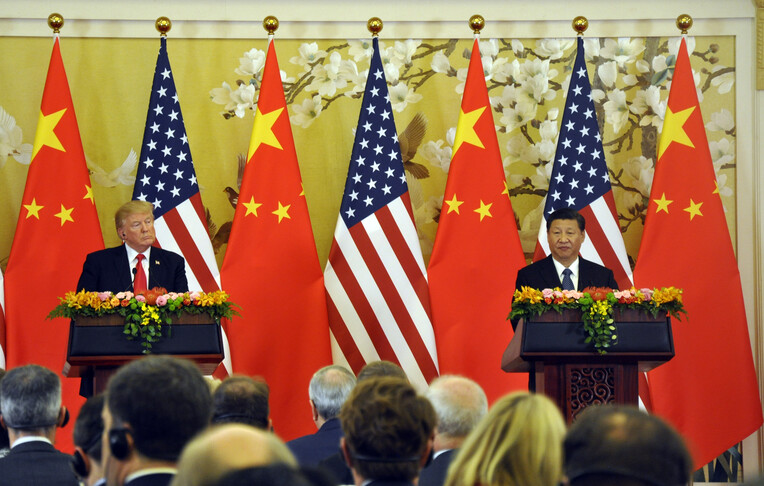
As all eyes are set on what Chinese President Xi Jinping and his US counterpart Donald Trump will discuss during their high-stakes Beijing summit, experts predict potential deals between the world's two largest economies.
Sourabh Gupta of the Institute for China-America Studies told Anadolu that there "will be" deals between the US and China after Xi and Trump meet.
"There has already been pre-planning. Large airplane order for Boeing. Large commitment to purchase variety of US agricultural goods. Remains to be seen what the US will reciprocally commit to," Gupta said in a text message soon after Trump landed in Beijing on Wednesday.
Xi and Trump will participate in a bilateral summit on Thursday and will meet again several more times up until Friday, when the US president departs Beijing.
The Iran war, Taiwan, trade, tariffs, as well as high tech are likely to be discussed at length as Washington seeks to rebalance the $414.7 billion bilateral trade relationship recorded last year.
Trump is accompanied by numerous CEOs from major US companies, including Nvidia’s Jensen Huang, Tesla’s Elon Musk, Apple's Tim Cook, BlackRock's Larry Fink, Blackstone's Stephen Schwarzman, Boeing's Kelly Ortberg, Cargill's Brian Sikes, Citigroup's Jane Fraser, GE Aerospace's Larry Culp, Goldman Sachs' David Solomon, Micron's Sanjay Mehrotra, and Qualcomm's Cristiano Amon.
Political economist Jostein Hauge said the "rare" concentration of household-name Fortune 500 CEOs that Trump brought to Beijing could lead to "big trade deals," according to a post on US social media company X.
Ahead of the Xi-Trump summit, top Chinese and US trade negotiators met in South Korea on Wednesday and held what Beijing described as “constructive exchanges.”
The meeting, led by US Treasury Secretary Scott Bessent and Chinese Vice Premier He Lifeng, held "candid, in-depth and constructive exchanges," focusing on economic and trade issues of mutual concern, as well as on further expanding practical cooperation.
Mushahid Hussain, a diplomat, practitioner, and a long-time China analyst, noted that Trump's visit is "probably the most significant and substantive visit by any US President to Beijing since President Nixon’s pathbreaking journey in 1972."
The discussions between the two leaders "will encompass a wide range of issues from Iran war to tariffs and trade to formulating new 'rules of the game' in the bilateral relationship between the world's largest two economies in a fast-transforming, turbulent world," Hussain, who leads the Pakistan-China Institute, told Anadolu in a text statement.
The US and China normalized ties soon after Nixon's trip and established diplomatic ties on Jan. 1, 1979.
China analyst Einar Tangen also noted the economic aspect of the talks.
"Beijing wants calmer economic waters while buying time for domestic adjustment: restoring business confidence, preventing accelerated decoupling, maintaining export access, stabilizing property and financial markets, and avoiding simultaneous crises on trade, technology, and security," Tangen told Anadolu from the Chinese capital.
Both leaders "want to avoid a Middle East war that sends energy prices sharply higher," he said, referring to the Iran war initiated by the US and Israel on Feb. 28.
"Neither Washington nor Beijing benefits from oil shocks or disruption in Gulf shipping lanes. So the likely outcome is not a grand bargain. It is managed coexistence," he said, noting that Trump desires "visible wins" that "he can sell politically," while China wants "strategic breathing room without conceding core interests."