Laura Gamba Fadul
12 May 2026•Update: 12 May 2026
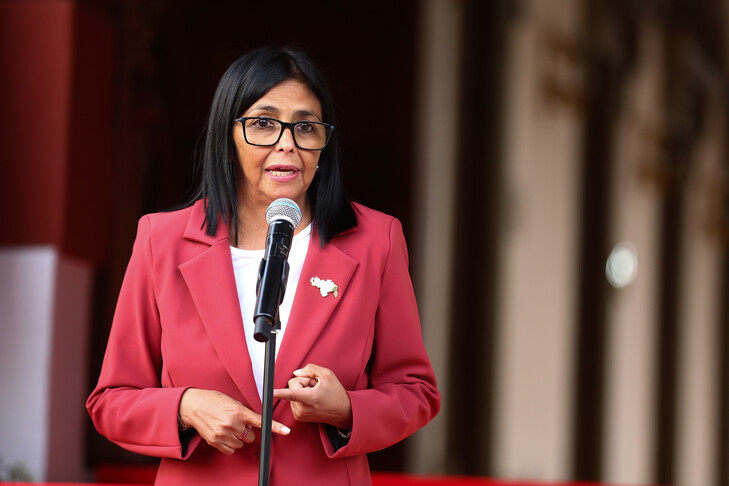
Venezuela’s Acting President Delcy Rodriguez arrived at the International Court of Justice (ICJ) on Monday, and described the long-standing territorial dispute with Guyana over the oil-rich Essequibo region as an “legal absurdity.”
Speaking from the Netherlands via a state television broadcast, Rodriguez doubled down on Caracas’s claims, asserting Venezuela remains the “only party with sovereignty” over the 160,000-square-kilometer territory.
Her visit marks her first trip to Europe since assuming power following the US military operation in Caracas that saw Nicolas Maduro and wife Cilia Flores taken to New York. Despite being under European Union sanctions since 2018, Rodriguez was permitted entry to the Hague to present Caracas’s formal position.
Before the UN’s highest court, Rodriguez argued that a judicial ruling would fail to provide a "definitive solution acceptable to both parties." Instead, she warned that ICJ involvement would only "perpetuate the dispute," causing both nations to entrench themselves further rather than seeking a practical settlement.
The acting president said Venezuela has submitted over 3,000 pages of evidence to the court, even as she accused the UK of obstructing the process.
“The United Kingdom prevented our access to evidentiary sources and destroyed evidence, granting access only to Guyana,” she claimed.
Rodriguez congratulated her investigative team for gathering “substantial” evidence intended to prove the invalidity of the 1899 Arbitral Award, which originally granted the territory to British Guiana. Caracas maintains that the 1899 ruling was a “fraud” and insists on a return to the 1966 Geneva Agreement as the only valid framework.
“We will not recognize an act of international illegality,” she said, suggesting that the proceedings aim to put the ICJ in an “embarrassing position” by validating historical fraud.
Essequibo represents nearly two-thirds of Guyana’s current territory. Tensions escalated in late 2023 following Venezuela’s referendum on the creation of the “Guayana Esequiba” state. Rodriguez framed the moment as a historic crossroads.
“We are here to demonstrate that dialogue and negotiation are the only paths to coexistence and the well-being of our peoples,” she said, maintaining Caracas’s long-held stance that the court lacks the jurisdiction to settle the heart of the Venezuelan identity.