Board of Peace envoy says Gaza process 'bound by verification,' not deadlines
Gaza's transitional administration 'a bridge' to Palestinian Authority reform, says Nickolay Mladenov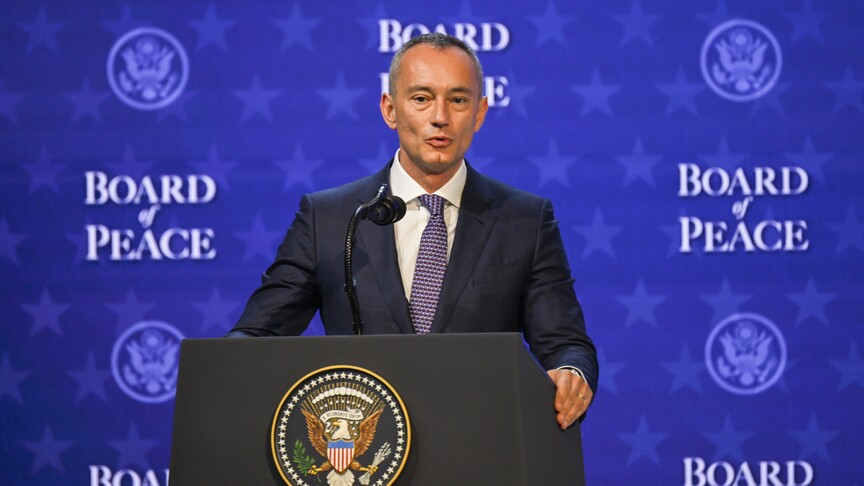
Senior officials from the Board of Peace on Wednesday briefed members on progress in the reconstruction and security transition of the Gaza Strip, describing a year of political milestones alongside the scale of work still ahead.
Nickolay Mladenov, the Board's lead envoy for Gaza, said the process had achieved what once seemed unlikely.
"Over the last year, we've had politically significant milestones. The 20-point plan, endorsed by the Security Council Resolution 2803, gave us the framework. Later, the roadmap we negotiated with Hamas, and I want to personally thank our mediating team from Türkiye, Egypt, and Qatar -- achieved what many, if not all, thought was impossible: a commitment to give up weapons," he said.
UN Resolution 2803 stipulated the establishment of a Board of Peace, an International Stabilization Force (ISF), and an administrative committee in the enclave.
"NCAG's (National Committee for the Administration of Gaza) authority in Gaza will grow, with step by step, and it will increase with every weapon that is accounted for, and every Israeli force that moves back to the perimeter. Our aim is to have Gaza under a unified transitional administration of the National Committee. And I want to be very clear that we're not bound by a calendar or dates; we're bound by verification," he said.
Noting that the NCAG is not meant to be permanent, Mladenov said, "It is a bridge. It is a bridge to a reformed Palestinian Authority and to a genuine political horizon for the Palestinians and Israelis to peace."
US Special Envoy Steve Witkoff said the situation had shifted markedly compared with a year earlier.
"A year ago, at the United Nations, the situation looked very different. Today, we can point to real progress, tangible. All of the hostages are home. There is a ceasefire, imperfect as it may be, but it still exists. Humanitarian efforts have achieved historic results with billions of dollars shared, donated, and pledged to meet urgent needs and support the long work of recovery," he said.
US envoy Jared Kushner said the briefing was designed to shift focus away from blame.
"We didn't talk about who was to blame. Nobody was blaming everyone, anybody. People were just focused on solutions, not slogans, not political speeches, and that was really what the purpose of today was to do: was to be transparent, to show everyone the work that's been done over the last year," he said.
Board member and former British Prime Minister Tony Blair called Resolution 2803 a "remarkable achievement," noting it was the fourth Gaza conflict in less than two decades.
"What was remarkable, however, about 2803 was not only that it ended the formal conflict, but that there was unanimity around a coherent architecture for Gaza's future, one which would end the cycle of conflict and not perpetuate it," he said.
Blair said the coming year would mark a shift from planning to execution. "So, for the next year, we move from preparation to implementation," he said, adding that Gaza "must live in peace with its neighbors and with itself."
Ali Shaath, chief commissioner of the NCAG, said his body was working to bring order to a chaotic environment on the ground.
"We have started our planning process because the current situation on the ground is chaotic," he said. "We are building a lean, slim governance body, not over 120,000."
He said recovery plans span dozens of sectors. "The projects we have developed by the early recovery plan has really about 71 programs starting from humanitarian development to infrastructure, economic revivification, and security, as we are following one principle: one authority, one law, and one weapon will not allow things to go back," said Shaath.