Murat Aslan is an Associate Professor of International Relations at Hasan Kalyoncu University, Gaziantep and Senior Researcher at SETA, a Turkish think tank.
In French literature, the story of Tristan and Isolde offers an apt analogy to modern-day Franco-Greek relations. This tale, which also inspired Romeo and Juliet, recounts the conflictual love between Tristan and Isolde. It centers on the forbidden relationship between Tristan, King Mark's nephew, and Princess Isolde – a relationship that begins when Tristan brings Isolde to the king as a bride but turns into a passionate affair after they accidentally drink a love potion, arranged by Isolde's mother. Despite Isolde's marriage to King Mark, this clandestine love affair deepens amid betrayal and exile. Ultimately, Tristan marries another woman. The tragedy intensifies, and as Tristan dies in despair, Isolde also loses her life.
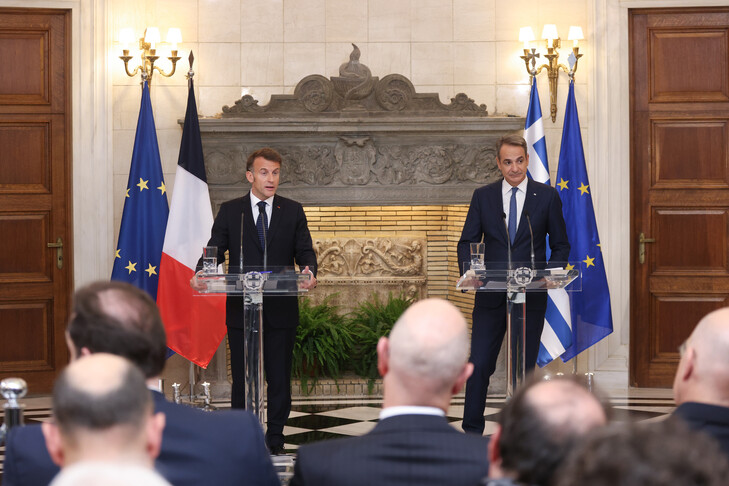
The story dramatically highlights the irreconcilable conflict between love and loyalty and the inevitable destructiveness of this love. While Tristan, lacking any martial prowess, loses himself in guilt and fate, Isolde emerges as manipulative. As their impossible love is inflamed by the potion effect, the betrayal of King Mark becomes the story's central narrative. The words French President Emmanuel Macron spoke in Athens, embodying the role of Tristan, evoke this impossible, self-destructive love – one that ultimately brings ruin to both parties.
However, the despair on display is not a sacred emotion like "love," but rather the games of Greek politics. Following Macron's announcement that he will not seek the presidency in the 2027 elections, a masterful setup unfolded at a historic venue in Athens. During a panel moderated by Alexis Papachelas, the booming-voiced editor-in-chief of the Kathimerini newspaper, Macron fell into a trap. In other words, he drank the potion. When Papachelas asked whether France would truly intervene militarily if Greece were under threat, Macron, caught off guard, conceded that the 2021 agreement is not merely a political declaration but an operational commitment that entails mutual defense obligations. In other words, he fell for Isolde's manipulation.
The panel was held at the Roman Agora. This site serves as a symbolic backdrop, representing a historical reference point for European civilization and tradition. At the panel, held under the theme "The Future of Europe and the Architecture of Security," Macron – despite having held a constructive meeting with Turkish President Recep Tayyip Erdogan on April 11 – suddenly let his guard down, swept up by the atmosphere and the allure of French romanticism. However, it would be an exaggeration to claim that Papachelas and Greek Prime Minister Kyriakos Mitsotakis, who successfully played the role of Isolde, truly harbored romantic feelings for “Tristan.”
At this point, we must give Tristan his due. Macron refrained from framing this commitment as a direct challenge to Türkiye. Describing Türkiye's role within NATO as "critical and indispensable," Macron highlighted its geostrategic position and stated that "Europe's security cannot be conceived without cooperation with Türkiye." However, when faced with a manipulative question, he blurted out that they would defend Greece. So, is there no logic behind this love that swept Macron into a Tristan-like romanticism in a carefree mood? Of course, there is. Let's examine it.
At this point, it would be helpful to focus first on French domestic politics. France, currently under a minority government, is set to hold elections next year. Macron's announcement that he will step down from politics in the 2027 elections – after failing to achieve the desired outcome in the municipal elections – is, in fact, a reflection of political realities. While the legal process regarding Le Pen's candidacy in the 2027 elections continues, Macron's centrist Renaissance Party – having lost major cities like Paris, Marseille, and Lyon – must attract conservative votes. For this reason, gaining sympathy through anti-Türkiye sentiment – which no French person would object to –and pro-Greek bias is politically permissible.
Another point concerns the role defense exports have played in the economic recovery. When comparing 2014-18 with 2019-23, France's arms exports increased by 47% following the Russia-Ukraine war. These figures show an upward trend, with a 21% increase when comparing 2016-20 with 2021-25. Given Europe's target of reaching 5% of GDP in defense spending and the EU's Horizon and SAFE programs, the debt stock – which has reached 115% due to agricultural subsidies – can be reduced only through defense exports.
Having suffered a significant loss of revenue following its withdrawal from Sub-Saharan Africa, France is now approaching countries like Greece, which are set to make substantial defense purchases in line with the 2030 Agenda, with a certain romanticism. These procurement prospects are the very elixir Greece, which is courting France regarding submarine and warship purchases, offered Macron at the Roman Agora. Airplanes, air defense, naval, and submarine procurement programs make the consumption of every elixir a necessity.
Another reality regarding France concerns the energy sector and the Eastern Mediterranean. French company TotalEnergies holds significant stakes in the illegal blocks claimed by Greece and the Greek Cypriot Administration. ENI and TotalEnergies are equal partners in the Cronos field, which the Greek Cypriot Administration has declared as Block 6. This field plays a critical role in Europe's gas supply, especially amid current discussions of sanctions against Russia. TotalEnergies also holds a stake in a liquefied natural gas project to be sold via Egypt. The primary reason for the military guarantee provided to Greece is the expected returns from these energy projects. As additional sanctions are imposed on Russia, the transfer of gas resources controlled by French companies in the Eastern Mediterranean to Europe is creating significant revenue expectations. Of course, if the US allows it.
At this point, it is worth noting Macron's "Napoleonic" mindset. France, which is attempting to bring Europe – growing estranged from the US – under its wing, seeks to appeal to the average European through Greece. Macron, who had previously declared NATO's "brain death," is playing Mitsotakis and Papachelas's game at the Roman Agora, where the European security architecture is voiced as a mask. In other words, in a space imbued with subliminal messages, he offers a hypnotic response to a provocative question.
Ultimately, we must ask: What will global realities and regional impasses gain or lose for France, which is under Greek manipulation? The gains are short-term. However, the losses are profound and irreparable in the long run. Setting aside the image of writhing in agony like Tristan, Europe's lack of vision and France's romanticism portend disaster. With Europe's aging population living in the shadow of the US, China, and Russia, the prospect of it becoming a superpower seems highly unlikely. Europe under "King Mark" – which cannot transcend being a regional power – and France, intoxicated by the "potion it has drunk," are falling prey to Greece's games, reminiscent of Isolde. The result is to pit Türkiye against them. European Commission President Ursula Von der Leyen's mention of Türkiye alongside Russia and China also reflects this mindset.
*Opinions expressed in this article are the author's own and do not necessarily reflect Anadolu's editorial policy.
news_share_descriptionsubscription_contact