BANGKOK
Days after a National Reform Council member called for reconciliation between Thailand's warring political factions, former premier Thaksin Shinawatra has said that he is ready for talks, but only with someone "who really holds power.”
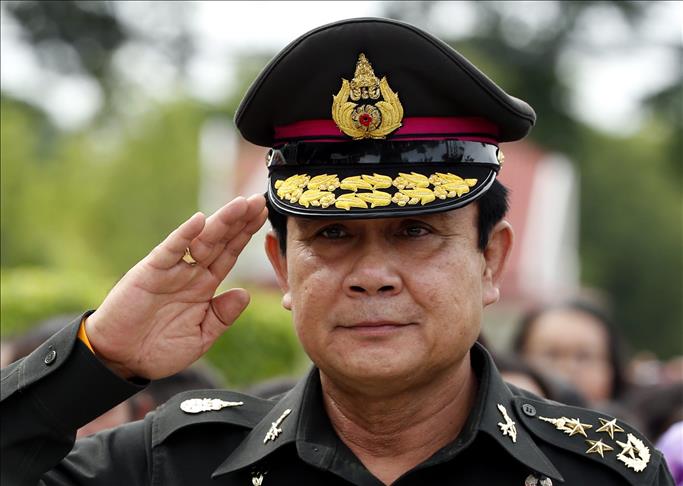
Hours earlier, junta leader General Prayuth Chan-ocha had dampened speculation of talks with the deeply divisive figure -- who many blame for the country's long-time political crisis -- by saying he would not meet a “convicted fugitive.”
Thaksin -- prime minister between 2001 and 2006, before he was deposed in a coup -- has lived in exile since 2008 after being sentenced to two years in jail for abuse of power. Chan-ocha seized power from Thaksin's sister Yingluck, whose government he overthrew in 2014.
“Don’t forget that Khun [Mr.] Thaksin is embroiled in criminal cases. How can I talk to him? Think about it,” Chan-ocha told local reporters.
Thailand's Nation newspaper reported an unnamed source from the Puea Thai party -- the political vehicle of the Shinawatra clan -- as saying Tuesday that Thaksin is ready for dialogue with his political enemies because “he wants the country to be peaceful and move forward.”
“But he wants to talk with people with the actual power to make decisions. He has been fooled many times already. Such talks often failed in the past," said the source.
Since the May 22 coup, all power has been concentrated in the hands of junta leader Chan-ocha and a few officers close to him.
The military-appointed government, also led by Chan-ocha, is more in charge of policy implementation and not of decision making. In its article 44, the interim constitution written after the coup says that the junta has ultimate power -- beyond executive, legislative and judicial powers -- in matters of national security.
The focus on possible talks emerged Sunday when Reform Council member Wanchai Sornsiri called for reconciliation dialogue.
Sornsiri said that Chan-ocha should meet with Thaksin to organize talks with representatives from all political factions in order to achieve reconciliation.
He called for Puea Thai, the Democrat party, the People Democratic Reform Committee - which protested massively against Yingluck’s government prior to the May 22 coup - and the Red Shirts - supporters of the Shinawatra – to all be involved.
The proposal followed calls from Red Shirt leader Kwanchai Praipana for Chan-ocha to play the role of moderator in talks between the opposing political sides. Praipana has said that an amnesty for all those sentenced and under trial as consequences of the political conflict – bar the leaders of opposite factions – should be included.
Despite Chan-ocha’s rejection, the junta appeared to leave the door open for discussion as Defense Minister and influential junta member General Prawit Wongsuwan said Monday that the “National Reconciliation Council may hold talks [with Thaksin] if that is necessary.”
“We are ready to help. I think Khun Thaksin is also ready. General Prayuth has repeatedly asked him to come back. The National Reconciliation Council should do whatever is necessary to achieve reconciliation,” he said according to The Nation.
In November 2014, Wongsuwan denied rumors -- which emerged in The Nation and the Bangkok Post -- that he had met with Thaksin during a semi-official trip to Beijing while the former PM was there.
Earlier Monday, Thai army chief and junta member General Udomdej Sitabutr had said Chan-ocha “might consider” meeting with Thaksin to help the Kingdom recover from the decade-old political crisis.
Chan-ocha -- speaking to the Bangkok Post -- had just underlined that any such meeting would have to be in Thailand.
The only way for Thaksin to participate in the reconciliation process is to come back, go through the justice process and prove himself in a court of law," it reported him as saying.
The military seized power May 22 after months of massive anti-government demonstrations.
After the coup, a junta granted itself amnesty for the putsch and all subsequent actions through a clause in a new interim constitution -- customary in post-coup Thailand.
The junta has since appointed a 250-member National Reform Council to reform the political system before new elections are held in 2016.
The council is dominated by people close to the country’s traditional elite, including businesspeople and technocrats. Its power is limited to proposing reforms and amending, approving or rejecting a draft constitution drawn up by a drafting committee made up of legal experts.