New US argument for possible intervention in Syria
Obama may justify a possible military intervention as "an essential response to the obvious violation of the international norms on the use of chemical weapons"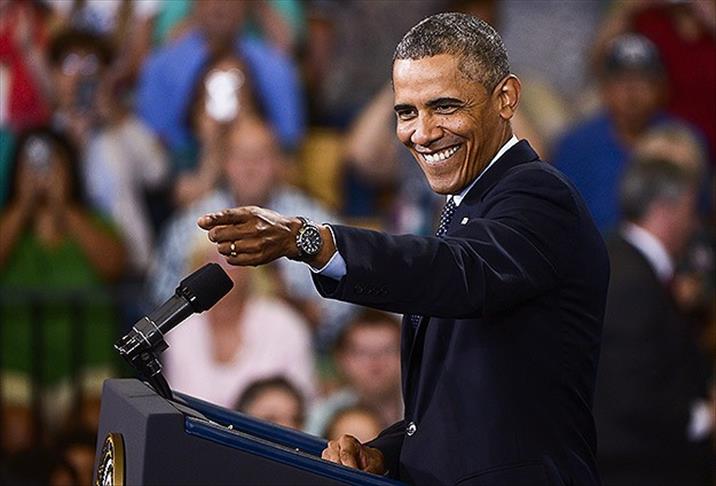
WASHINGTON - Anaysis
US President Barack Obama, upon the use of chemical weapons by Assad regime on Syrian civilians, seems to depend his justification for a possible military intervention, if he decides so, in the two-year-old Syrian civil war not on "unseating via intervention the government tyrannizing its own people" but on "an essential response to the obvious violation of the ban in the international norms on the use of chemical weapons to prevent a further violation and recurrence of the crime by the Syrian regime."
Obama, more likely to take a step this time, is expected to announce his final decision in the following days on a possible US military intervention in Syria.
There are several reasons behind the hesitation of Washington to launch a military intervention in the clashes ongoing for over two years in the Syrian civil war.
Along with key factors such as the lack of a certain opposition in the war-torn country for long and the stance of the opposition that does not behave in the way the US wants, Obama, most importantly, does not wish to get stuck in an open-ended impasse in Syria, after the recent fiascos in Iraq and Afghanistan.
US President neither wishes to get into a scrape like the former president George W. Bush whom he harshly criticized during his first election campaign for entering Iraq on the grounds of "saving the Iraqi people from the oppression of Saddam Hussein and finding chemical weapons in Iraq."
Extensive use of chemical weapons targeting civilians changes the estimates
When Assad regime used chemical weapons on its own people in the East Ghouta suburbs of Damascus on August 21, all those estimates have taken yet another turn.
Designating the use of chemical weapons as the "red line" in the Syrian civil war, the US has regarded the use of chemical weapons as "of small scale" until the recent chemical attack, refraining from taking any related steps.
The White House, starting to weigh possible responses to the Syrian regime upon the recent wide scale use of chemical weapons leading to a massacre, signals that the US will head for a military intervention in Syria, if decides so, with a new, more valid ground possible to change all estimates.
US Secretary of State John Kerry urged that all nations must stand up for accountability on the use of chemical weapons in Syria, saying "There is a reason why, no matter what you believe about Syria, all peoples and all nations who believe in the cause of our common humanity must stand up to assure that there is accountability for the use of chemical weapons so that it never happens again."
"The indiscriminate slaughter of civilians, the killing of women and children and innocent bystanders by chemical weapons is a moral obscenity. By any standard, it is inexcusable. And despite the excuses and equivocations that some have manufactured, it is undeniable," he said.
The White House spokesman Jay Carney also announced on Monday that it was undeniable that chemical weapons were used in Syria as a "horrific violation of an international norm," and that there is little doubt that the Syrian government used them.
"President Barack Obama and his team are evaluating the appropriate response to the use of chemical weapons," he added.
What it will bring to Obama, if he decides on a military intervention?
In the light of these statements, Obama government noted that, in case of an international response such as a military intervention in Syria, it would not be a direct intervention in the Syrian conflict but only a response based on the justification that "obvious and extensive violation of an international norm and use of a banned weapon on innocent civilian people as a means of slaughter as contradictory to all humanitarian values."
Accordingly, Obama could defend a possible military intervention more easily before the US and foreign public eye basing it on a moral ground, arguing that it is not an attempt to interfere in the internal affairs of a country, so as to distinguish himself from Bush who mounted a "military operation in Iraq to change the regime."
Meanwhile, Germany is now more moderate regarding a possible military intervention in Syria upon the recent use of chemical weapons, despite its earlier discountenance on such a response, which strengthens the hand of Washington.
Thus, as the most articulated and limited option, the US and the international community can for example attack with missiles against the weapons capacity of Assad's army without direct intervention in the clashes between the Syrian regime forces and opposition forces.
The US Navy has now four cruise-missile armed warships in the Mediterranean Sea, along with 1,000 of its soldiers in Jordan and F-16 warcrafts.
Besides, Britain may deploy Tornado missiles of the British Royal Air Forces as well as the four war warships named "HMS Montrose", "HMS Westminster", "HMS Dragon" and "HMS Bulwark."
Instructing to the US intelligence services to investigate the use of chemical weapons in Syria, President Obama is continuing his consultation talks with the international community and will make up his mind soon on a solution after the answer of the US intelligence.