ANKARA
Serbia and Kosovo signed on Tuesday night four agreements aimed at normalization of relations between the two neighboring countries.
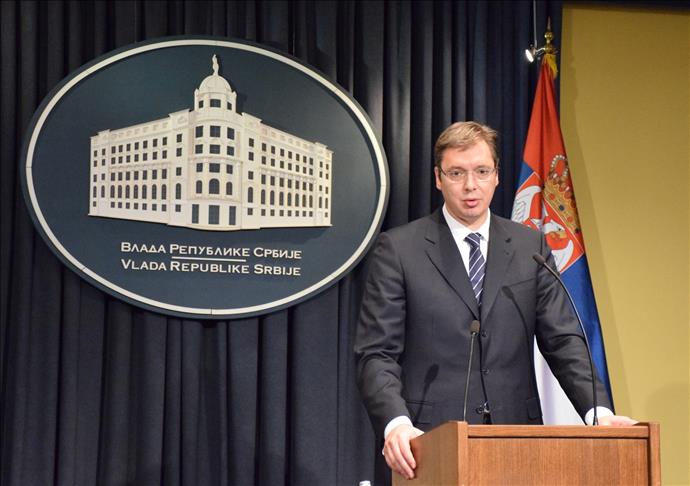
Serbian Prime Minister Alexander Vucic and his Kosovar counterpart Isa Mustafa signed the agreements in the Belgian capital of Brussels, which covered “energy, telecoms, establishment of association/community of Serb majority municipalities as well as the freedom of movement/Mitrovica Bridge”.
EU’s foreign policy chief Federica Mogherini, who brokered the dialogue, called the agreement a “landmark achievement in normalization process”.
“The prime ministers also agreed the arrangement for the Mitrovica Bridge. This will define the use of the bridge in a mutually acceptable way which symbolizes the spirit of the dialogue that I am facilitating,” Mogherini said.
The Mitrovica Bridge in northern Kosovo has divided the two sides of the city for years, one of them populated by Albanians and the other by Serbs.
“Solutions such as those found today bring concrete benefits to the people and at the same time enable the two sides to advance on their European path,” she added.
One of the key agreements is about the association of Serb majority municipalities.
Serbia’s Tanjug news agency quoted Vucic as saying: “We are establishing the community of Serb municipalities tonight. The [Serbian municipalities association] ZSO will have broad powers, a president, vice-president, assembly, council, coat of arms, flag ... it will be financed from Serbia”.
Also, Mustafa told Kosovo’s public service broadcaster RTK that the “association of Serb majority municipalities will not have executive function”.
Kosovar authorities have repeatedly accused Serbia of helping Serbians in Kosovo create alleged parallel institutions in northern Kosovo.
Under a previous agreement signed in April 2013 between then Kosovar premier Hashim Thaci and ex-Serb premier Ivica Dacic, Pristina authorities could extend their limited authority in the northern Mitrovica in exchange for some extra rights given to Serbs.
Kosovo which uses Serbia’s, Monaco’s and Slovenia’s codes for its fixed and mobile phone networks would also from now on use its own code +383.
“You will soon call Kosovo on international dialing code +383,” Kosovo’s deputy premier and Foreign Minister Hashim Thaci tweeted Tuesday following the agreement.
Kosovo is a former Serbian province populated by nearly 1.8 million people, over 90 percent of whom are Kosovo Albanians.
Kosovo declared its independence on Feb. 17, 2008 and is recognized by about 110 countries, including the U.S., the U.K, France, Germany and Turkey. Serbia, Russia and China are among countries that have not recognized the country's independence.
Kosovo Albanians and Serbia fought a war in 1998-1999, which following the NATO air camping against former Yugoslavian objectives saw Serbian army leaving Kosovo.
More than 10,000 Kosovo Albanian nationals are estimated to have been killed by the then Yugoslav forces, while more than 1,700 others remain missing.
Kosovo and Serbia now aim to join the European Union.